Die Brücke: Ernst Ludwig Kirchner
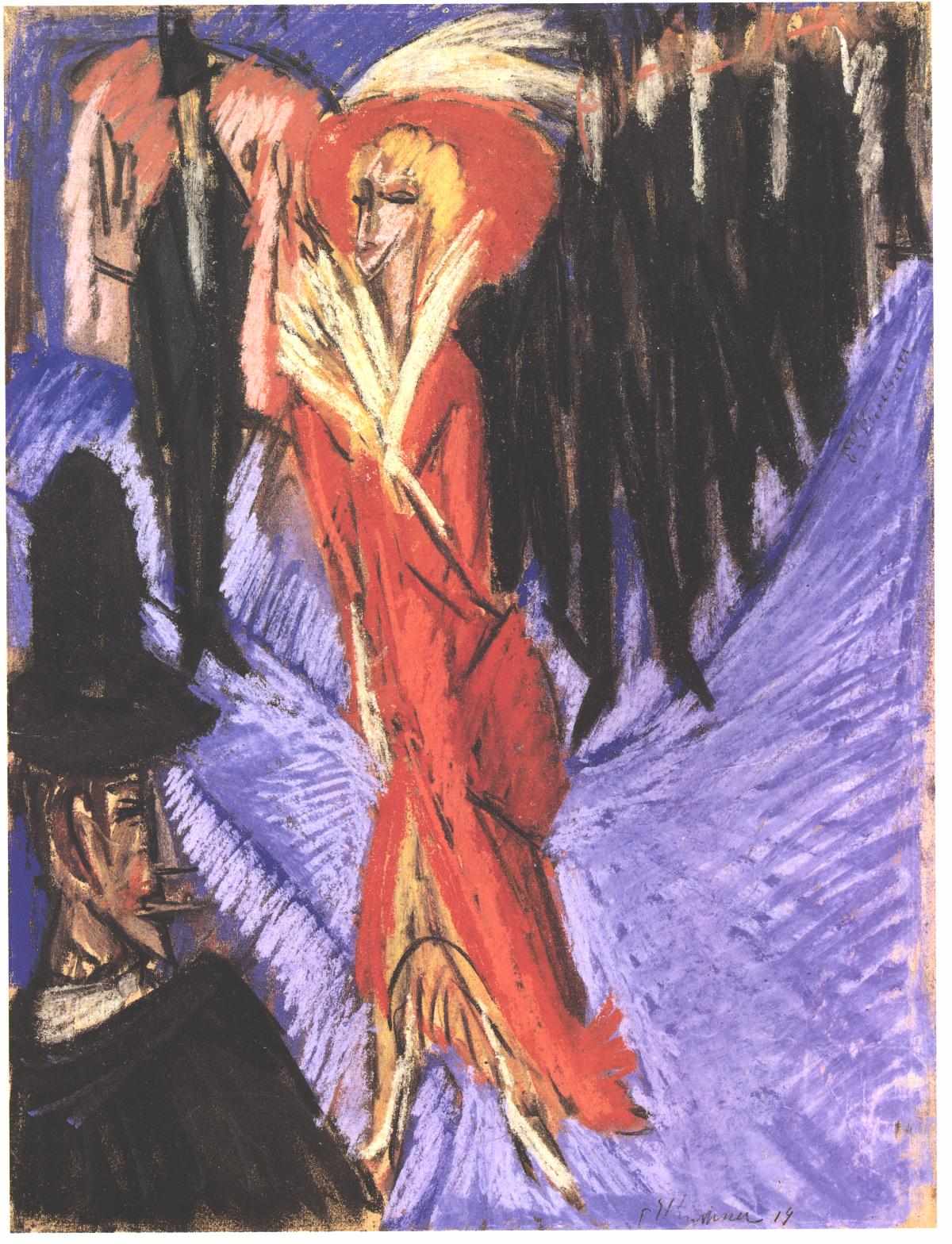
Red Courtesan (Rote Kokotte), 1914
Colored chalk, tempera, white heightening on paper
41 × 30.2 cm
© Staatsgalerie Stuttgart, Germany
Red Courtesan rises from the paper with a heat and immediacy that belong entirely to Kirchner’s Berlin years, when the city’s restless pulse sharpened his line and pushed his palette toward extremes. The courtesan stands slightly angled at the center, her red hat tilting forward like a flare and her orange‑yellow garment catching the light in abrupt, angular planes. Behind her, the blue and black strokes fracture into short, jagged segments that feel less like a crowd than a compressed current of movement, a field of male presence pressing forward without ever resolving into individual figures. The whole sheet seems squeezed upward, the vertical thrust of her body held in tension with the sideways pressure of the street.
The man at lower left, sharply caricatured with his tall black hat and cigarette jutting from the mouth, is more than a compositional counterweight. He carries a knowing, almost cynical air, as if he has stepped out of the mass to acknowledge her with a private understanding. His presence steadies the tilt of the scene, but he also sharpens its mood; he is the viewer’s surrogate, yet fully part of the charged choreography that unfolds around her.
Kirchner’s strokes are slashing and urgent, layered in quick, decisive gestures that give the drawing its feverish temperature. Her face, held in a mask‑like stillness, commands attention not through expression but through form and color, her presence defined by the sharpness of her silhouette and the blaze of her palette. The background dissolves into rhythm rather than description, and the whole image becomes a study in desire, spectacle, and the uneasy anonymity of the modern city.
This drawing belongs to a decisive moment in Kirchner’s life, just after the dissolution of Die Brücke in 1913, when he found himself both liberated and unmoored. The softer, more organic forms of his Dresden years had given way to the angular, compressed language of Berlin, a shift that mirrored his own growing sense of strain. By 1914 he was already feeling the psychological pressure that would intensify during the war, and the tension in his line reflects that inner turbulence. Europe itself was on the brink of conflict, and the urgency of his mark carries something of that looming fracture.
As one of the founders of Die Brücke, Kirchner had long sought to break open academic convention, and the group’s influence on modern art was decisive. Though often mentioned alongside the Berlin Secession, they stood apart from it; the Secession’s 1910 rejection of twenty‑seven expressionist artists only deepened the divide. Through Max Pechstein, Die Brücke joined other excluded artists to form the Neue Secession, which finally offered expressionism a platform on its own terms. Red Courtesan stands squarely within this moment of artistic self‑assertion, when Kirchner’s line grew more urgent, his subjects more exposed, and the city itself became both catalyst and stage for a new, uncompromising modern vision.

Leave a Reply