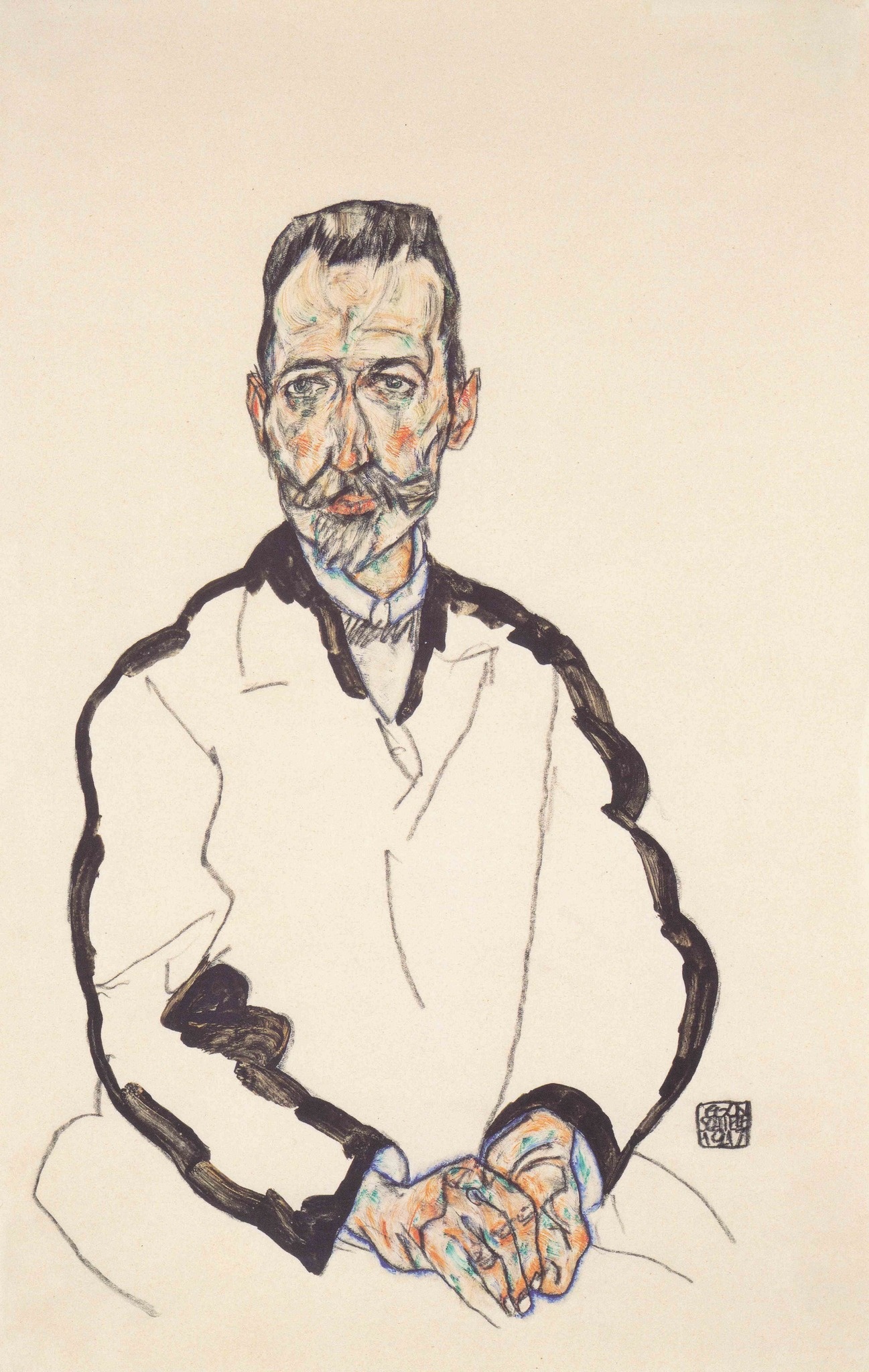
Egon Schiele:
Chief Inspector Benesch (Oberinspektor Benesch), 1917
Gouache, watercolor, and black crayon
45.7 × 29.3 cm
© Kunstmuseum Bern
(Kallir d2098)
Schiele’s portrait of Chief Inspector Heinrich Benesch belongs to the intimate group of studies he made of his longtime friend in 1917, each revealing a different facet of their long friendship. Compared to the study of d2099, this sheet feels gentler in its handling, with softer washes and a more introspective mood. Benesch sits with his hands clasped, the fingers interlaced in a gesture that feels composed yet faintly tense, as though he is gathering his thoughts rather than presenting himself. The interlaced hands, absent in the related drawing, introduce a note of inwardness that anchors the portrait in a moment of quiet self‑containment. His jacket, rendered with lighter washes and fewer structural accents than in the companion sheet, gives him a modest, unadorned presence that reinforces the portrait’s tone of sincerity. The facial modeling is notably softer than in the related drawing, the planes of the cheeks and brow handled with a gentler modulation that tempers the psychological intensity. Schiele’s line is unusually gentle for 1917, guiding the contours with a sympathetic steadiness rather than the sharper incisiveness seen elsewhere in his late portraiture. The empty background isolates him in a contemplative space that feels respectful rather than stark, and where the related drawing bears Schiele’s full signature and date, this sheet is marked only with a discreet monogram, underscoring its quieter, more intimate character.
Heinrich Benesch (1862–1947) was a railway official, an art enthusiast, and one of Schiele’s earliest and most steadfast supporters. He collected Schiele’s drawings and watercolors with genuine conviction, long before the artist achieved broader recognition. Benesch’s support was not merely financial: he offered guidance, companionship, and moral encouragement at moments when Schiele faced public criticism and personal hardship, and his visit to Schiele during the artist’s brief imprisonment in 1912 became a defining moment in their relationship. Through Benesch, Schiele also met Otto Benesch—Heinrich’s son—who would later become a leading art historian and director of the Albertina, and the family’s preservation of Schiele’s works and letters shaped the historical understanding of his life and career.
Schiele portrayed Heinrich and Otto Benesch together in 1913 in a celebrated double portrait, now considered a cornerstone of Austrian Expressionism. Here, however, the mood is quieter and more contemplative, reflecting the maturity of their friendship: a portrait not of status or symbolism, but of presence, character, and the deep mutual respect that bound artist and patron. Taken together, the two 1917 drawings form a subtle pair—one outward‑looking and structurally assertive, the other inward, contemplative, and shaped by long familiarity.
For comparison, see the related 1917 drawing (Kallir D 2099), which presents a more linear and structurally exposed approach to the same sitter.
https://schieleandklimt.com/2026/03/17/portrait-of-heinrich-benesch-1917-egon-schiele/
Leave a Reply