Gustav Klimt:
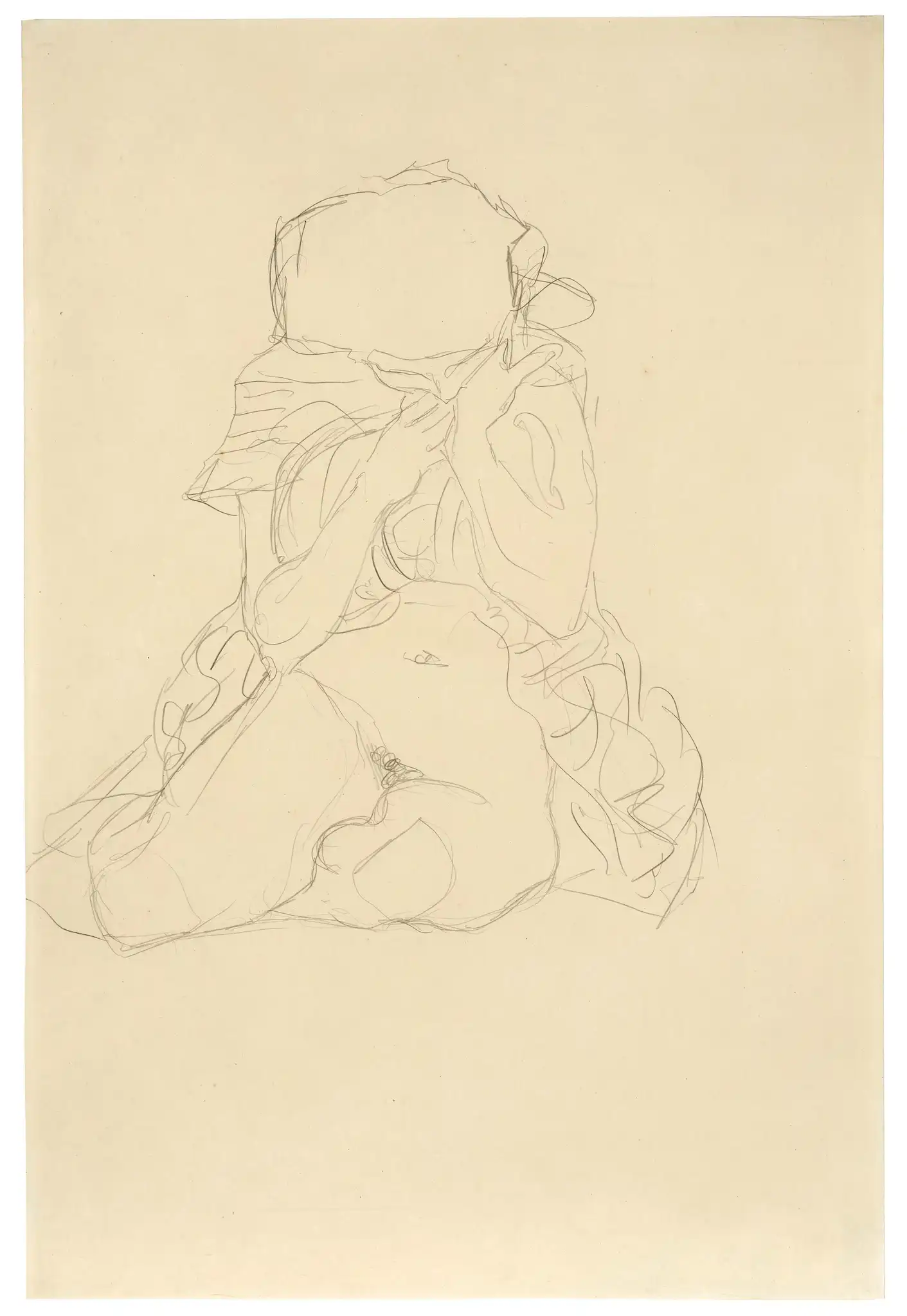
Semi-Nude Seated. Study for Death and Life (Sitzender Halbakt von vorne. Studie zu Tod und Leben), circa 1908/1909
pencil on paper
56 × 37.2 cm
Auctioned at Dorotheum on 20 May 2025 for EUR 52,000 (Strobl s1827)
Created at the moment when Klimt was moving beyond the splendour of his Golden Period and into a more contemplative, human-centred phase, this drawing belongs to the earliest preparations for Death and Life. Before shaping the monumental confrontation between the clustered, dreaming figures and the stark presence of Death, he returned repeatedly to the individual bodies that would carry the emotional weight of the composition. This study is one of the first attempts to understand the woman who later appears at the front of the embracing group, her bowed head and inward-turning posture already anticipating the quiet gravity she brings to the finished painting.
The model sits slightly off-centre, her body folding into a compact, protective curve. Klimt encloses her with a softly searching contour, a line that hovers and adjusts before settling, as though he were feeling his way toward the emotional truth of the pose. The head is only lightly indicated, almost featureless, which lends the figure a universal, symbolic presence rather than the specificity of portraiture. The lower body opens gently toward the viewer, illuminated with a soft clarity, while the upper body folds inward, the lifted garment gathered close like a small refuge. Even in this minimal state, the cloth acts as a boundary around the torso, a delicate membrane that shapes the emotional space of the figure. The fabric falls in loose, irregular cascades along the sides, framing her without disturbing the inwardness of her pose.
The spareness of the sheet heightens this introspection. Klimt leaves the surrounding paper untouched, allowing the figure to float in a quiet, unanchored field, which amplifies the sense of isolation and the self-contained nature of the moment. The drawing’s unfinished quality feels entirely intentional: he stops at the precise point where the posture’s emotional temperature becomes clear, trusting the economy of the line to carry the weight of the idea.
What emerges is a meditation on the fragile balance between exposure and withdrawal, a theme that threads through the entire cycle of drawings for Death and Life. Klimt’s renewed commitment to drawing at this moment was not a retreat from ornament but a return to the human presence beneath it. In this sheet, with its quiet radiance and its gentle insistence on the dignity of introspection, he finds again the essential core of his art: the living, thinking, feeling body, held with extraordinary care by the line that describes it.

Leave a Reply