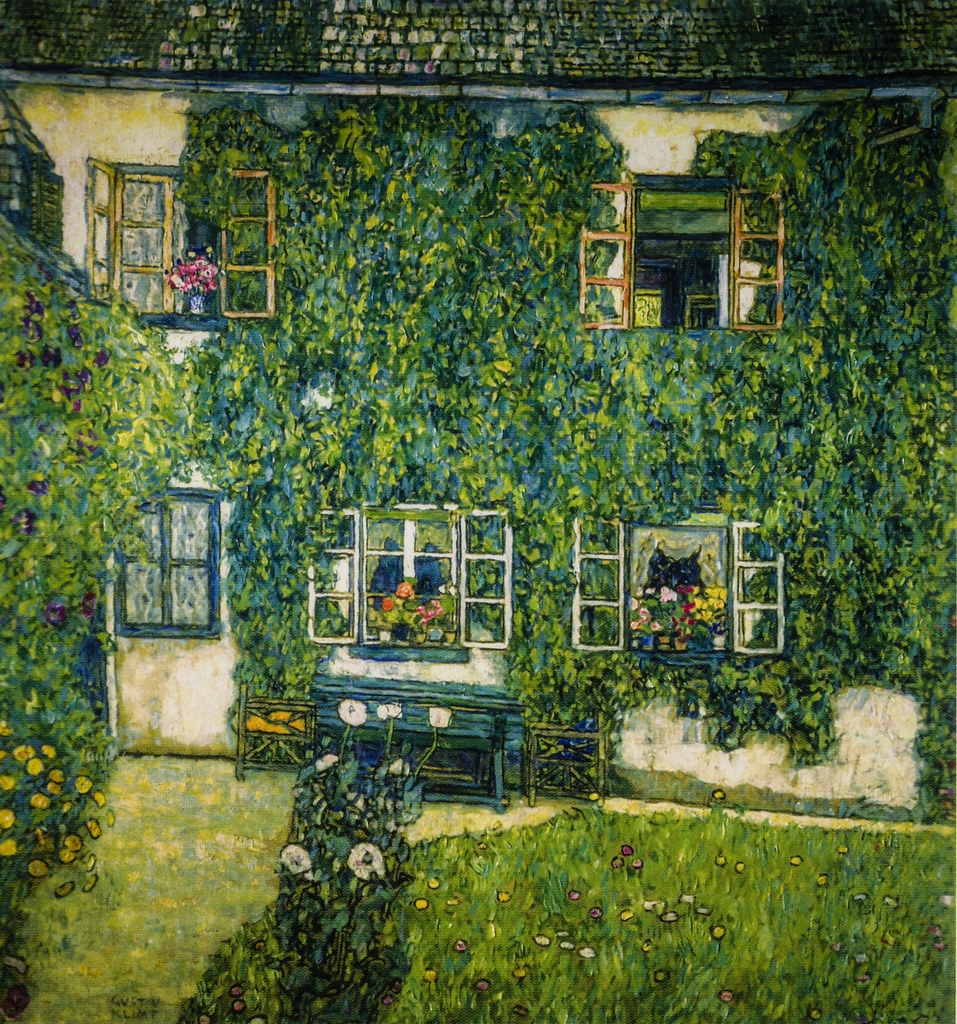
Gustav Klimt:
Forester’s House in Weissenbach II (Garden) (Forsthaus in Weissenbach II), 1914
Oil on canvas
110 × 110 cm
Private collection / Neue Galerie
(Natter no. 209)
There is, as the title implies, a Forester’s House in Weissenbach I, though the sequence in which Klimt painted the two remains unresolved; unlike this close, frontal study of a façade wrapped in ivy, the first version opens the view outward, placing the house within a broader landscape and giving it more spatial breathing room. Both works belong to his final Attersee summer in 1914, a season marked by a quiet inwardness. Klimt rented a small house about half a mile from Weissenbach, deliberately choosing a place where he could withdraw from the lively rhythms of the Flöge household, who stayed closer to the lake. This gentle distance gave him the freedom to wander, observe façades softened by summer growth, and work with the unhurried concentration that shaped his late landscapes.
The painting presents the house frontally, as if the viewer were standing directly before it on a warm afternoon. The façade is almost entirely enveloped in ivy, a dense, living skin that transforms the architecture into a shimmering tapestry. Klimt builds this surface leaf by leaf, using small, rhythmic strokes that hover between natural description and decorative pattern. The greens shift subtly across the plane—cooler in the shadows, warmer where the light catches—creating a quiet vibration that animates the entire surface. This is not pointillism but Klimt’s own mosaic-like language, a method he refined in these years to dissolve the boundary between structure and nature.
The windows interrupt the green with gentle human presence. Their wooden frames open outward, revealing flowerpots filled with reds, pinks, and yellows that glow against the ivy. These small bursts of colour feel intimate, as if someone has just tended them. Beneath the central window, a simple bench rests in the shade, half-claimed by the surrounding growth. The lower garden is modest: a patch of grass dotted with tiny flowers, each painted with Klimt’s characteristic precision, adding bright, jewel-like notes without disturbing the stillness. The dark, weathered roof anchors the composition, giving the façade a quiet gravity that balances the shimmering surface below.
The square format, one of Klimt’s preferred choices for landscapes, reinforces the painting’s sense of equilibrium. It creates a self-contained world, a moment suspended in time, where the viewer is invited to linger. The house is not overwhelmed by nature but gently embraced by it, as if the ivy were holding it in a soft, protective gesture. This closeness, this sense of being drawn into a quiet, inhabited space, is central to the painting’s emotional register. It feels like a pause in the day, a breath held in warm air.
When the painting was shown at the Berlin Secession in 1916, its calm, sunlit intimacy must have carried a poignant resonance. Europe was already deep into the war, and Klimt’s vision of a house wrapped in summer green would have seemed like a memory from a more peaceful world. Today, it still radiates that same sense of refuge: a façade transformed into a living tapestry, flowers leaning toward the light, and Klimt’s unmistakable tenderness for the quiet corners of the Attersee landscape woven into every inch of the canvas.
Leave a Reply