Egon Schiele:
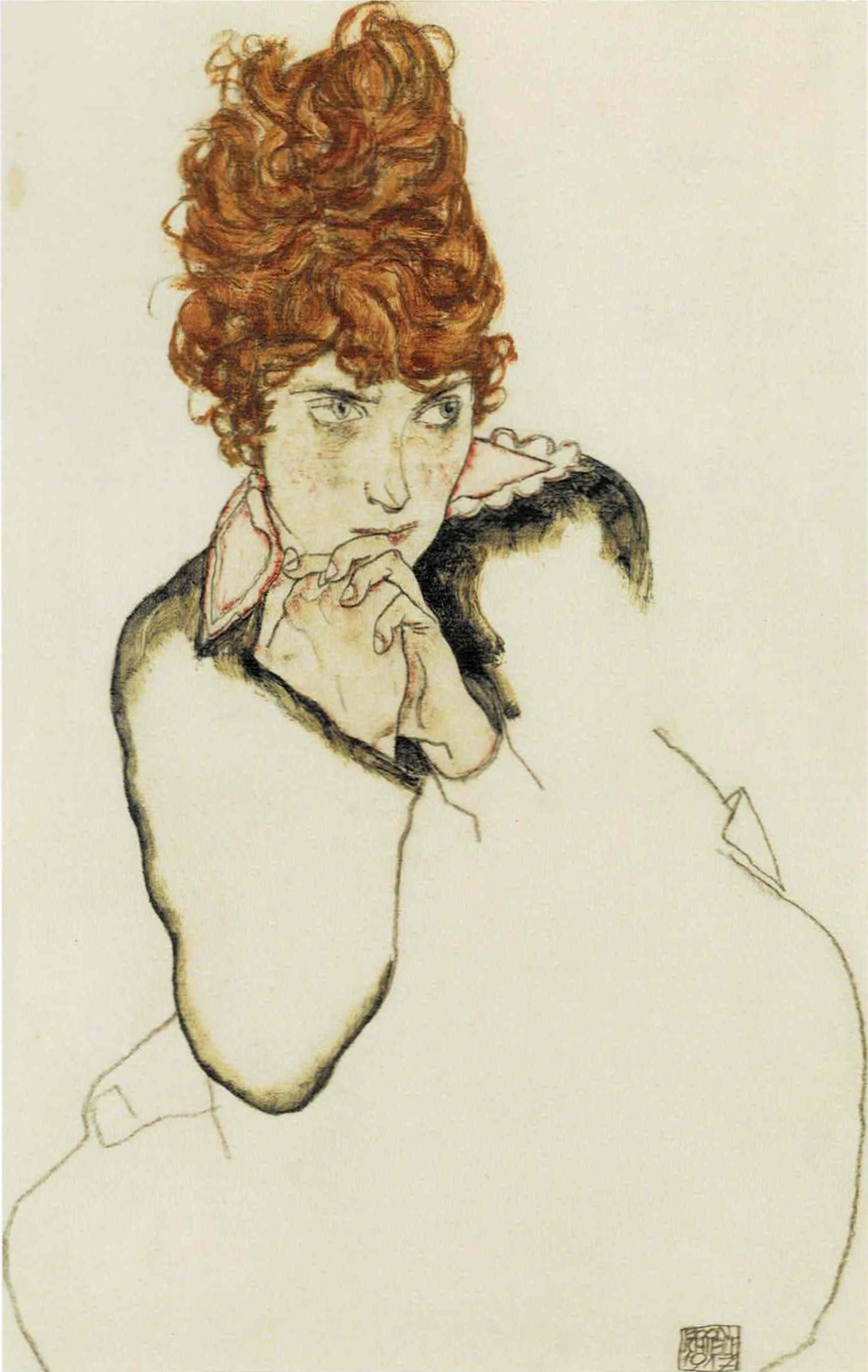
Schiele’s sister‑in‑law with clasped hands, half‑length (Schieles Schwägerin mit gefalteten Händen, Halbfigur), 1913
Gouache and charcoal on paper
48.3 × 28.5 cm
Private collection
(Kallir d1913)
For years I knew this drawing only as a small, grainy black‑and‑white reproduction, barely enough to register the tension of the pose. Encountering it unexpectedly at the Leopold Museum, in the 2025 exhibition Changing Times: Egon Schiele’s Last Years (1914–1918), was like seeing a familiar name spoken aloud for the first time, and I realised immediately how much I liked this drawing — its quiet force, its inwardness, its refusal to declare itself too quickly. The sheet is taller, more concentrated, and far more intimate than the old reproduction ever suggested. The figure rises in a narrow vertical field, her reddish‑brown hair swept upward in a soft, voluminous mass, the hands clasped close to the face in a gesture that feels both protective and inward‑turning. Schiele lets the charcoal line carry the nervous energy of the pose, while the gouache settles into quiet, opaque planes that give the head and hands a fragile solidity.
The question of identity — Edith or Adele — remains unresolved, and perhaps deliberately so. Edith, Schiele’s wife, disliked being drawn and especially resisted posing nude; Adele, by contrast, was more comfortable in front of him. Yet Schiele often blurred their features, sometimes folding in the traits of a model until the likeness became a composite of memory, proximity and invention. Adele’s hair was more reddish, Edith’s lighter and more blonde, and here the warm, coppery tone suggests Adele, while the softer facial structure hints at Edith. The result is a sister‑in‑law rather than a securely named individual, a figure suspended between resemblance and artistic necessity.
The clasped hands are the emotional centre of the drawing. They are not devotional, not theatrical, but a private gesture of bracing — fingers interlaced, knuckles drawn inward, as if she were holding a thought or a feeling too delicate to release. The slight tilt of the head, the closed‑in shoulders, the faint red accents at the collar: all of it contributes to a mood of quiet tension. Schiele leaves the background almost entirely bare, a pale field that isolates the figure and heightens the sense of interiority. Nothing distracts from the encounter between viewer and sitter; the drawing becomes a study in containment, in the way a person gathers themselves in a moment of uncertainty.
Seen within the context of Schiele’s final years, the sheet feels emblematic of the emotional register he reached during the war: intimate, compressed, marked by closeness and unease. Whether Edith or Adele, the sitter appears as someone caught between roles — sister, wife’s sister, model, surrogate — her identity softened into a presence shaped by gesture rather than name. That ambiguity, held so delicately in the clasped hands and the inward gaze, is precisely what gives the drawing its lasting force.
Leave a Reply