Egon Schiele:
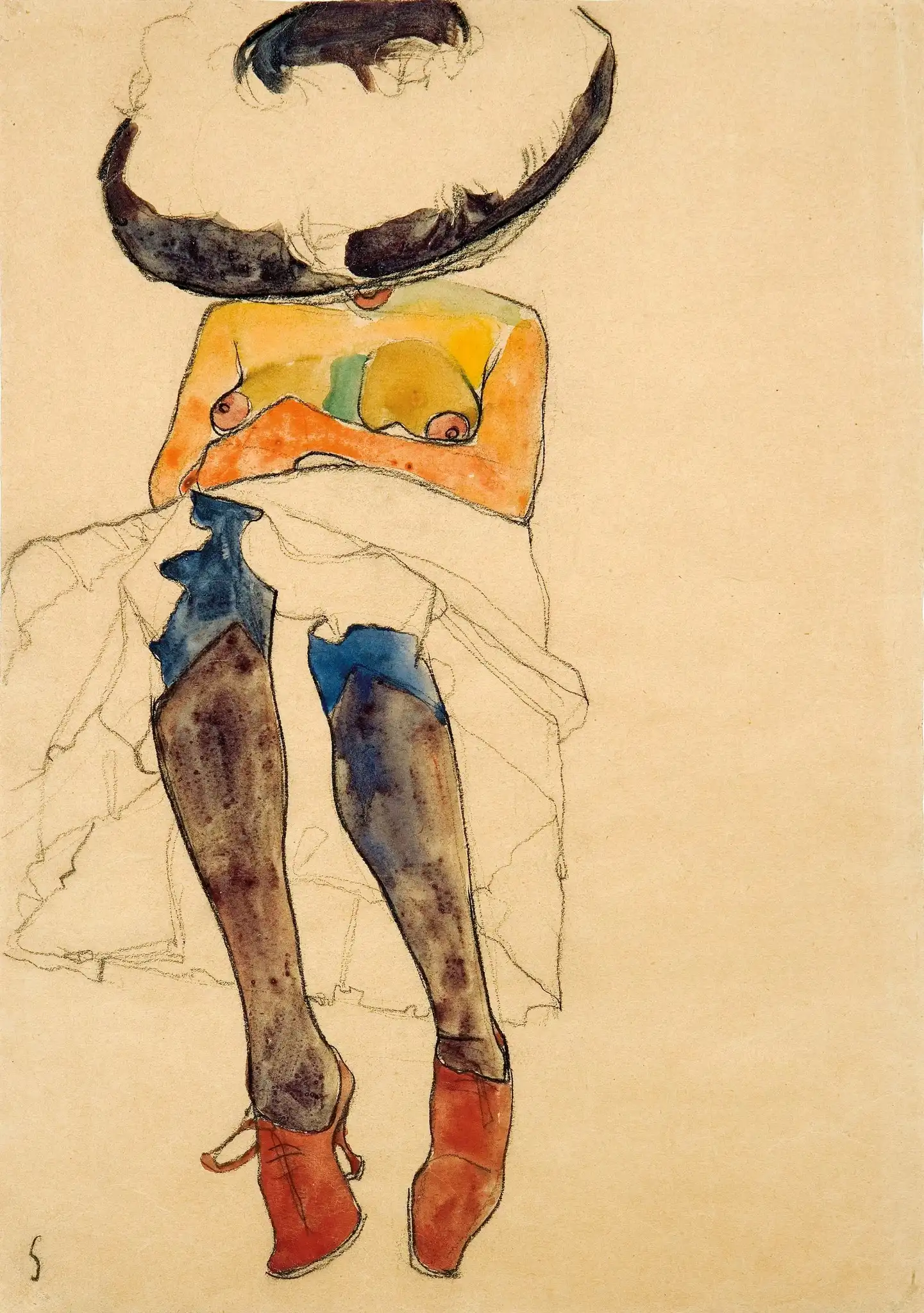
Seated Semi‑Nude with a hat and purple stockings (Gerti) (Sitzender Halbakt mit Hut und violetten Strümpfen), 1910
Black crayon, gouache and watercolour on paper
44,9 × 31,7 cm
Auctioned at Wienerroither & Kohlbacher
(Kallir d525a)
This 1910 drawing of Gerti Schiele sits at the moment when Egon Schiele’s line becomes unmistakably his own — sharp, restless, and already charged with psychological tension. Gerti is placed slightly off‑centre, as if Schiele had discovered her by chance rather than arranging her carefully. His black crayon moves with a confident, continuous rhythm, defining the limbs in a single sweep, while the lighter touches around the petticoats and the soft decoration of the hat show how easily he could shift from pressure to delicacy. The hat itself is handled with remarkable economy: a few dark strokes for the crown and brim, and then the plume left to emerge almost entirely from the untouched paper.
Before turning to the drawing’s deeper nuances, it is worth acknowledging that several of the insights that follow draw on observations first noted in the auction literature, here reworked and absorbed.
The colour is applied in the patch‑worked manner that marks this period — warm pinks and oranges on the arms and chest set against cooler yellows and greens on the shoulders. It gives the body a sense of being both present and unsettled, as if the figure were caught between exposure and withdrawal. The whole drawing is animated by two kinds of contrast: the odd mixture of clothing and nakedness, and the constant play between projecting and receding forms. The oversized hat, almost absurd in scale, sits above a completely bare torso; the legs, neatly dressed for the outside world, contradict the fragile domesticity of the lightly indicated undergarments. Schiele loved these contradictions, and he lets them shape the entire sheet.
Two of his favourite motifs from 1910 meet here — the coloured stockings and the extravagant hat. The purple stockings, which elsewhere could carry a clear erotic charge, feel almost modest in this drawing; the thighs remain enclosed, and the emphasis shifts instead to the strange elegance of the pose. The hat, by contrast, is almost theatrical in scale, pressing down over the face so completely that only a small glimpse of chin appears beneath the brim. It’s a tiny detail, easy to miss, but it gives the whole drawing a quiet spark of intimacy.
The pose itself feels like a mixture of cooperation and hesitation. The lowered head, the hidden face, the crossed arms — none of it reads as dramatic, but all of it suggests a sitter who is aware of the moment and slightly guarded within it. Gerti’s relationship with her brother as a model was shifting at this time, and the drawing carries that sense of closeness mixed with uncertainty. It is easy to imagine this being made during their stay in Krumau in the summer of 1910, when Schiele was both inspired and unsettled by the isolation there. The drawing has that blend of intimacy and faint melancholy that runs through many of his works from that period.
And then there is the smallest detail — almost hidden, almost playful — that rewards the attentive viewer: the tiny curl of feather that “signals” the pink chin tucked beneath the brim. It is Schiele’s quiet reminder that concealment and revelation always coexist in his work.
Seen as a whole, the sheet captures a young artist testing how much a figure can hold — not just in form, but in mood, in hesitation, in the small gestures that reveal more than they conceal. Gerti appears not as a passive model but as a presence shaped by the tension between being seen and hiding within the pose. The drawing stands as a vivid marker of Schiele’s early development, when every line still felt like a discovery and every sitter carried a quiet emotional charge.


Leave a Reply