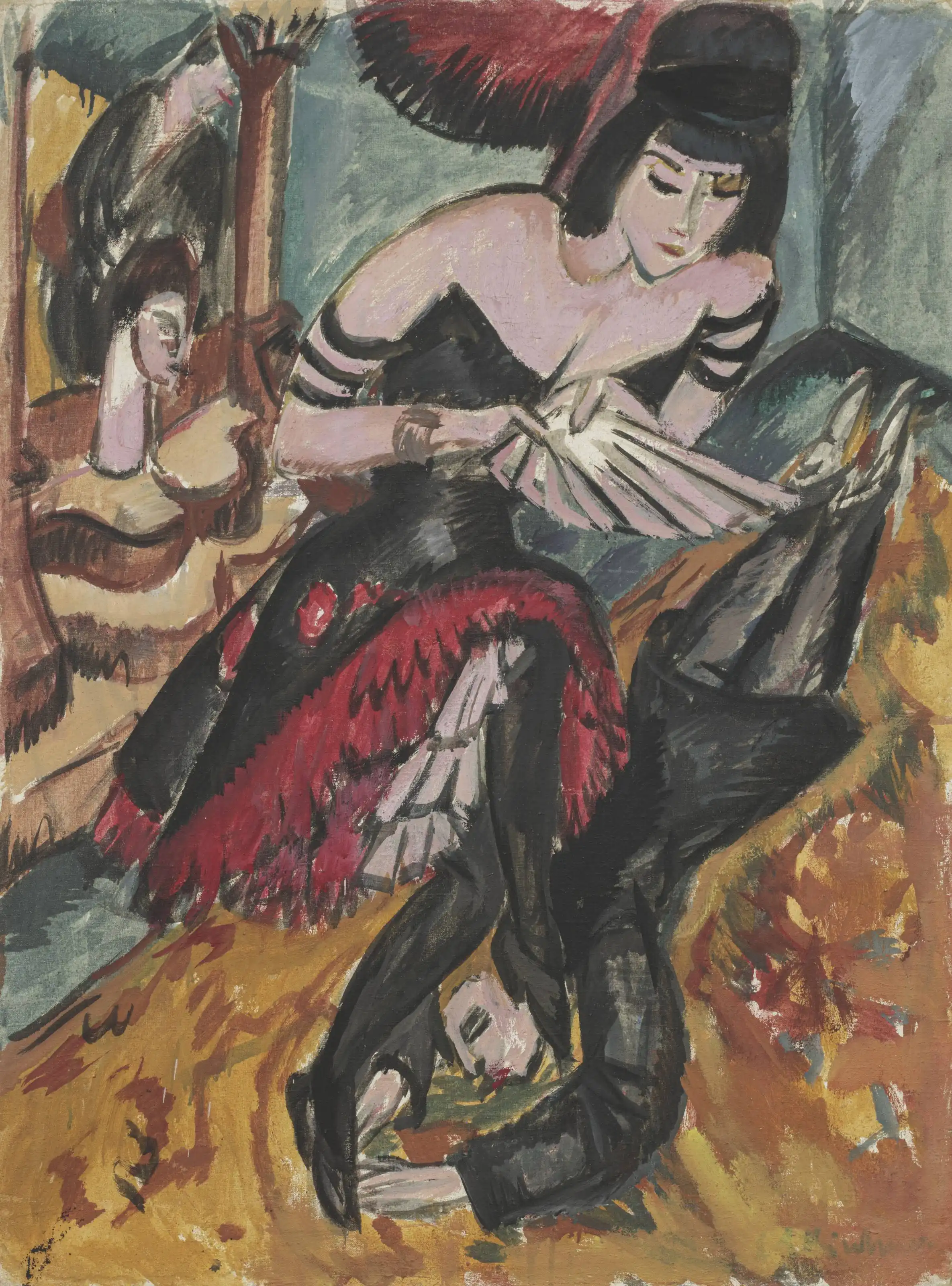
Die Brücke: Ernst Ludwig Kirchner
Revenge of the Dancer (Die Rache der Tänzerin), 1912
oil on canvas
100.7 × 75.5 cm. (39 5/8 × 29 ¾ in.)
Auctioned in 2021 for GBP 7,140,000 at Christie’s
The painting belongs to that charged moment when Kirchner, newly immersed in Berlin’s restless nightlife, let the pulse of Die Brücke spill directly into his canvases. The Reimann School’s pantomime productions offered him a theatre of heightened gesture, exaggerated silhouettes, and a kind of emotional shorthand that suited his instinct for immediacy. Here the dancer with her fan becomes a vivid, almost electric presence, her angular body cutting sharply against the man beside her, as if the entire drama were unfolding in a single breath. Kirchner’s colour—acidic, urgent, and unblended—feels like stage light turned emotional temperature, bathing the figures in a glow that is both theatrical and deeply human. Even within the tension of the scene, there is warmth in the way he lets the brushwork breathe, as though he were painting not just the performance but the fragile, flickering life behind it.
Filled with this glowing intensity, Revenge of the Dancer also marks the growing complexity of Kirchner’s Berlin years, when questions of identity, sexuality, and psychological interplay began to surface more boldly in his work. Dancers, cabaret artists, and circus performers—subjects that had long fascinated him—took on a new prominence after his move to the capital in 1911. They became emblems of the city’s intoxicating freedoms, their bodies reflecting the swirl of amusements and temptations that surrounded him. Kirchner sketched obsessively, capturing the whirl of movement, the flash of costume, the charged glances exchanged onstage, storing these impressions until he could unfold them slowly in the studio.
The taut, sensual form of the female figure in this painting may well have been inspired by Gerda or Erna Schilling, dancers in one of Berlin’s Varietétheater, whom Kirchner met shortly after his arrival. Both sisters modelled for him frequently, and their statuesque presence—self‑possessed, physically assured, and unafraid of the stage’s charged atmosphere—ushered in a profound shift in his approach to the female body. Their silhouettes, at once elegant and unguarded, offered him a new vocabulary of line and movement, one that carried directly into the heightened physicality of his Berlin works.
As his world widened, Kirchner entered the orbit of the city’s literary avant‑garde. Through Simon Guttmann he encountered the young poets of Der Sturm, Der Neue Klub, and Das Neopathetische Kabarett, whose own visions of the metropolis—restless, chaotic, and alive with possibility—echoed his own. Their performances and writings offered him new emotional registers, new ways of thinking about movement and psychological tension. Schmidt‑Rottluff and Heckel designed programmes for the Neopathetisches Kabarett; Kirchner himself drew scenery for Guttmann’s pantomimes and contributed to the short‑lived periodical Das Neue Pathos. These collaborations fed directly into his theatre‑inflected canvases, sharpening his sense of gesture and heightening the emotional voltage of his figures.
The theme had roots in Dresden, where winter evenings in 1908–1909 found Kirchner, Heckel, and Pechstein drifting from vaudeville to cabaret to circus, sending postcards full of breathless descriptions of what they had seen. While French precedents—Manet, Degas, Toulouse‑Lautrec, Seurat—hover in the background, the Die Brücke vision was unmistakably their own: raw, immediate, and fuelled by colour that felt scraped from the nerves. Kirchner’s correspondence reveals how wide his curiosity ranged: trapeze acts, jugglers, shadow theatre, family entertainments, but also the more erotically charged spectacles—can‑can dancers, belly dancers, snake charmers, and the “exotic” performances that fed the era’s fantasies. A postcard from May 1911, written with Heckel to Sidi, describes an evening at the Flora Variété with a Chinese dancer followed by an Indian one—performances that sparked a cascade of drawings, prints, and paintings in the months that followed.
Revenge of the Dancer appears to draw directly from a short pantomime by Hans Reimann, the young Leipzig writer who would later become known for his sharp satirical voice. In Kirchner’s hands, Reimann’s scenario becomes something more than narrative: a charged encounter distilled into colour and line, a moment where performance, psychology, and the feverish rhythm of Berlin converge. The painting holds that instant before the scene erupts, when bodies, light, and desire gather themselves into a single, unforgettable gesture. And fair is fair: this post is based on the auction note, expanded and re‑voiced with care.
Leave a Reply