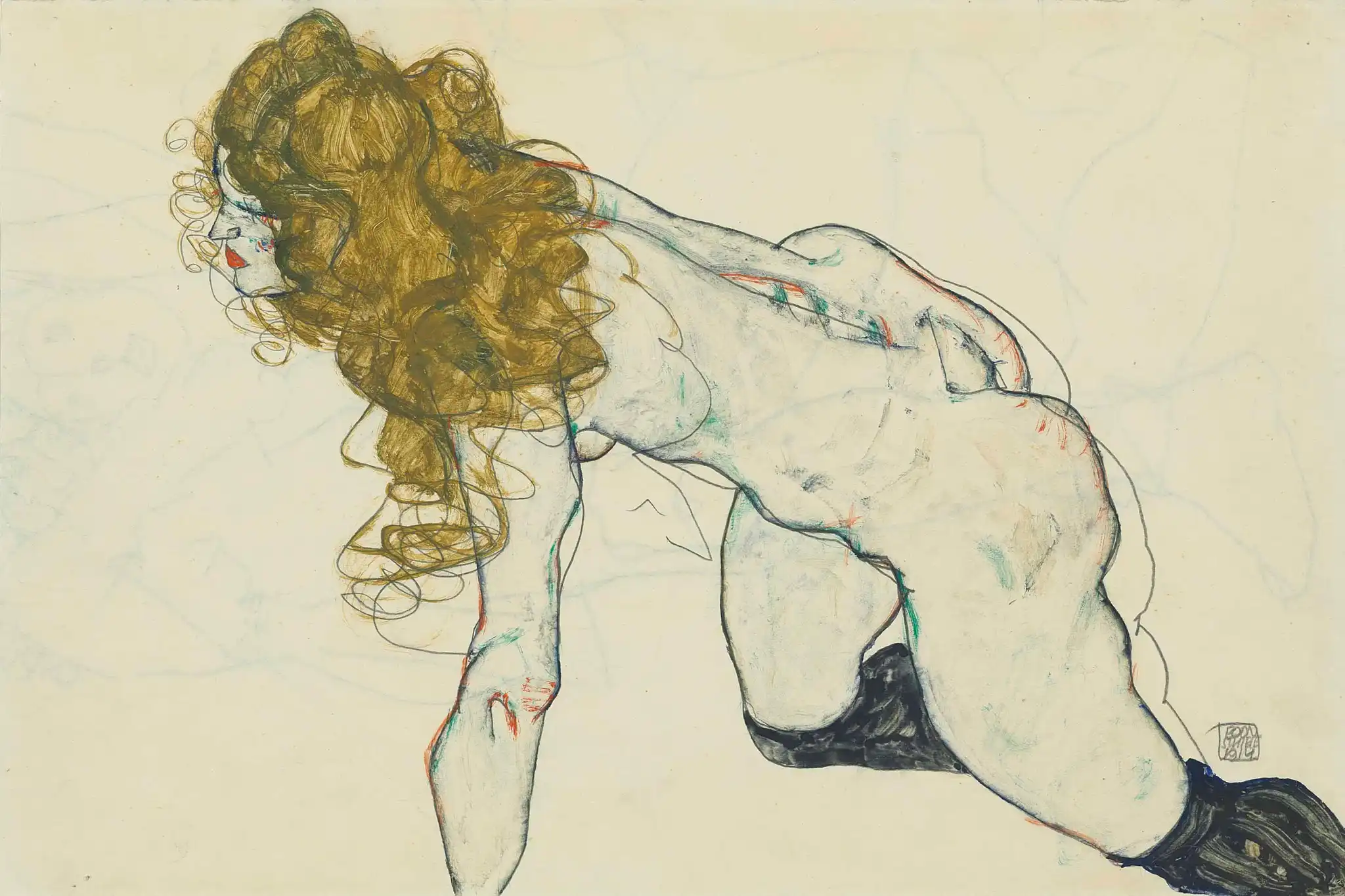
Egon Schiele:
Crouching Blond Nude with Extended Left Arm (Kauernder blonder Akt mit ausgestrecktem linken Arm), 1914
Gouache, watercolor, and black crayon
45.7 × 32.9 cm
Auctioned at Sotheby’s in 2013 for USD 378,000
(Kallir d1481)
By 1914 Schiele had reached a moment of remarkable assurance in his handling of the nude. The body had long been his primary instrument of expression, but in these years he approached it with a new clarity and emotional precision. His models often appear in poses that oscillate between exposure and introspection, their faces turned away or obscured, as if the body itself were the true bearer of meaning. The present sheet belongs to this period of heightened experimentation, when Schiele’s line grew sharper, his colour more daring, and his attention to physical presence more tender.
The model in this drawing is shown crouching low to the ground, her weight pressed into her bent legs, her torso leaning forward with a subtle, feline tension. She wears black stockings that cut sharply across the pale flesh of her thighs, introducing a graphic contrast that heightens the erotic charge of the pose. Her thick, curling dark hair spills forward in loose waves, framing the curve of her back and the angle of her shoulder. Schiele’s contour is quick, incisive, and alive: every shift of weight, every tightening of muscle, is registered with a precision that feels both analytical and unexpectedly warm. A translucent underlayer of ochre establishes the body’s volume, while touches of green and red along the contours breathe life into the surface, giving the figure a tactile immediacy.
The figure fills the sheet almost to its edges, her head and feet cropped by the limits of the paper. This sense of compression intensifies the immediacy of the encounter. Her posture — half‑crawling, half‑poised — suggests a moment suspended between movement and stillness. She appears absorbed in her own interior world, unaware of being watched, and Schiele responds not with detachment but with a kind of protective clarity. This balance between desire, empathy, and formal rigor is characteristic of his finest works from 1914, when he was refining a language that would define the remainder of his short career.
The sheet stands as a a quiet affirmation of Schiele’s ability to draw the viewer into an intimate encounter without resorting to sentimentality. The body becomes both subject and metaphor: a site of tension, beauty, and emotional truth. In this drawing, Schiele captures not only the model’s physical presence but the fragile, flickering moment of being that animates her — a moment held in place by the precision of his line and the warmth of his gaze.
Leave a Reply