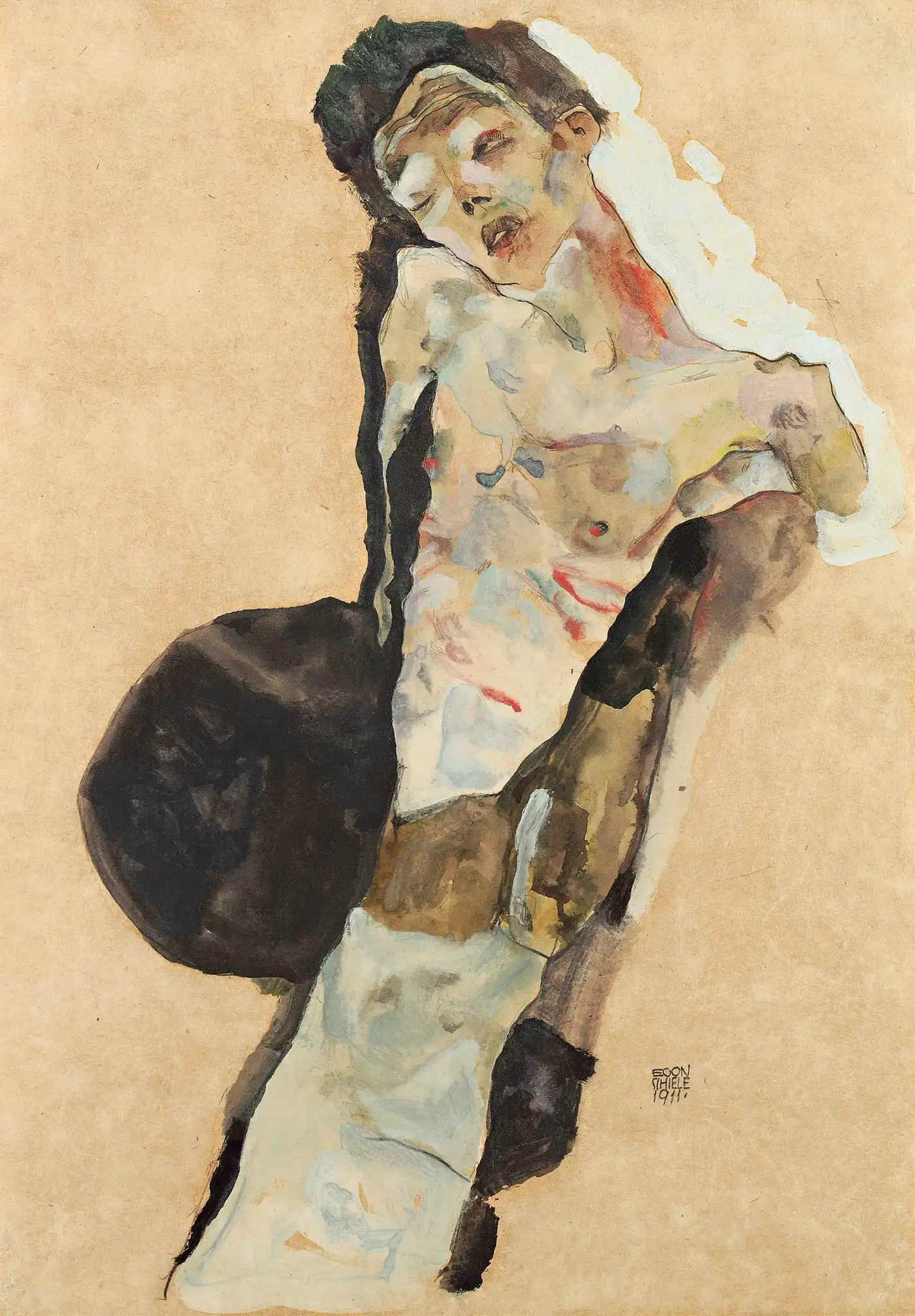
Egon Schiele:
Self-Portrait, Semi-Nude (Selbstbildnis, Halbakt), 1911
Gouache, watercolor, and pencil
44.7 × 31.3 cm
© Leopold Museum, Vienna
(Kallir d950)
This self-portrait captures Egon Schiele at a moment when everything in his life was shifting — his art, his sense of self, even his understanding of what a body could express. The figure leans back as if caught between breath and thought, the eyes closed, the neck taut, the torso twisting in a way that feels both deliberate and involuntary. It is not a pose chosen for effect; it is a state of being. The colors — those sudden reds, the bruised blues, the earthy ochres — seem to rise from inside the body rather than sit on its surface.
Schiele’s materials work together with unusual immediacy here. The pencil lines are quick and searching, almost impatient, while the watercolor slips into the paper like a pulse. The gouache, heavier and more opaque, anchors the form where he wants the eye to stay. The result is a figure that feels alive in its tension, as if the artist has caught himself in the middle of a private reckoning.
By 1911, Schiele had stepped decisively away from Klimt’s ornamental world. Vienna was in the midst of its own cultural upheaval — Freud was reshaping the language of the inner life, the Secession was splintering, and the city’s young artists were searching for new ways to express the anxieties and desires of a rapidly changing world. Schiele felt this atmosphere intensely. He was only twenty-one, but already convinced that art had to confront the truth of the self, even when that truth was uncomfortable.
This was also the year he left the Academy behind for good, choosing instead the precarious freedom of independence. He moved through studios and temporary lodgings, often with Wally Neuzil at his side, painting with a sense of urgency that bordered on compulsion. His circle was small but fiercely committed to modernism, and the exhibitions he participated in — from small artist-run shows to more ambitious group presentations — gave him a platform to test the boundaries of what Viennese audiences would accept.
What stands out in this sheet is the emotional temperature. The closed eyes are not peaceful; they are inward-looking, almost fevered. The body is stretched, alert, as if listening to its own unrest. Schiele understood that the figure could carry psychological weight, and here he lets that weight settle into every line and wash. The drawing feels suspended between vulnerability and defiance, a young artist testing how far he can go in revealing himself.
Seen today, the work still feels startlingly direct. There is no distance between the viewer and the artist; he offers himself without disguise, without flattery, without hesitation. This is not a portrait of how Schiele looked in 1911 — it is a portrait of what it felt like to be him. And that is why it remains one of the most compelling sheets from his early maturity: intimate, unsettling, and unmistakably alive.


Leave a Reply