Die Brücke: Ernst Ludwig Kirchner
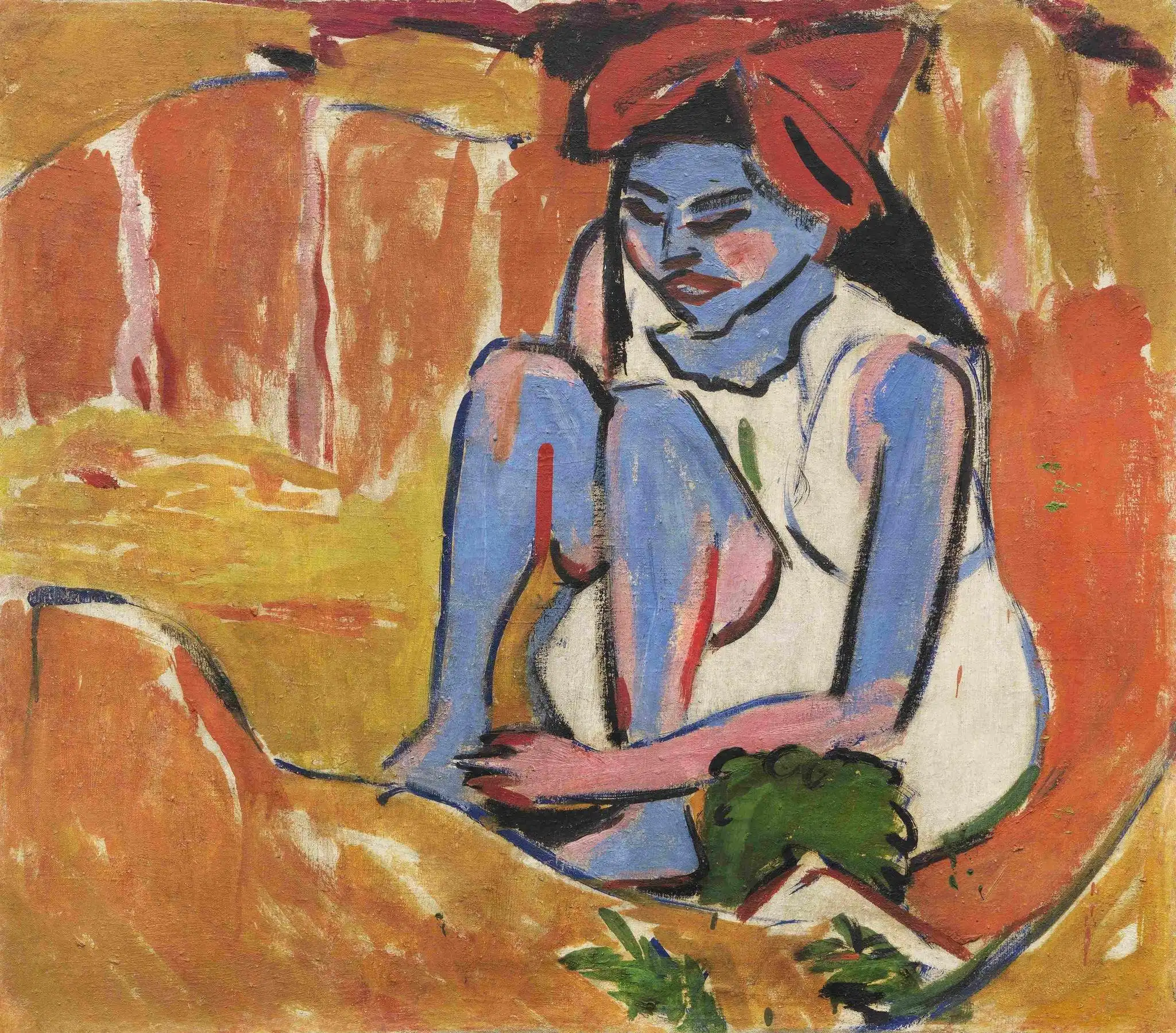
The Blue Girl in the Sun (Das blaue Mädchen in der Sonne), 1910
Oil on canvas
82.5 × 92.5 cm
Auctioned at Ketterer Kunst in 2022 (for $4,987,500)
Ernst Ludwig Kirchner (1880–1938) stands at the heart of Die Brücke, the Dresden group that sought to collapse the distance between art and life. By 1910, the year he painted The Blue Girl in the Sun, Kirchner had reached the full intensity of his Brücke style: angular, immediate, and charged with a sun‑struck emotional voltage. The painting belongs to the legendary Moritzburg summers, when Kirchner, Max Pechstein, and Erich Heckel abandoned the city for the ponds and forests outside Dresden, living out their dream of a freer, more instinctive existence.
The model is Lina Franziska Fehrmann, known as Fränzi, then about ten years old. She appears throughout Kirchner’s work of this period, instantly recognizable by her pointed face, wiry limbs, and dark hair tied with a large bow. Fränzi became a kind of emblem for the Brücke circle — a figure whose unguarded presence embodied the spontaneity and authenticity they sought in their art. A contemporary drawing by Pechstein shows her in the same pose, with the same red bow, underscoring how deeply she figured in the group’s shared visual vocabulary.
The Moritzburg summers have taken on an almost mythic status in the history of German Expressionism. The artists spent their days painting and sketching outdoors, swimming nude with their models, and staging playful scenes with boomerangs, bows and arrows, and reed‑filled hideouts. They believed that by stripping away the conventions of urban life, they could recover a more elemental mode of being. Their fascination with tribal art — particularly the carved and painted beams from Palau and the reconstructed villages in the Dresden zoo — fed into this vision. Like many reform movements of the early twentieth century, from nudism and sun worship to expressive dance and vegetarianism, the Brücke artists sought renewal through a return to nature.
Kirchner’s style in these years reflects this pursuit of immediacy. His contours become jagged and sharply angled, echoing the carved forms of the Palau beams that so captivated him. The figure is built from decisive, almost sculptural strokes, as though carved rather than painted. Color is liberated from naturalism: pure, complementary hues vibrate against one another, a response not only to his own instincts but also to the influence of French Post‑Impressionism. Kirchner had seen works by Matisse, Cézanne, and Gauguin exhibited in Germany, and he absorbed their lessons with characteristic intensity. Paul Signac’s theories on the juxtaposition of pure color also left their mark, contributing to the painting’s chromatic tension.
In The Blue Girl in the Sun, these elements converge with remarkable clarity. Fränzi sits in the blazing light, her body reduced to angular planes, her skin rendered in cool blues and violets that contrast sharply with the heat of the surrounding landscape. The red bow becomes a flash of intensity, anchoring the composition and heightening the emotional charge. The painting radiates both innocence and defiance: the child’s presence is unguarded, yet the style is fiercely modern, pushing against the boundaries of representation.
What gives the work its enduring power is the tension between the immediacy of the moment and the radicality of Kirchner’s vision. The painting is rooted in a specific summer, a specific child, a specific circle of artists living out their dream of artistic freedom. Yet it also marks a turning point in modern art, where form, color, and experience fuse into a new, uncompromising language. The Blue Girl in the Sun stands as one of the clearest expressions of the Brücke ideal: a work that captures the sunlit intensity of youth, the urgency of artistic experimentation, and the restless search for authenticity that defined Kirchner’s early years.

Leave a Reply