Egon Schiele:
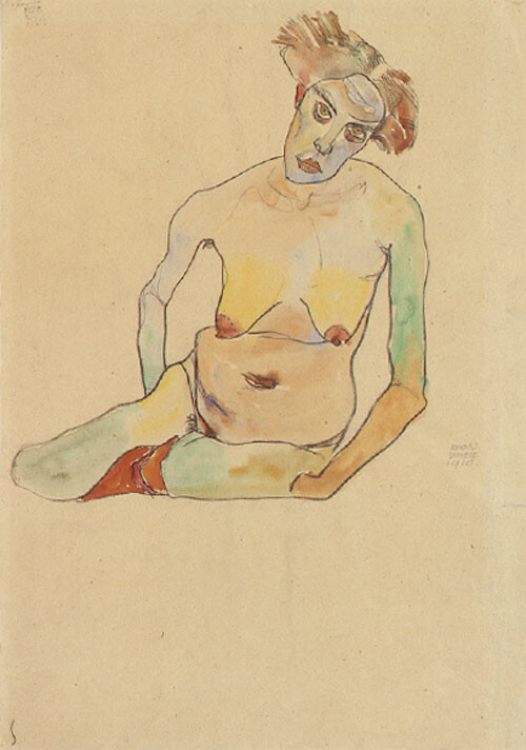
Female Nude (Weiblicher Akt), 1910
Watercolor and black crayon
44,7 × 31 cm
© Stiftung Sammlung Kamm, Zug, Switzerland
(Kallir d536)
This 1910 nude belongs to a moment when Schiele was looking at the human body with a new kind of attentiveness—quiet, direct, and unembellished. Today the drawing is housed in the Stiftung Sammlung Kamm in Zug, a private foundation known for its thoughtful focus on early 20th‑century Austrian and German art, and for preserving works that illuminate the more intimate corners of an artist’s development.
Around this time, Schiele’s friendship with the gynecologist Erwin von Graff opened an unusual door for a young artist: access to the 2nd Women’s Clinic in Vienna. There, he drew pregnant women and newborns, not in the privacy of a studio but in the sober, clinical light of a hospital ward. He often omitted the surroundings, placing his subjects in empty space, yet the bodies themselves carry traces of that environment: the openness of the poses, the unguarded presentation, the sense of being observed for what the body is, not what it represents. Even if Female Nude was not made in that setting, it resonates with the same atmosphere of close, unfiltered observation that shaped his work in early 1910.
The figure here sits with her limbs drawn in, her posture natural and unforced. There is a quiet introspection in the way her head tilts downward, a moment of inwardness rather than display. Schiele approaches the nudity with sensitivity: nothing is dramatized, nothing is eroticized. The body is simply present, seen with a clarity that feels both tender and unsentimental.
His use of black crayon gives the contour its characteristic tension—alert, slightly nervous—while the watercolor washes introduce soft, translucent accents: muted greens, ochres, and gentle reds that settle into the paper like breath. These touches of color do not idealize the figure; they acknowledge its warmth, its fragility, its humanity. Even at this early stage, Schiele’s line is unmistakable: searching, responsive, alive.
What makes this sheet so compelling is the balance between vulnerability and dignity. The proportions stretch slightly, as they often do in his early work, but nothing feels exaggerated for effect. The elongation seems to follow the emotional line of the pose, not a stylistic formula. The figure feels observed with care—neither objectified nor protected, simply seen.
In the broader context of his brief work in the clinic, this drawing echoes the era’s shared curiosity about the body, a curiosity that linked art and medicine in Vienna around 1900. Schiele’s approach is not clinical, but it is clear‑eyed. He looks without judgment, without ornament, trusting that the truth of the body—its posture, its weight, its quietness—is enough.
Female Nude offers a glimpse into a young artist learning to trust his instincts, discovering how much could be conveyed with a few decisive lines and a handful of translucent washes. It is a modest sheet, but one that carries the warmth of close observation and the early stirrings of the expressive language that would soon define him.

Leave a Reply