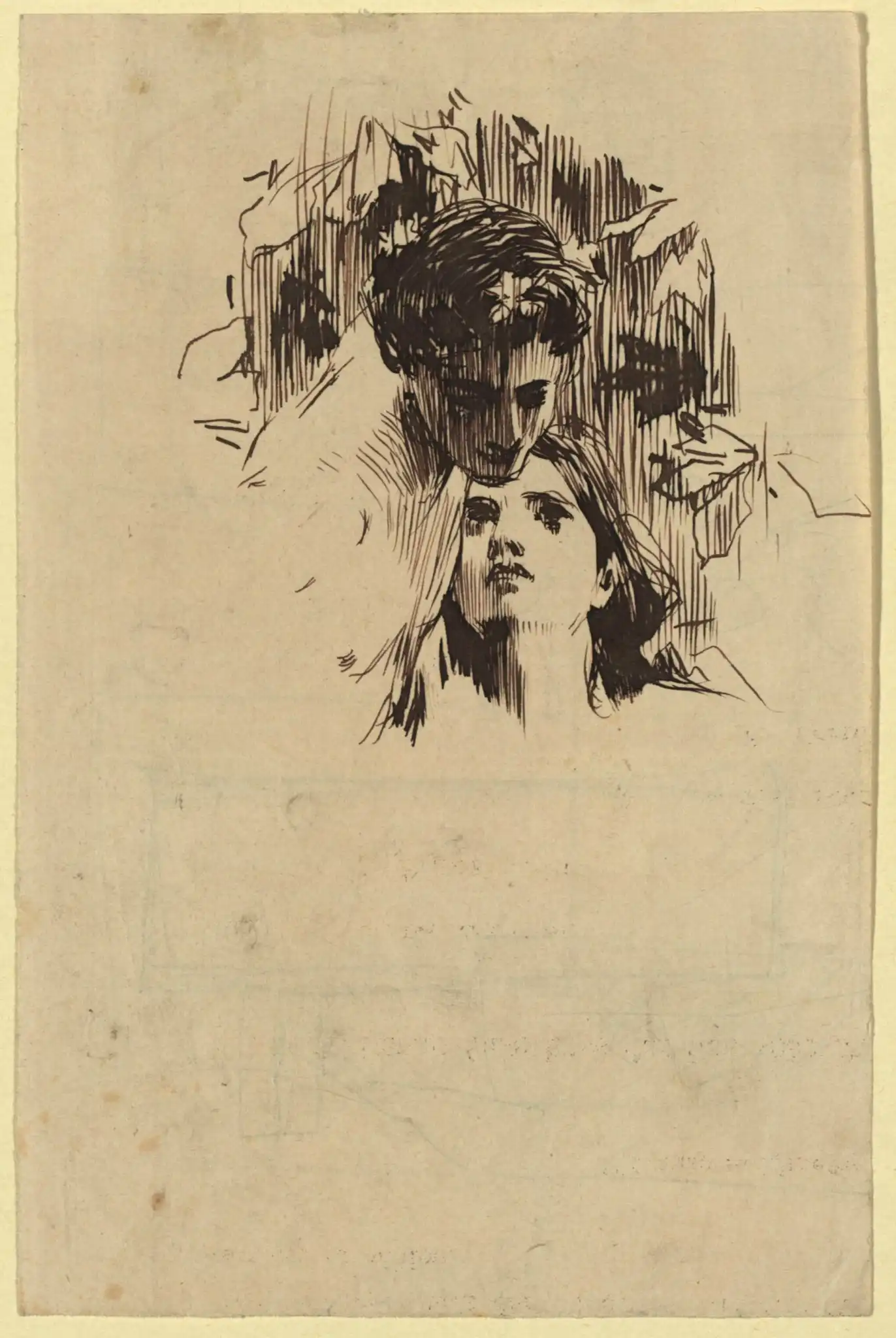
Vienna Secession: Koloman Moser
Lovers (Liebespaar) (ca. 1900)
pen and ink drawing
17.1 x 11.1 cm
©Wien Museum, Vienna
Among the contemporaries of Klimt who shaped the Vienna Secession, Koloman Moser (1868–1918) stands out as one of the most significant voices—arguably the most celebrated after Klimt himself. His artistic path is fascinating: although his early work harmonizes beautifully with the refined elegance of the Secession, his later years move toward the sharper, more expressive language we associate with Egon Schiele and Oskar Kokoschka. It is a shift that some viewers embrace wholeheartedly and others find challenging, much like the divided reactions to Schiele and Kokoschka themselves. Yet this tension—between beauty and distortion, harmony and rawness—is precisely what makes expressionist art so compelling to explore.
This drawing, Lovers, is a tender and intimate work that reveals Moser’s early mastery of line. The two figures are rendered with a soft, almost caressing contour, their faces close enough to suggest a moment of quiet emotional exchange. The male figure bends toward the female, whose upward gaze is serene and receptive. Around them, Moser builds a textured backdrop of foliage-like strokes—loose, rhythmic, and atmospheric—creating a sense of enclosure without overwhelming the figures. The lower portion of the sheet remains blank, giving the composition a floating, unfinished quality that heightens its immediacy. This balance of delicacy, intimacy, and expressive linework is characteristic of Moser’s Secession-period drawings.
Born in Vienna, Moser was not only a painter but a remarkably versatile creator. His graphic work, design sensibility, and applied arts practice made him a central figure in the artistic revolution of his time. As co‑founder of the Wiener Werkstätte with Josef Hoffmann, he helped shape a new vision of modern living. His designs touched nearly every aspect of daily life: fashion, furniture, mosaics, ceramics, jewelry, and more. He also taught at the Vienna School of Applied Arts (Kunstgewerbeschule), where his influence shaped a new generation of designers and craftsmen. Still, it is worthwhile to linger with his paintings and drawings, where his sensitivity and restlessness as an artist are most intimately felt.
Moser was among the founding members of the Vienna Secession in 1897 and contributed extensively to Ver Sacrum, the group’s influential magazine. He stood firmly with Klimt during the internal disputes over the Secession’s direction, and in 1905 he left the group alongside Klimt when the divide became irreconcilable. A similar story unfolded with the Wiener Werkstätte: by 1907, artistic and financial pressures led him to withdraw from the enterprise he had helped build.
His early work, up to around 1901, fits seamlessly within the ornamental, symbolist, and often dreamlike vocabulary of the Secession. But as the years progressed, Moser’s style shifted. Geometric clarity began to replace decorative fluidity, influenced in part by his interest in Middle Eastern art and pattern. After leaving the Wiener Werkstätte, his work absorbed the growing expressionist mood that was sweeping through European painting. A key influence was the Swiss painter and Symbolist Ferdinand Hodler, whom Moser met in 1903 while preparing a Secession exhibition. Their conversations and subsequent meetings left a deep imprint on Moser’s evolving artistic language, encouraging a more monumental, rhythmic approach to form.
In his final years, Moser faced a long illness—cancer—that gradually limited his ability to work. He died in 1918, only weeks before Egon Schiele, in that devastating year that claimed so many artists and reshaped the cultural landscape of Vienna. His legacy, however, remains vibrant: a testament to an artist who moved gracefully between worlds—ornament and expression, design and painting, beauty and the unsettling truths beneath it—always remaining close in spirit to the ideals that he and Klimt had set in motion at the dawn of the Secession.
Leave a Reply