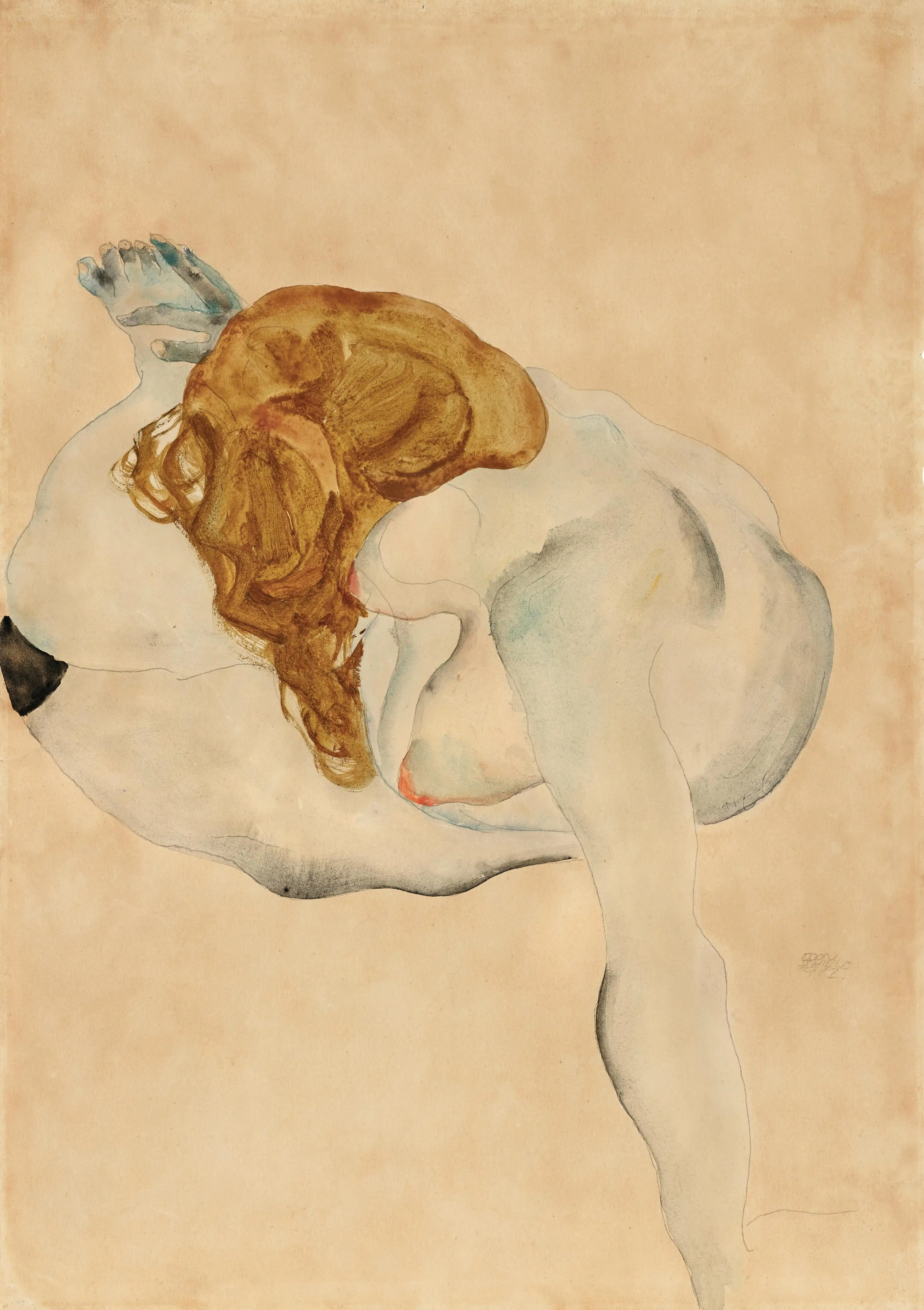
Egon Schiele:
Female Nude Leaning on Her Arm (Weiblicher Akt auf ihren Arm gestützt), 1912
Gouache, watercolor and pencil on paper
45 × 31.6 cm
Auctioned at Dorotheum in 2025 for EUR 400,000
(Kallir d1051)
This 1912 nude belongs to a moment when Schiele’s engagement with the human body reached a new level of intensity and refinement. The combination of gouache, watercolor and pencil allows him to move between firmness and softness: the pencil establishes the essential structure, while the washes of color bring warmth, vulnerability and a subtle inner glow to the figure. The pose — the body leaning into its own weight, supported by a single arm — creates a quiet tension that feels unmistakably Schiele, intimate and psychologically charged.
The sheet was created during Schiele’s months in Neulengbach, the small market town west of Vienna where he sought a quieter rhythm of life in 1912. The calm of that setting was abruptly interrupted by his arrest and brief imprisonment — an episode that left a lasting mark on his artistic choices. Although he regarded the accusations as unfounded, he understood the warning they carried. After this year he largely abandoned depictions of children, turning instead to young women, who now became the primary focus of his exploration of the human figure.
At this time, Wally Neuzil was his closest companion — confidante, lover, and the model who understood his artistic needs with instinctive clarity. Schiele rarely portrayed her with a fully defined face, yet her presence is unmistakable in the warm, reddish tones of the hair that recur throughout his works of 1912. The quiet tenderness of this sheet, and the particular way the body is held, suggest that she may well have posed for it.
The figure seems to hover rather than sit, her bent legs and bowed head creating a suspended, introspective stillness. Seen from above, the viewer encounters a young woman whose only visible support is her extended left arm. Rising from the lower edge of the paper, that arm functions almost like the stem of a flower, carrying the body upward into full bloom. Its strong vertical thrust contrasts with the delicate lightness of the torso, which forms the quiet center of the composition. The interplay of strength and fragility — of structure and softness — is characteristic of Schiele’s finest works from this pivotal year. As noted in the Dorotheum auction commentary, the sheet’s remarkable balance of tension and weightlessness is one of its most striking qualities.
The influence of Auguste Rodin’s graphic work, which had made a profound impression on the Viennese avant‑garde after the 1908 exhibition at the Kunstsalon Hugo Heller, can be felt here in subtle ways. Rodin’s free, exploratory studies — bodies captured in shifting postures, animated by translucent washes — offered younger artists a new vocabulary for expressing the human figure. Schiele absorbed this impulse and transformed it into something unmistakably his own. In this sheet, the body seems to emerge from the untouched paper through a thin, incisive pencil line. Around the neck and breasts, the contours loosen, allowing movement and emotion to register simultaneously rather than through strict anatomical fidelity.
Within this framework, Schiele’s own sensibility becomes unmistakable. The restrained application of gouache, alternating with the lightest washes of black and bluish watercolor along the edges, lends the figure a sculptural presence while preserving an overall sense of weightlessness. In the delicate proximity between the fingers of the right hand and the foot — rendered in shimmering tones from blue to black — Schiele reveals his singular sensitivity to the charged, intimate spaces of the body. It is in these small, electrified moments that his mature style speaks most clearly, offering a glimpse of the emotional depth that would define his work in the years to come.
Leave a Reply