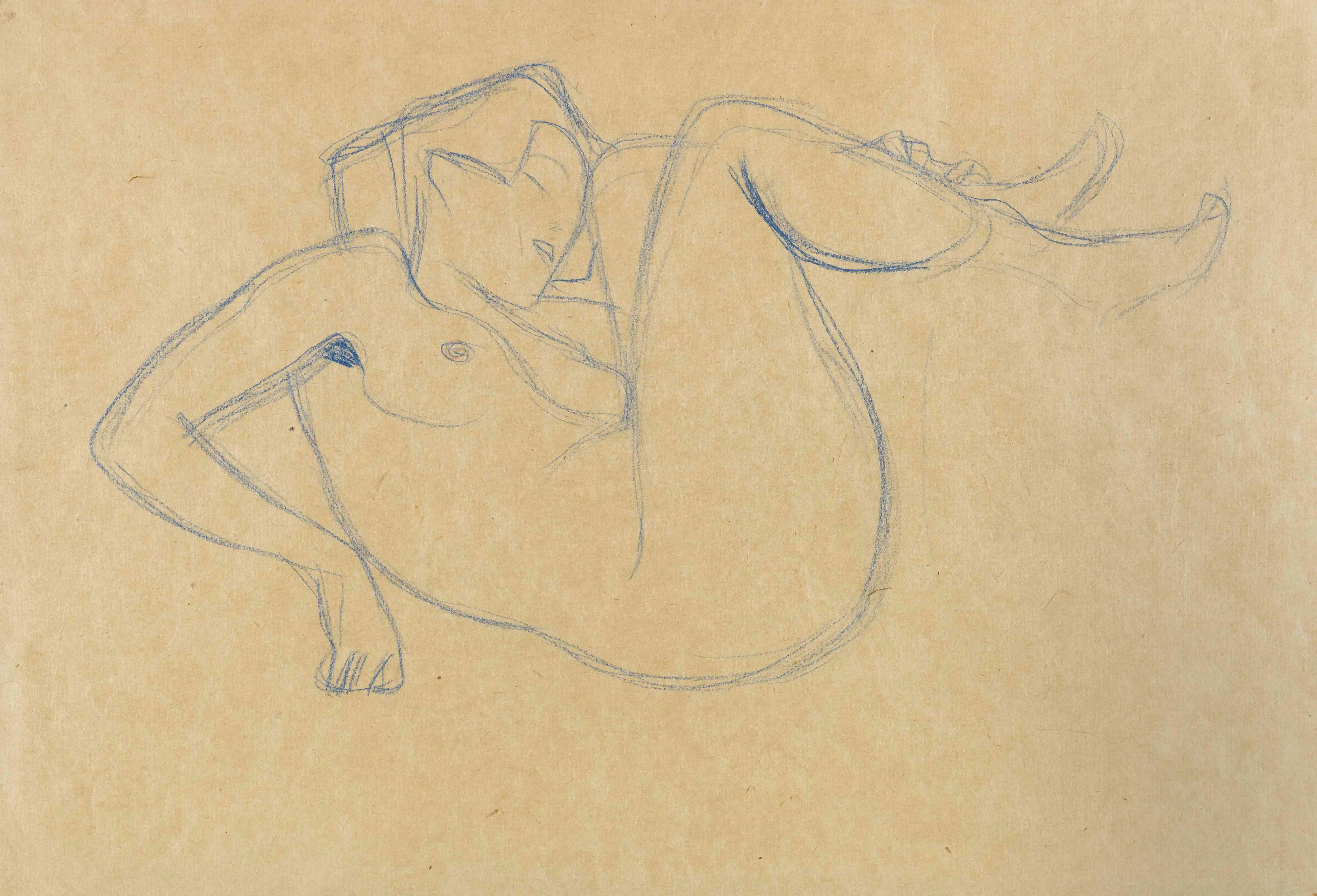
Gustav Klimt:
Crouching Female Nude with Drawn‑Up Legs (Mit angezogenen Schenkeln kauernder Mädchenakt), 1903
Colored crayon drawing in blue
On packaging paper
30.6 × 44.5 cm (12 × 17.5 in)
Auctioned at Ketterer Kunst in 2023 for € 45,720 / $ 53,949
(Strobl s1009)
Gustav Klimt (1862–1918) created this tender, crouching female nude in 1903, at a moment when his drawing practice had reached an extraordinary level of refinement and emotional immediacy. Executed in blue crayon on humble packaging paper, the sheet radiates a warmth and intimacy that belie its modest materials. Klimt’s line — soft, searching, and unmistakably alive — caresses the contours of the young woman’s body, capturing both her physical presence and the quiet inwardness of her pose.
During these years Klimt often preferred inexpensive, everyday papers and blue crayon, a combination that allowed him to work with remarkable freedom and immediacy.
This drawing is a preliminary study for Klimt’s celebrated painting Danaë (1907–08), one of the most sensuous works of his entire oeuvre. In the myth, Zeus approaches the imprisoned Danaë in the form of a golden shower, and Klimt transforms this ancient tale into a vision of erotic transcendence. The pose explored here — the raised knee and gently curled torso — already anticipates the intimate, inward‑turning gesture of the later painting, where sensuality and mythic symbolism merge into a single, glowing image.
Klimt’s interest in the female nude at this time was shaped by a broader artistic dialogue. Thematically, the sheet resonates with the emotional charge of works such as Hoffnung I (National Gallery of Canada, Ottawa), Hoffnung II (MoMA, New York), and Der Kuss (Belvedere, Vienna), where the female body becomes a vessel for longing, vulnerability, and ecstatic transformation. Art historically, the pose also recalls the lost Leda by Michelangelo — known today through a 16th‑century copy in the National Gallery, London — whose sinuous, twisting form Klimt admired and subtly reinterpreted.
The drawing’s significance was underscored in the landmark 1970 exhibition at the Mathildenhöhe in Darmstadt, where Klimt’s graphic work was shown alongside that of Henri Matisse. The pairing highlighted what both artists understood so profoundly: that the contour line, when handled with sensitivity and daring, can express the full emotional range of the human figure. In this sheet, Klimt’s line is not merely descriptive — it breathes, it trembles, it embraces.
Crouching Female Nude with Drawn‑Up Legs stands as a luminous example of Klimt’s ability to elevate the private act of drawing into a moment of poetic revelation. The young woman’s curled posture, rendered with such tenderness, anticipates the mythic radiance of Danaë while preserving the quiet humanity of the model before him. It is a study, yes — but also a complete, intimate world in itself.

Leave a Reply to Margarita.Cancel reply