
The Imitation Game: The Golden Apple Tree, Coloured?
The internet can be a marvellous place for discovery, but it can also quietly distort the reality of Klimt’s paintings. With the rapid spread of AI‑generated imagery, this distortion is only accelerating. When an invented picture is shared often enough, it begins to feel familiar — and familiarity can be mistaken for truth. The Imitation Game exists to slow that process down, to remind us that repetition does not equal authenticity.
The first image you see here is the coloured version that keeps circulating online — confidently presented as if it were a genuine reproduction of Klimt’s lost Golden Apple Tree. It appears again and again across social media, and because of that repetition, many people assume it must be real. But the facts tell a very different story.
The painting was most possibly destroyed at Schloss Immendorf in 1945, along with several other major Klimts. No colour photograph of it survives. Not one. The only visual record we possess is a single black‑and‑white photograph, which I place here in this text — the same image reproduced in Natter’s catalogue raisonné. That monochrome photograph is all that remains of the painting.
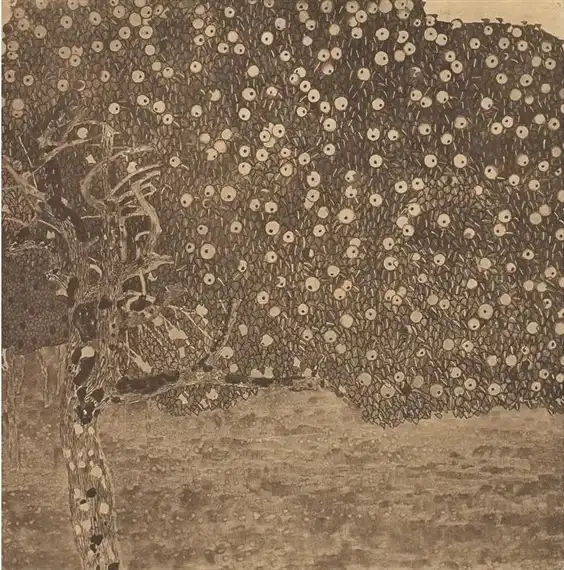
As with all early studio photographs of artworks, the surviving image flattens colour, compresses tonal relationships, and loses the shimmering surface effects that were so essential to Klimt’s landscapes. These works depend profoundly on colour, pattern, and texture; without them, any attempt to “restore” or “reconstruct” the palette becomes pure speculation. Yet despite this, some individuals have created their own coloured interpretations, presenting them as authentic and even selling them as such.
Once these fabrications enter the online ecosystem, they spread quickly. People encounter them repeatedly, assume they must be real, and unknowingly help to reinforce the illusion. It’s not malice — it’s the quiet power of repetition. And in the age of AI, that power is only growing.
So a gentle warning is needed. You may find the coloured image appealing, but since the painting was lost in 1945, no colour record survives, and nobody today can claim to know what Klimt’s palette looked like. Any coloured version circulating online is a modern invention, not a rediscovered Klimt.
This is precisely why The Imitation Game exists: to keep the historical record clear, and to honour the works that were lost by refusing to let inventions replace them.


Leave a Reply