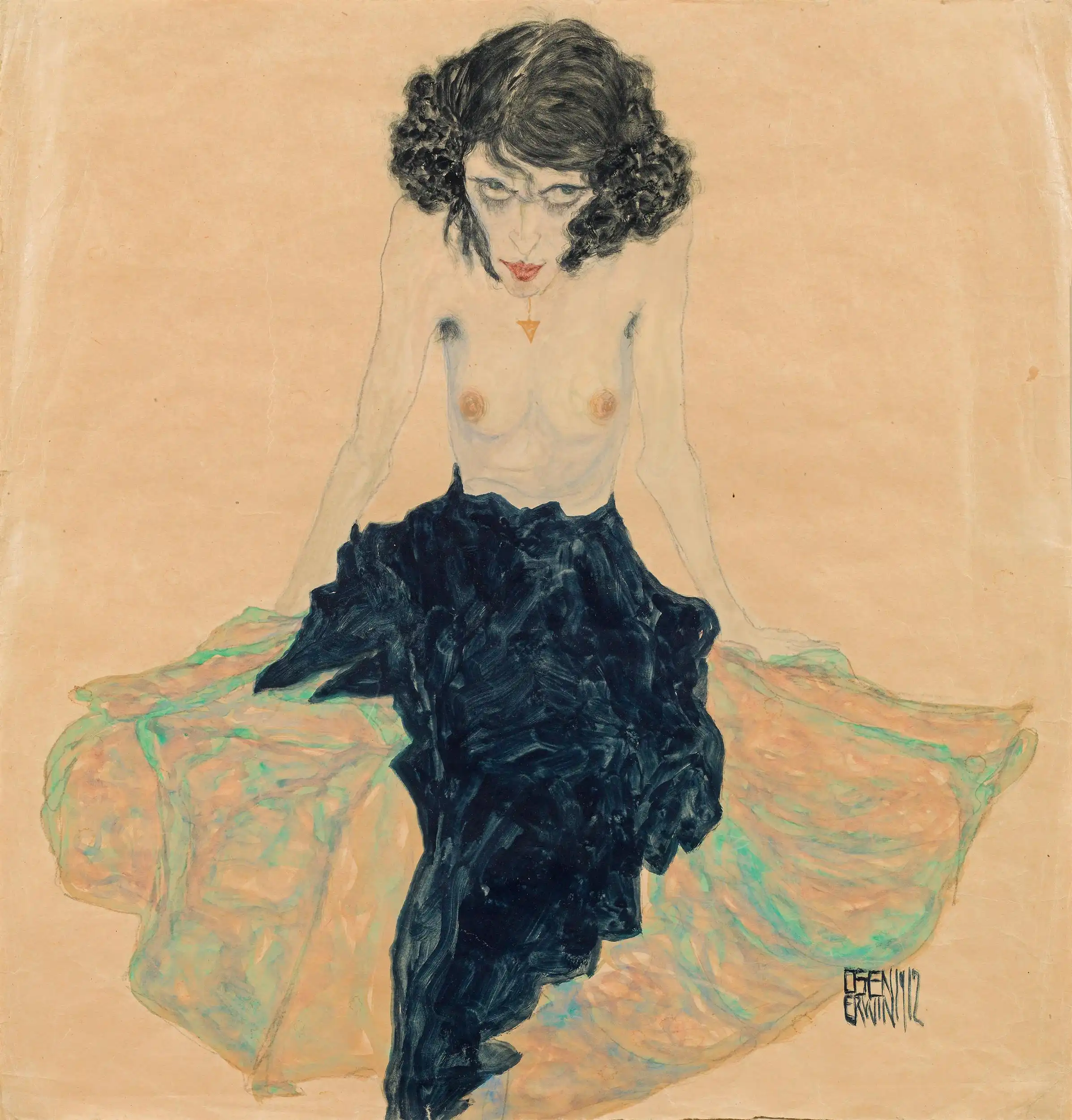
Die Neukunstgruppe and Friends of Schiele: Erwin Osen:
Sitting Semi‑Nude Dancer Moa (Sitzende Halbakt, Sitzende Halbakt, Tänzerin Moa), 1912
Watercolour and pencil on paper
46 × 43.5 cm
Auctioned at im Kinsky in 2017 for € 85.000
Erwin Dominik Osen (1891–1970) moved through Vienna’s theatrical and artistic world around 1910 with a kind of restless brightness. He slipped easily between roles—actor, mime, dancer, stage designer, painter—always carrying that untamed spark that made him impossible to overlook. When Egon Schiele met him around 1909, he was immediately struck by Osen’s vitality and refusal to fit into any conventional frame. Their encounter grew into a close friendship and a period of intense artistic exchange. Anton Peschka, Schiele’s brother‑in‑law, later described Osen as a “catalyst” in Schiele’s shift away from Art Nouveau and in loosening the long shadow of Klimt—an observation that shows how strongly Osen’s contemporaries felt his presence. Schiele captured their bond in nine portraits and numerous back studies before the war pulled their paths apart in 1914.
Around 1911, Osen met the dancer Moa Mandu, a familiar figure on Vienna’s suburban stages. Arthur Roessler described her as “spectacular and mysterious,” a willowy performer with a mask‑like calm beneath her dark, center‑parted hair. Osen and Moa quickly became close—emotionally, artistically, and in the everyday sense of sharing a life. Schiele, who shared a studio with Osen at the time, was equally fascinated by her delicate, almost mechanical movements and by the soft melancholy of her eyes, shadowed brown‑blue under heavy lids. She became a welcome model for both artists, though only four watercolours by Osen featuring her were previously known.
This sheet captures Moa in a moment of unguarded stillness. Osen’s pencil lines hold her with a gentle steadiness, while the soft watercolour washes warm her skin, giving the figure a subdued radiance. The intimacy feels lived rather than staged, shaped by the closeness of two people who shared both daily life and the restless creative energy of Vienna in these years.
A final detail worth noting is Osen’s signature: his full name and the date, arranged in a compact, square block that feels intentionally graphic. The echo of Schiele’s signatures from the same period is unmistakable and speaks to the closeness of their artistic dialogue—two young artists watching each other work, borrowing, responding, and shaping their visual languages in parallel.


Leave a Reply to Half‑Nude with Skirt. The Dancer Moa Mandu, 1911 – Erwin Osen – Schiele & Klimt: The Art of Secession and BeyondCancel reply