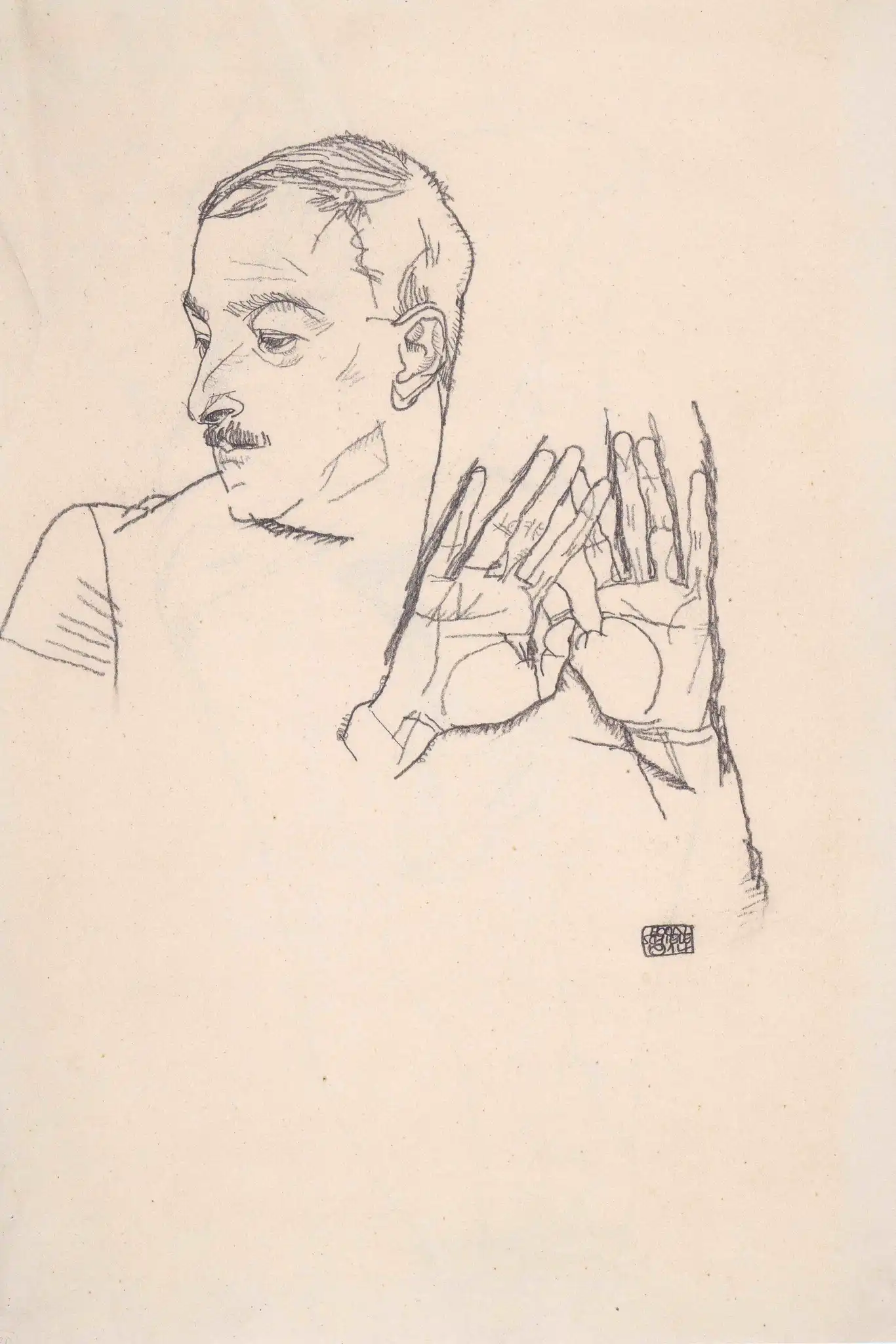
Egon Schiele:
Portrait of Art Critic Arthur Roessler (Bildnis des Kunstkritikers Arthur Roessler), 1914
Pencil
48.6 × 31 cm
© Historisches Museum der Stadt Wien, Vienna
(Kallir d1630)
Arthur Roessler (1877–1955) was one of the most formative figures in Egon Schiele’s life, and this 1914 pencil portrait conveys that closeness with a quiet, unforced warmth. Schiele draws Roessler in profile with a few deliberate, economical strokes, reducing the portrait to its essentials: the alert tilt of the head, the fine moustache, the concentrated gaze, and — most strikingly — the expressive hands raised in an open, almost conversational gesture. The spareness of the sheet gives the drawing an intimate, immediate quality, as if Schiele captured Roessler mid‑thought, mid‑sentence, in a moment of genuine presence.
Schiele and Roessler met in 1909, when Schiele was only nineteen. Roessler immediately recognised the young artist’s extraordinary talent and became far more than a collector. He bought drawings when Schiele was struggling financially, helped him navigate the practicalities of artistic life, and acted as a confidant, advocate, and intermediary. Among Schiele’s patrons, Roessler was the most multifaceted: a critic for the socialist Arbeiter‑Zeitung, an early champion of modern Austrian art, a writer who later authored several monographs on Schiele, and at times a quasi‑dealer who placed works with sympathetic collectors. His support was not merely transactional; it was personal, protective, and at moments almost familial.
Schiele had portrayed Roessler before — most notably in a painted portrait — and in 1912 he painted Roessler’s wife, Adele, with the same mixture of psychological insight and affectionate observation. These works form a small but revealing constellation within Schiele’s oeuvre. They are among the most tender portraits he ever made, marked by a gentleness that stands apart from the sharper, more confrontational energy of many of his other likenesses. In the 1914 drawing, the line is steady and reflective, characteristic of the stylistic shift taking place in Schiele’s work at this time. The emphasis on the hands — open, articulate, almost speaking — suggests Roessler’s role as a mediator of ideas, a man whose influence operated through words, advocacy, and conversation.
Roessler’s support proved crucial during Schiele’s most challenging years, including the period surrounding his 1912 imprisonment. He defended the artist publicly, wrote about him with conviction, and helped sustain his career when many others hesitated. His writings — from early reviews to later monographs — played a decisive role in shaping Schiele’s public image and securing his posthumous reputation. This drawing, made two years after the crisis of 1912, carries the quiet weight of that loyalty. It is not a grand statement but a personal one: a record of gratitude, companionship, and the deep human connections that shaped Schiele’s short, brilliant life.
Leave a Reply