Egon Schiele:
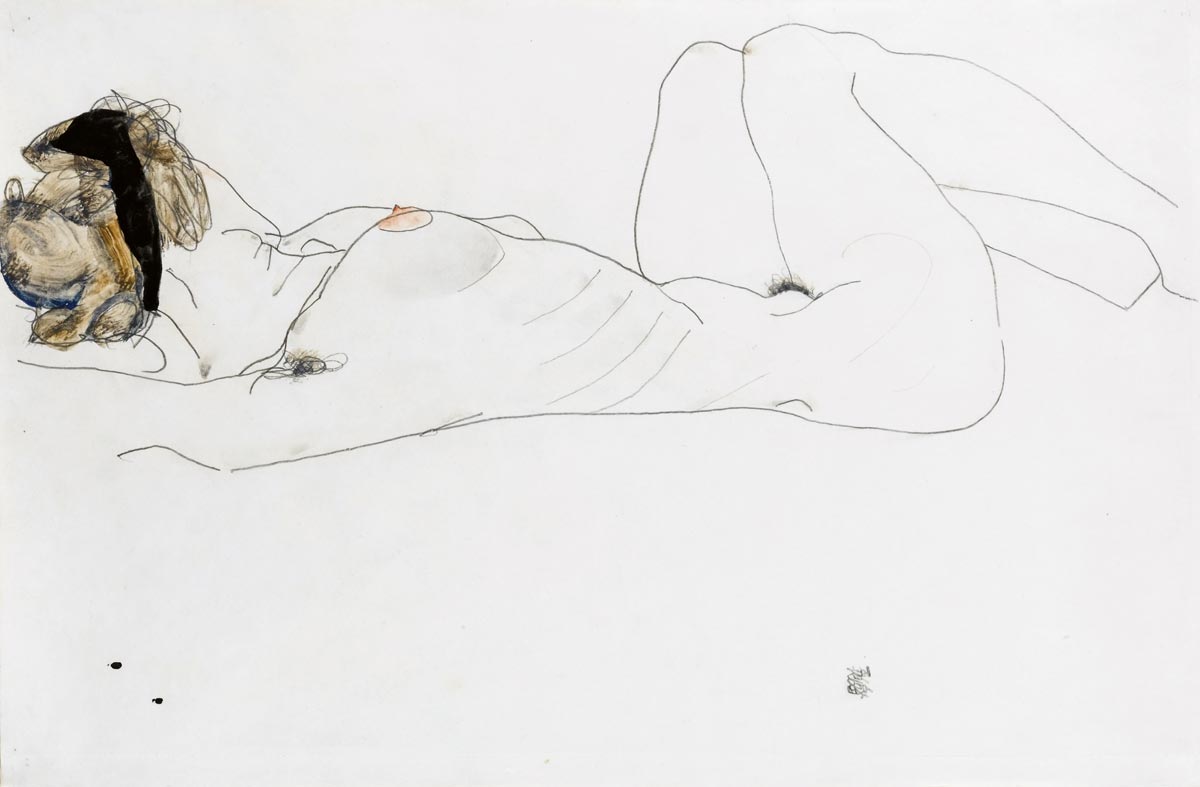
Reclining Female Nude (Liegender weiblicher Akt), 1912
Pencil and watercolour on paper
31.5 × 48.2 cm (12 3/8 × 19 in.)
Auctioned at Christie’s in 2007 for GBP 692,000
(Kallir d1141)
This 1912 sheet shows Schiele working with an elegant economy of means, achieving remarkable expressive depth through restraint. Christie’s has noted how confidently he pushes his graphic language here: the thin, fluid pencil line; the concentrated bursts of colour; the way form is conjured with the lightest possible touch. Even within the vast number of nudes he produced, Liegender weiblicher Akt feels unusually distilled — a study that reveals how assured his hand had become by this moment.
The model lies on her side, head turned away, one leg bent, the other extended. The pose is quiet, almost withdrawn, and Schiele resists any theatrical framing. His line traces the body with a kind of reverent detachment, letting the contours emerge without exaggeration. The figure feels observed rather than staged — a moment of rest rendered with clarity and restraint.
The model may be Valerie Neuzil, or Wally, whose presence shapes much of Schiele’s work in 1912. Her red hair, loosely pulled back, and the delicate features of her face suggest her familiar presence. Yet the anonymity of the pose — the turned head, the closed body — leaves room for ambiguity. Schiele concentrates on the contours as if they were an erotic landscape, using a single meandering line to define volume and repose.
Colour appears only where it matters: the hair, the face, and a few concentrated points along the body. These accents heighten the drawing’s quiet eroticism, not through overt gesture but through precision. For Schiele, such eroticism was tied to what he saw as the inner vitality of the human being — the spiritual force beneath the skin that his line sought to reveal. The flushed tones, the tousled hair, the concentrated highlights all hint at that interior life.
The drawing’s animate presence is set against the stark emptiness of the surrounding page. As he often did, Schiele signs the lower space with his cartouche-like signature, placed as if the sheet were meant to be read vertically. This reflects his interest in Japanese print aesthetics — the balance of figure and void, the tension between gesture and blankness — even if the reclining pose here is clearly intended to remain horizontal.
What emerges is a nude that feels both immediate and quietly resonant, its simplicity sharpened by Schiele’s absolute command of line. In this sheet, his graphic language reaches a new clarity: economical, introspective, and unmistakably his.
Leave a Reply