Egon Schiele:
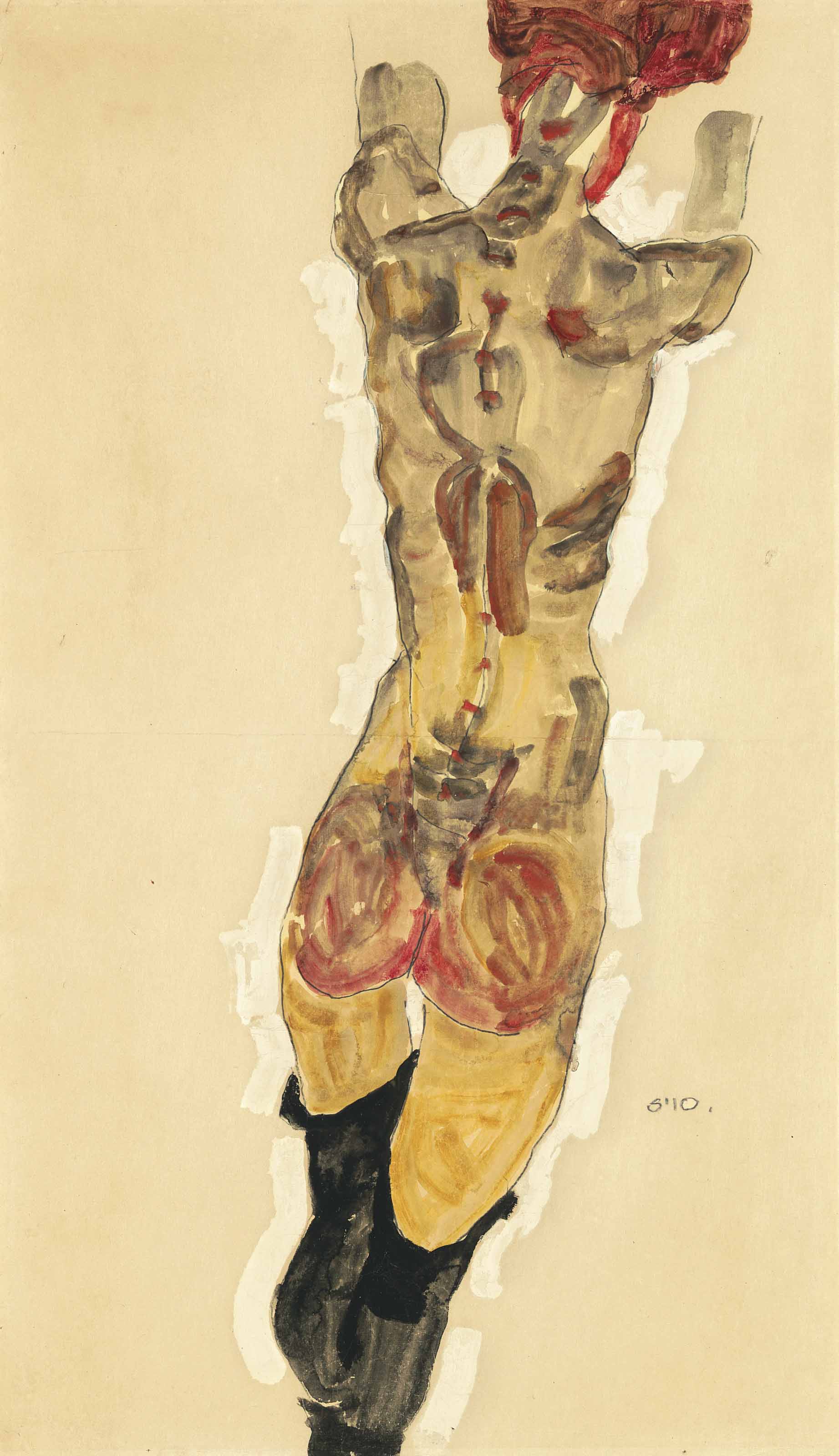
Standing Nude from the Back (Stehender Rückenakt), 1910
Gouache, watercolor and pencil on paper
56.1 × 33.1 cm (22 1/8 × 13 in.)
Auctioned at Christie’s for USD 3,612,500 in 2018
(Kallir d558)
Created in 1910, at a turning point in Schiele’s early development, Stehender Rückenakt shows the young artist embracing a sharper, more incisive way of drawing the human body. The nude becomes a charged presence rather than an idealized motif, rendered with a clarity and emotional intensity that mark Schiele’s break from Klimt’s ornamental world. Christie’s has emphasized the significance of this moment in his career, and the commanding character of this sheet helps explain its remarkable result at auction.
The model stands with her arms lifted to gather her vivid red hair, the movement tightening the musculature of her back into a strong, upward sweep. Her body fills nearly the entire sheet, the limbs slipping beyond the edges so that she seems to press outward from the paper. The stark, unmodulated background heightens this effect, isolating her form and allowing the viewer to feel the full weight of her presence.
The black stockings still clinging to her legs introduce a charged, transitional note — a trace of undressing that lingers in the composition. It’s a small but potent detail, deepening the sense of immediacy and suggesting a moment suspended between gesture and stillness. Schiele’s gaze is attentive and unflinching; he draws the body as something felt as much as seen.
Technically, the sheet reflects Schiele’s growing assurance. The pencil line, newly favored over charcoal, is crisp and alive, vibrating with the nervous energy that would soon define his mature style. A faint white halo surrounds the figure, pushing her forward from the page and giving the body a sculptural lift. The watercolor washes — mauve, peach, scarlet — overlap and bleed with deliberate fluidity, mapping the warmth and tension of living flesh. The back, the curve of the buttocks, the junction of neck and jaw: each is rendered with a sensitivity that reveals both observation and fascination.
What emerges is a figure defined by tension and presence, monumental in stance and intensely alive. In this sheet, Schiele’s line asserts itself with a clarity and force that already signal the uncompromising voice of his mature work.


Leave a Reply