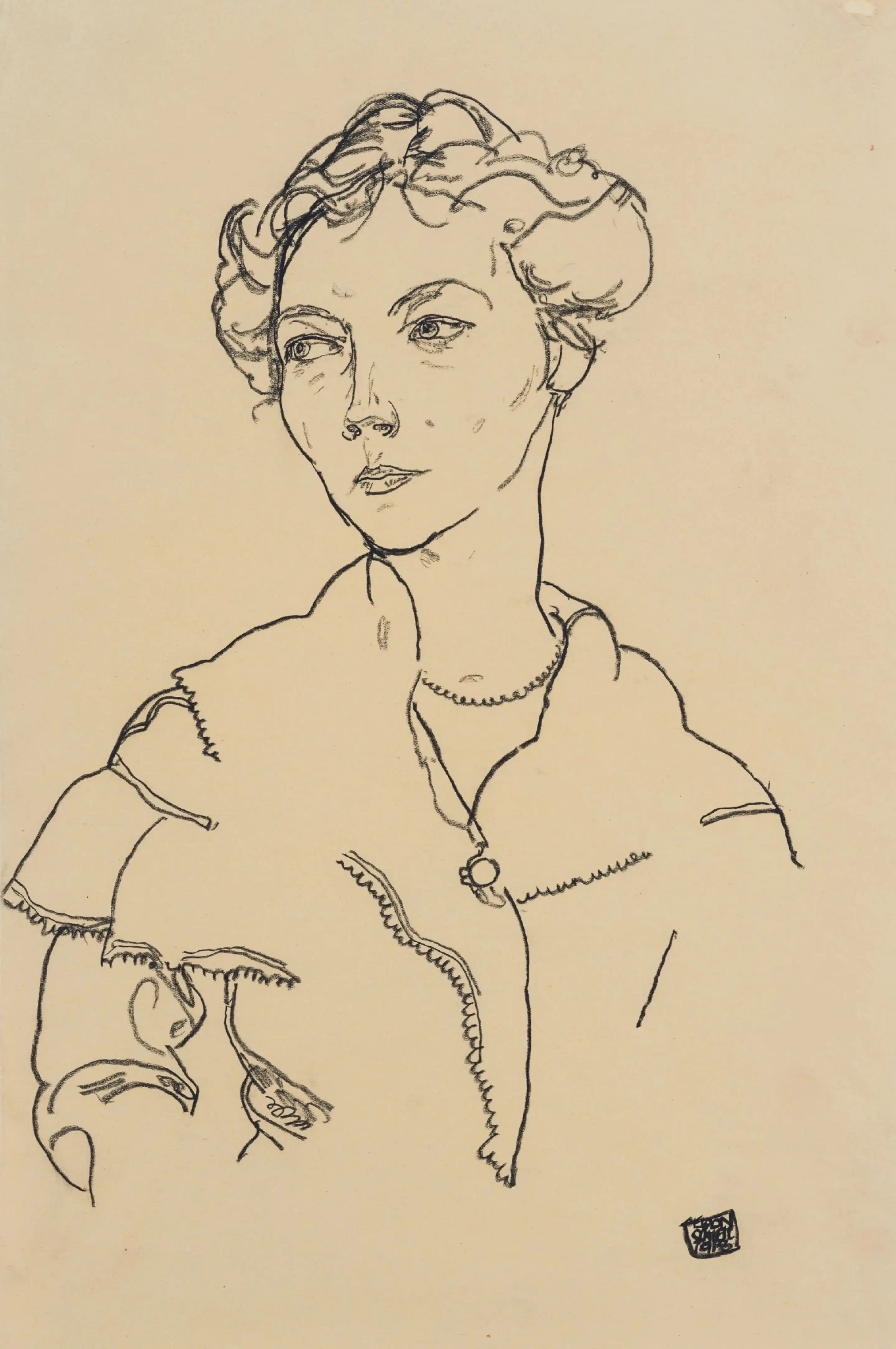
Egon Schiele:
Portrait of Lilly Steiner (Bildnis Lilly Steiner), 1918
charcoal on paper
44.5 × 29.6 cm
auctioned at Sotheby’s in 2017 for 200,000 GBP
(Kallir d2210a)
Lilly Steiner (1884–1961), born in Vienna as Lilly Hofmann, is the sitter of this elegant portrait. An artist in her own right, she belonged to the Hagenbund circle, though her work only began to receive broader attention after she settled in Paris in 1927. Her marriage to the manufacturer Hugo Steiner placed her within a cultivated Viennese milieu; their home, Villa Steiner — designed by Adolf Loos — remains one of the clearest expressions of Loos’s architectural principles. This drawing fits within this cultural landscape, a reminder of the world in which both sitter and artist moved.
The drawing’s early history adds another layer of resonance. It once belonged to Otto and Eva Benesch in Vienna, a provenance of real significance. Otto Benesch, one of Austria’s most influential art historians and former director of the Albertina, was a pioneering scholar of modern drawing and an early, authoritative voice in the study of Schiele. His stewardship of the sheet underscores the esteem in which it was held. After his death in 1964, the drawing remained with Eva Benesch before passing to the family of the present owner in 1981.
By 1918, Schiele’s draughtsmanship had reached a remarkable clarity. His portraits of women from this period reveal a shift away from the charged sensuality of his early years toward a more attentive, interior kind of seeing. In this drawing, the charcoal line carries that maturity: soft where it needs to breathe, firm where it anchors the structure of the face. The economy of means is striking — a handful of deliberate strokes, a few tonal accents — yet the sitter’s presence feels immediate and unforced. The drawing’s restraint heightens its intimacy, allowing Lilly Steiner’s character to emerge through clarity rather than detail.
The Kallir reference d2210a indicates that the sheet entered the catalogue raisonné after the second edition, suggesting a period in which the drawing remained outside the public or scholarly record. Works with the “a” suffix often have such histories — known in private hands, insufficiently documented, or simply overlooked until later research brought them into clearer view. This drawing’s reappearance adds another layer to its story, underscoring the way Schiele’s works continue to surface and reshape our understanding of his final years.
Schiele portrayed Lilly Steiner several times — five drawings are known — and one of them now resides in the Metropolitan Museum of Art in New York. Among these, the present sheet stands out for its intimacy. The line is unhurried, the mood contemplative, as if Schiele were less concerned with likeness alone than with capturing a moment of stillness shared between artist and sitter. Created in the last year of his life, it feels like a distilled expression of what his late portraiture could achieve: depth through simplicity, presence through the lightest touch.

Leave a Reply