The Glasgow Girls: Norah Neilson Gray
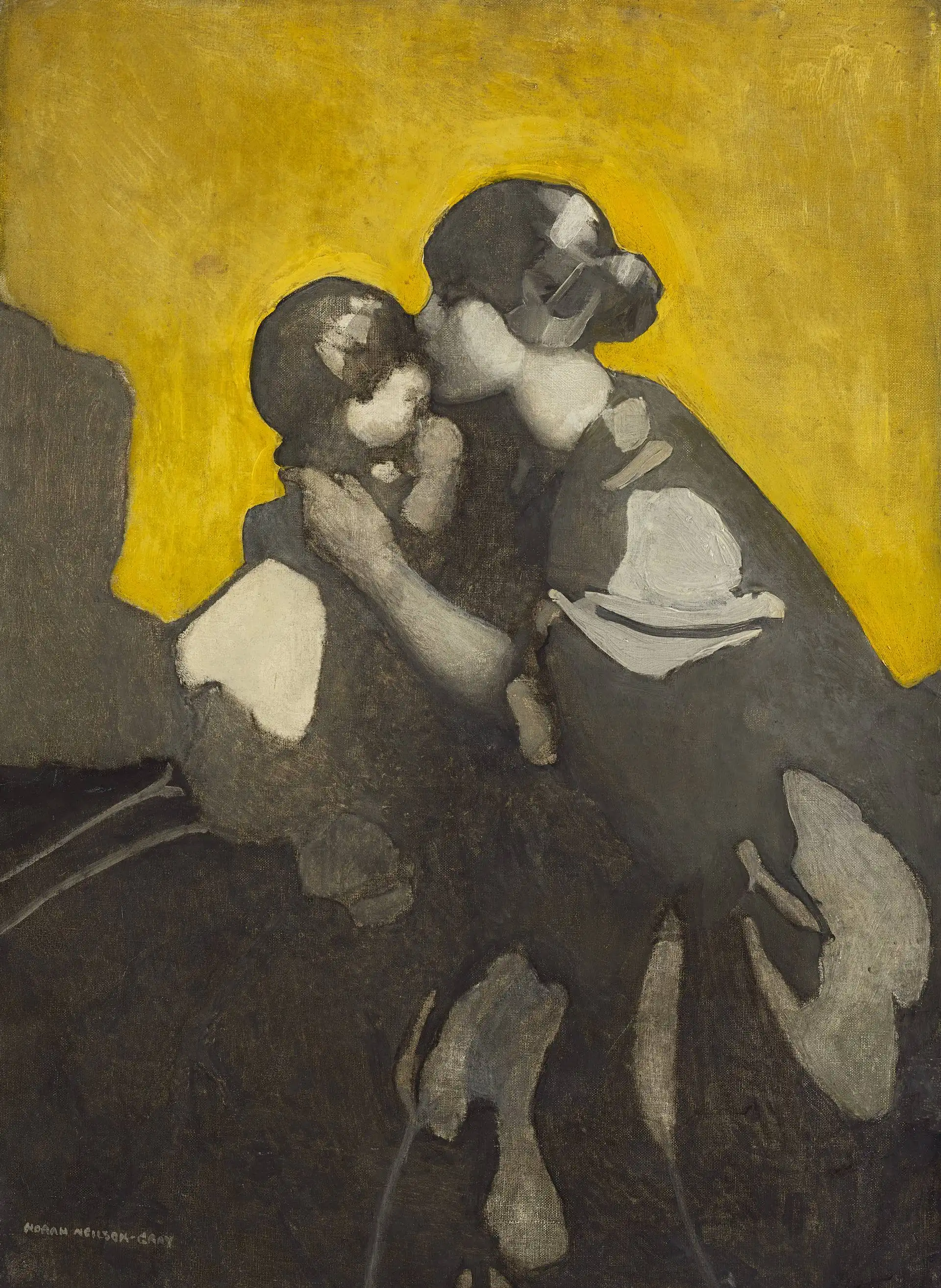
Mother and Child, c.1925–1931
Oil on canvas
77 × 57 cm (30 5/16 × 22 7/16 in.)
Auctioned at Bonhams in 2015 for £4,750
Mother and Child is a moving example of Norah Neilson Gray’s late style, created at a moment when her work was becoming increasingly distilled, expressive, and modernist. As one of the most accomplished members of the Glasgow Girls — the group of women artists and designers active around the Glasgow School of Art who championed professional training, artistic independence, and the emotional potential of everyday subjects — Gray carried their ethos into her mature work with quiet conviction.
In this painting, the figures are simplified and stylised, their bodies rendered in soft greys and blacks that merge and separate in gentle rhythms. The embrace is unmistakably tender, yet the forms are pared back to their essentials. Against them, a vivid yellow ground radiates with quiet intensity, heightening the contrast between the intimate gesture and the surrounding space. The abstraction is never distant; instead, it deepens the emotional resonance, allowing the viewer to feel the closeness of the moment without relying on facial detail or narrative cues.
Gray’s training at the Glasgow School of Art, and her later role as a teacher there, shaped her lifelong commitment to structure and clarity. Even in her wartime commissions — where she documented the work of the Women’s Services with remarkable empathy — she maintained this balance between discipline and emotional insight. In her domestic subjects, that sensitivity becomes even more pronounced. Here, the relationship between parent and child is expressed through posture, colour, and the subtle interplay of shapes rather than through descriptive realism.
By the mid‑1920s, Gray’s palette had softened and her compositions had become more contemplative. Works from this period often explore the psychological space between figures, using simplified forms to evoke mood rather than to record likeness. Mother and Child belongs firmly to this late phase: intimate, pared back, and quietly luminous. It shows an artist who had absorbed the lessons of modernism while remaining rooted in the values that defined the Glasgow Girls — clarity, empathy, and a deep respect for the emotional lives of ordinary people.


Leave a Reply