
Gustav Klimt:
Old Woman (Alte Frau), 1909
Oil on canvas
95.3 × 47 cm (37½ × 18½ in.)
Auctioned at Christie’s in 2007 for GBP 378,400
(Natter no. 184)
Old Woman is one of the most unusual and quietly compelling works in Klimt’s career. Painted in 1909, it belongs to a brief but revealing moment when Klimt stepped away from the radiant opulence of his golden period and began searching for a more introspective, emotionally grounded visual language. This painting is best understood alongside Mother and Two Children, created immediately afterward and sharing the same somber, expressionist atmosphere.
Its position in Klimt’s chronology makes it especially striking. Coming directly after The Kiss and Judith II, Old Woman feels almost like a deliberate turning inward. The figure is elongated, withdrawn, and sculptural in her stillness. The muted palette and contemplative mood suggest an artist stripping away ornament to confront the raw presence of age, vulnerability, and dignity. Klimt’s Dame mit Hut und Federboa and Mutter mit Kindern were exhibited together with this work at the Vienna Kunstschau of 1909, an exhibition that offered a sweeping view of contemporary European art. Paintings by Schiele and Kokoschka hung beside works by Edvard Munch, Félix Vallotton, Henri Matisse, and Ernst Barlach, while Van Gogh and Gauguin were also represented. In this context, Klimt’s shift toward a more expressionist, psychologically charged style becomes even more understandable.
By 1909, Klimt felt that his golden style had become too static and monumental. He was wrestling with the direction of his own work, absorbing new influences, and responding to the younger generation rising around him. Old Woman and the subsequent Mother with Two Children mark this transitional moment: a brief, somber interlude in which Klimt experimented with expressive distortion, spiritual gravity, and a darker, more sculptural presence.
Many scholars see a connection between this painting and George Minne’s sculpture Praying Nun (1898). The bowed head, the elongated form, and the quiet inwardness all echo Minne’s spiritual austerity, suggesting that Klimt was engaging with new artistic currents as he moved away from the decorative splendor of his earlier years.
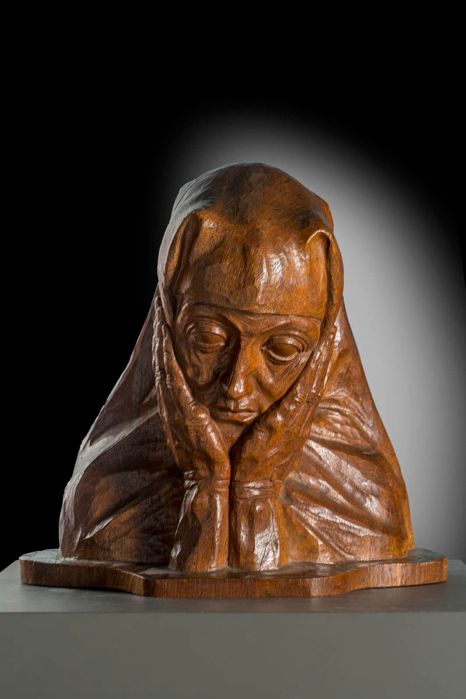
Seen today, Old Woman stands as a poignant glimpse into Klimt’s artistic uncertainty—and his courage. It reveals an artist willing to leave behind the gold and acclaim to explore something more fragile, more searching, and deeply human.


Leave a Reply