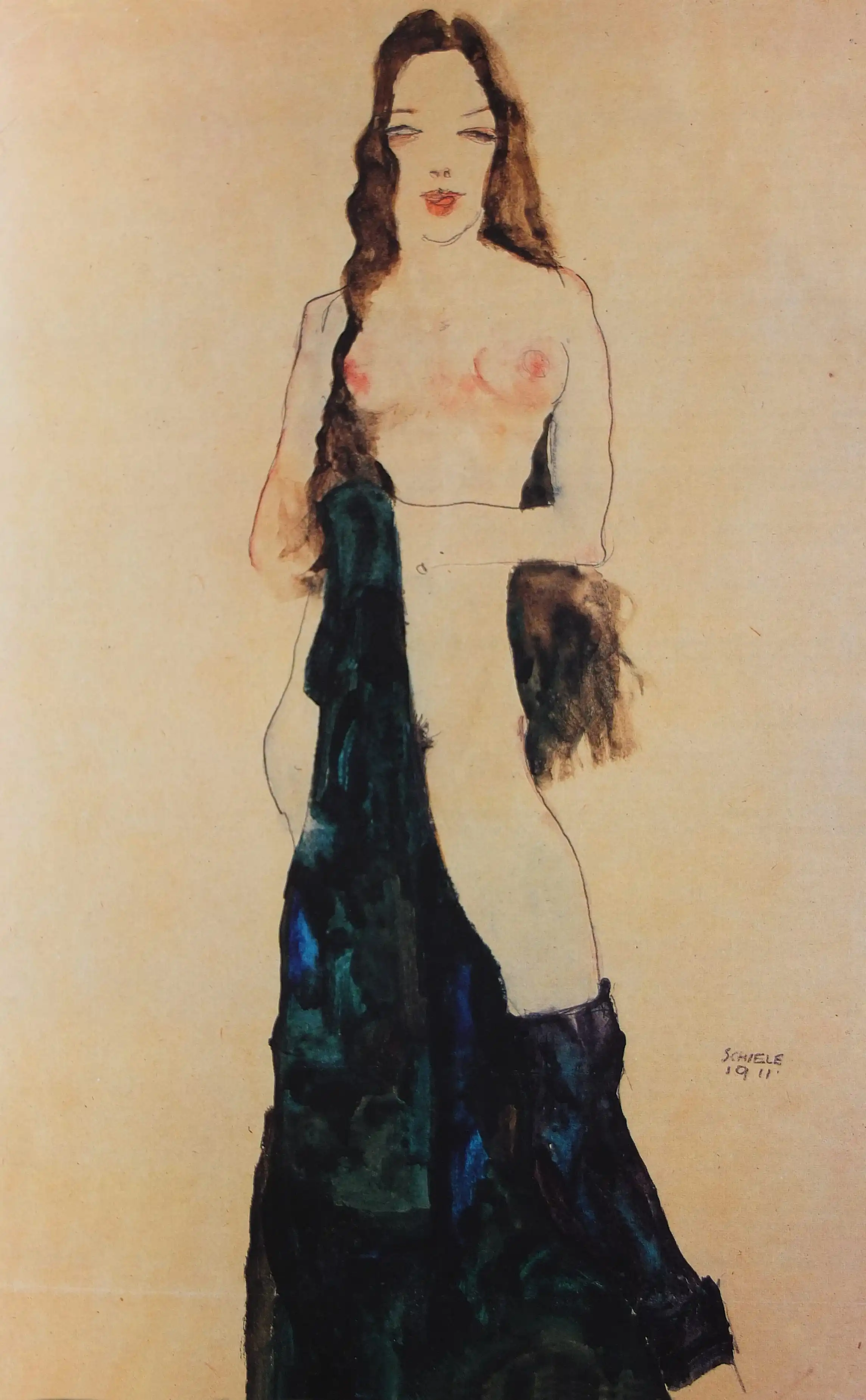
Egon Schiele:
Standing Nude with Draped Cloth (Stehender Akt mit Draperietuch), 1911
Gouache, watercolor and pencil on paper
56.7 × 35 cm
Auctioned at Christie’s in 2024 for USD 1,197,000
(Kallir d808)
The woman in this drawing stands directly before us, meeting the viewer with a steady, almost challenging gaze. Her frontal pose recalls older artistic traditions, yet Schiele’s treatment is unmistakably modern: the single, confident pencil line; the bold, saturated passages of gouache; and the fluid, shifting washes of watercolor. The cloth she holds both softens and heightens the moment, as if she is poised between revealing and withholding, fully aware of the effect of her stance.
Schiele made this work in 1911, a year that marked a clear turning point in his development. He was moving beyond Klimt’s influence and shaping a visual language that was sharper, more direct, and more psychologically charged. The drapery shows how far he had come with watercolor and gouache: layered blues that drift into purples and violets, meeting the darker tones of her stockinged leg. He had learned to control watercolor’s unpredictability, using it here with a confidence that gives the sheet a gentle, luminous depth.
Across the figure, the color shifts between thin, transparent washes and more opaque touches, creating a surface that feels alive. Small accents, soft rose at her lips, gentle warmth around her eyes, the slight flush at her chest—bring a sense of closeness and immediacy. Her long dark hair, falling well below her shoulders, makes her body appear even more delicate and elongated.
Schiele pays close attention to the small signals of her posture: the raised eyebrow, the weight resting on one hip, the stocking clearly visible on her left leg. These details suggest a woman who knows exactly how she is being seen. She returns the gaze with calm assurance, neither shy nor passive. This confident, self‑aware presence became a defining feature of Schiele’s nudes in 1911, marking a shift from the quieter, more reserved figures of the previous year.
By this point, Schiele was shaping a new kind of nude—one that was emotionally open, sexually direct, and unafraid to meet the viewer head‑on. This drawing captures that moment of change with striking clarity, combining technical experimentation with a fresh, assertive understanding of the human figure.
Leave a Reply