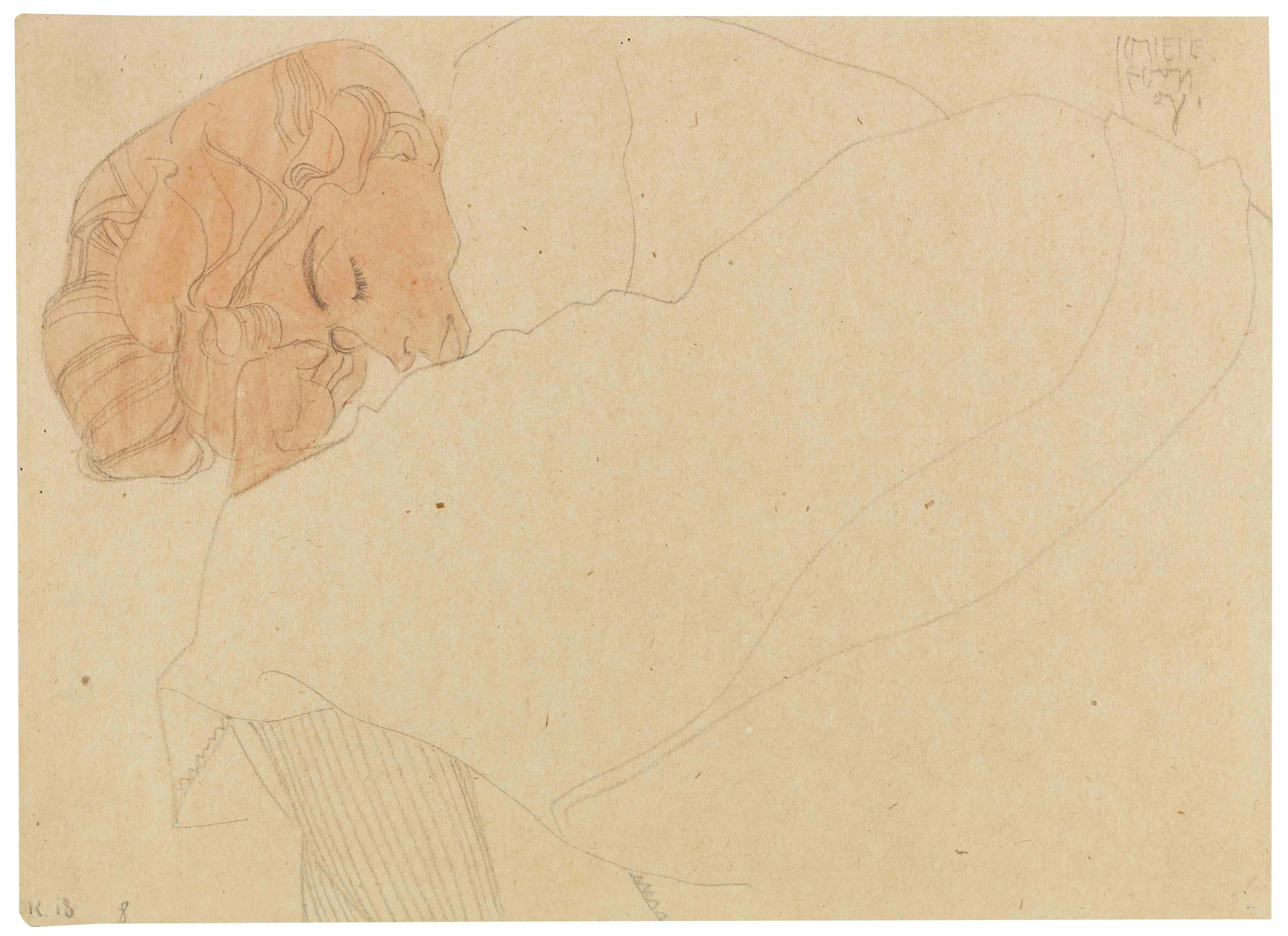
Egon Schiele:
Sleeping Girl (Schlafendes Mädchen; Portrait of Melanie Schiele; Study for Danae), 1908
Pencil and gouache on paper
21.8 × 30.0 cm
Auctioned at Ketterer Kunst in 2021 for € 193,750
(Kallir d196a)
This early drawing carries a quiet warmth that feels very close to the young Schiele himself — a moment of stillness, tenderness, and unguarded observation before his art took on its later urgency. It’s the kind of sheet that Galerie Fledermaus would frame not as a precursor, but as a small, luminous window into Vienna 1900: soft Jugendstil contours touched by the first stirrings of something more inward and searching.
Melanie Schiele (1886–1974) appears here as she does in several works from these earliest years, when the artist often turned to the people around him for models. Her presence belongs to this intimate, formative period; there is no clear evidence she continued to sit for him later. That knowledge gives the drawing a gentle, familial closeness — a sense of the young artist working within the quiet rhythms of home, before his line hardened into the sharper, more confrontational language of his maturity.
The Ketterer Kunst note beautifully observed how little Schiele needed to create a sense of presence: the faint seam of a dress, the soft riffle of stockings, the way the head settles into the hand. These small, attentive touches guide the eye back to the sleeping face, rendered from above with a delicacy that feels almost protective. Even at eighteen, Schiele could hold a moment of rest with extraordinary sensitivity.
The drawing also belongs to a formative moment in his development. Around 1907–08, Schiele was loosening himself from the Academy, seeking Klimt’s guidance, and encountering Kokoschka — influences that would soon push his line toward greater intensity. It is precisely here that the Klimt reference becomes visible: the gentle inward curl of the body, the closed eyes, the sense of a figure enclosed within her own private world all echo the emotional atmosphere of Klimt’s Danae. Schiele is not imitating Klimt, but absorbing the mood — the merging of vulnerability, sensuality, and dreamlike inwardness — and testing how such a sensibility might live within his own emerging language. You can feel him rehearsing the emotional terrain that would later shape his own Danae.
The provenance, clarified by Jane Kallir, adds another thread of early‑career closeness. Her reading of the Sütterlin inscription — “Besitz Hayd” — links the sheet to Karl Hayd, a fellow Academy student who exchanged drawings with Schiele around 1908. How it later entered the Drexel estate remains uncertain, but the early connection reinforces the sense of a small circle of young artists sharing work, influence, and encouragement.
Taken together, the drawing feels like a gentle threshold: a sleeping figure, a family model, a young artist absorbing the world around him and beginning to move beyond it. It is one of those early sheets where tenderness and transformation sit quietly side by side.
Leave a Reply