Egon Schiele:
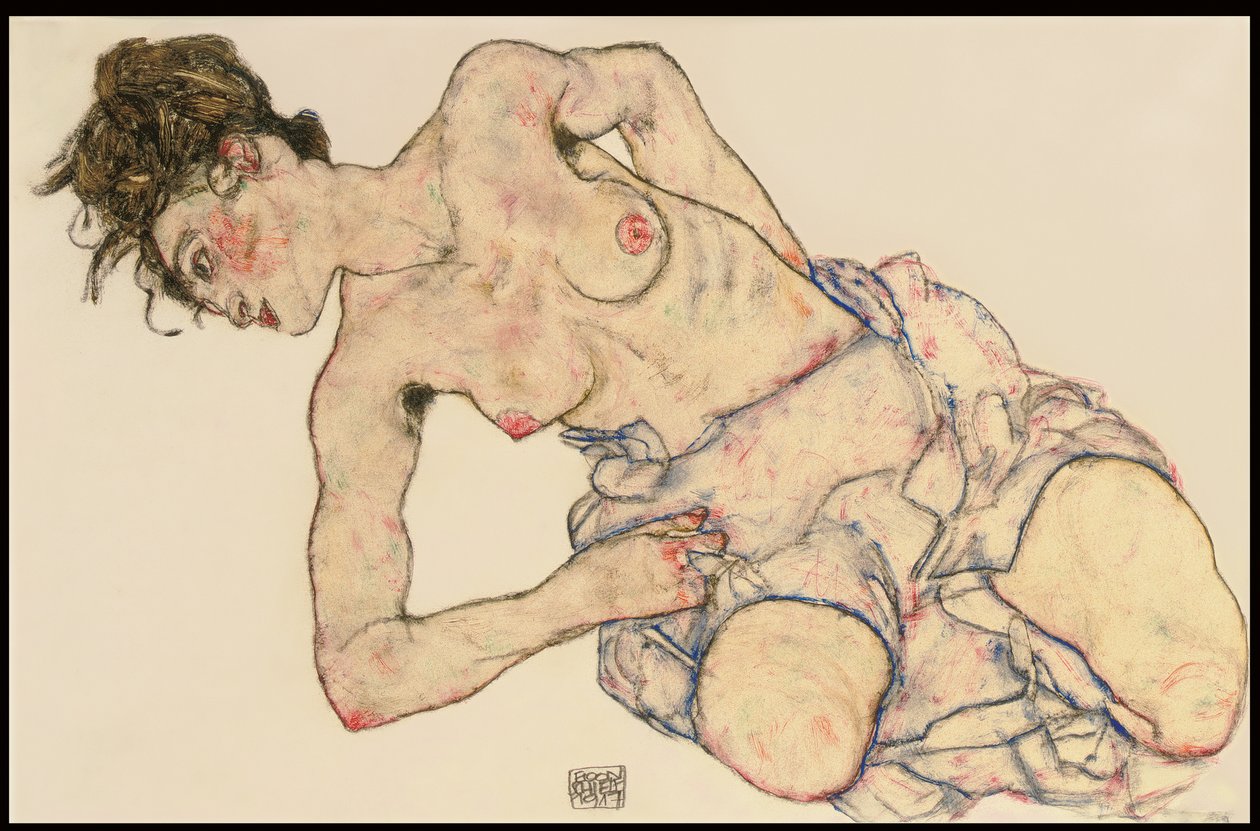
Kneeling Female Half‑Length (Kniender weiblicher Halbakt), 1917
Gouache, black crayon, wash and pencil on paper
27.3 × 42.2 cm
Auctioned at Christie’s, London, in 2006 for GBP 4,152,000
(Kallir d1946)
Executed in 1917, this drawing belongs to the final, reflective phase of Schiele’s career — a moment he himself described with striking clarity in a letter to Anton Peschka: “I want to start anew… it seems to me that until now I have just been preparing the tools.” That sense of renewal is palpable here. The sheet feels quieter, more inward, and more attuned to the human figure as a living presence rather than an expressive instrument.
The kneeling pose is modest and slightly turned, a posture that invites contemplation rather than confrontation. Schiele’s handling of gouache and wash is unusually gentle: the warm tones of the skin, the soft transitions around the shoulders and hips, and the subtle articulation of bone beneath flesh all contribute to a sense of a figure held in a moment of breath. The black crayon anchors the form without dominating it, allowing the body to emerge gradually from the blank ground.
A few insights from the Christie’s auction note are worth acknowledging, though I weave them here in my own way. The note observes that in 1917 Schiele’s earlier erotic charge gives way to a more measured attention to the body’s natural presence. That shift is unmistakable in this sheet. The figure is not a portrait, nor is she a psychological study; she is a human form understood as something elemental — shaped by gravity, breath, and the quiet rhythms of being alive. The contrast between the warm, animate body and the untouched paper around it heightens this sense of presence. The void is not empty; it is the space in which the figure lives.
The identity of the model remains uncertain. Christie’s suggests the possibility of a professional model or one of the Harms sisters, who appear frequently in Schiele’s work from this year. But the drawing resists identification. The features are softened, the individuality muted. What matters here is not who she is, but what she embodies: a living form, observed with tenderness and clarity.
What distinguishes this sheet — and what makes it one of the most compelling works of 1917 — is the way Schiele balances structure and softness. The body bends in a diagonal that feels both natural and expressive, a quiet gesture that animates the entire page. There is no need for distortion, no theatrical emphasis. The drawing breathes through restraint. It is a late work in which Schiele’s command of line and wash has become so assured that the figure seems to rise from the paper with almost effortless grace.
In this sense, Kniender weiblicher Halbakt stands among the finest of his late drawings: a work where maturity brings not heaviness but clarity, and where the human figure becomes a vessel for a deeper, more contemplative understanding of nature and presence.

Leave a Reply