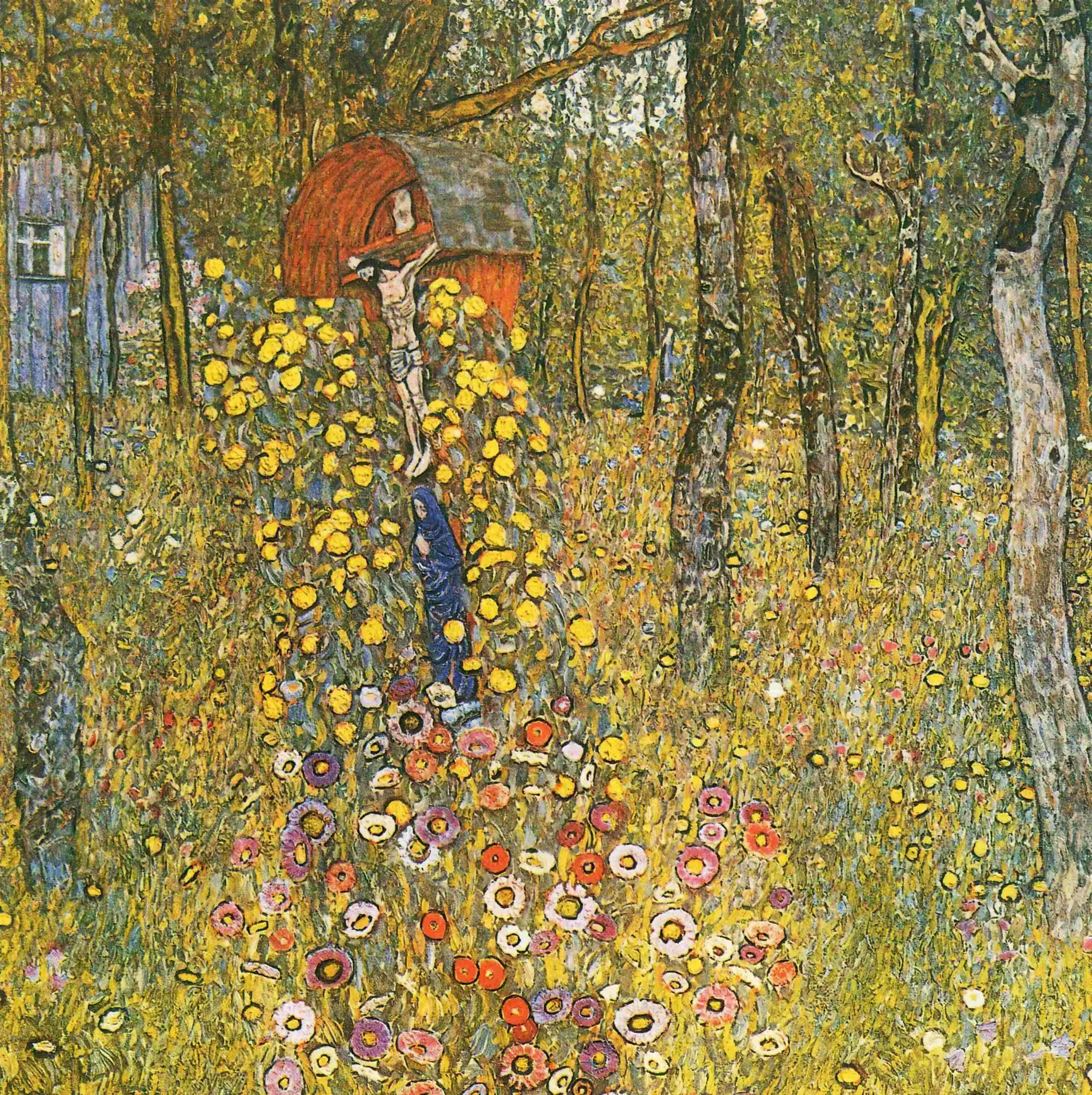
Gustav Klimt:
Country Garden with Calvary (Bauerngarten mit Kruzifix) (1912)
Oil on canvas
110 × 110 cm
Destroyed by fire in May 1945 at Schloss Immendorf, Austria
(Natter no. 200)
According to Tobias Natter’s widely accepted catalogue raisonné of Klimt’s paintings, the work was first exhibited in 1914 under the alternative title Cross in a Country Garden. The motif belongs to Klimt’s late landscape period, yet it stands apart for its inclusion of overtly religious elements. The crucifix and small roadside Madonna—quietly set among the dense flowering field—introduce a note of stillness and devotion that is rare in Klimt’s painted work.
The small building in the upper left corner has been identified as the same structure seen in Upper Austrian Farmhouse (1911), suggesting that Klimt returned to this rural setting with a kind of affection, reworking its forms across different summers. The square format, characteristic of his landscapes from this period, lends the composition a calm, balanced presence.
Country Garden with Calvary belonged to the celebrated Lederer collection, assembled by one of Klimt’s most devoted patron families. Following the 1938 Anschluss—the annexation of Austria into Nazi Germany—the Nazis seized the Lederer collection. At some point during the later years of the war, the painting was transferred—together with the rest of the looted Lederer collection—to Schloss Immendorf, where it remained until the castle burned in May 1945.
In early May 1945, as the conflict reached its end, the castle was set ablaze, likely by retreating SS troops. The Klimt paintings stored there were lost, including this one. Whether Country Garden with Calvary was consumed in the fire or vanished under other circumstances remains uncertain, but no trace has surfaced since. It survives only through early photographs and catalogue descriptions, leaving the full richness of its colour and surface forever out of reach.


Leave a Reply