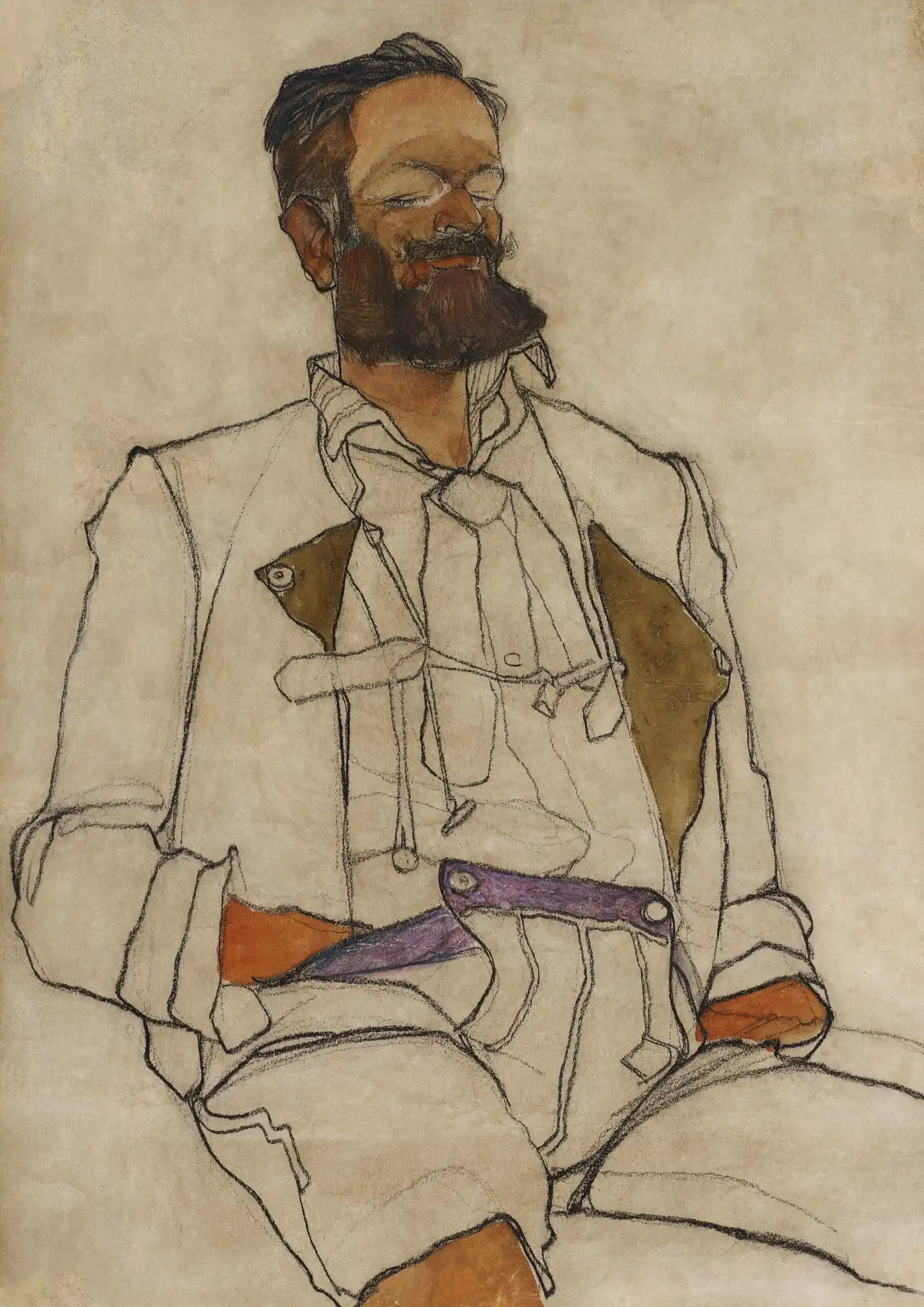
Egon Schiele:
Portrait of a Gentleman (Bildnis eines Herren, Carl Reininghaus), 1910
Gouache, watercolor and black Conté crayon on paper
44.2 × 31.1 cm (17 3/8 × 12 1/4 in.)
Auctioned at Christie’s, 2022 for USD 403,200)
(Kallir d608)
Egon Schiele’s Portrait of a Gentleman belongs to the intensely fertile years of 1909–1911, when his line sharpened, his palette grew bolder, and his psychological insight deepened with remarkable speed. Painted in 1910, the work depicts Carl Reininghaus, the wealthy industrialist and early champion of the Viennese avant‑garde. Their friendship, begun that same year, would last—sometimes warmly, sometimes tensely—until Schiele’s death in 1918.
Reininghaus was far more than a collector. As Christie’s noted in the 2022 auction, he played a vital role in shaping Vienna’s modernist landscape. In 1902, he acquired Gustav Klimt’s Beethovenfries, saving it from destruction after the XIV Secession exhibition. He organized competitions for young artists, offered financial support when few others dared, and cultivated an environment where new ideas could take root. Schiele, still in his early twenties, found in him a patron who understood both his ambition and his volatility.
This portrait captures that dynamic with unusual tenderness. Schiele’s 1910 line—taut, angular, and searching—encircles Reininghaus with a kind of electric clarity. The combination of gouache, watercolor, and Conté crayon allows Schiele to balance softness and incision: translucent washes lend the sheet a quiet warmth, while the black contour cuts through it with psychological precision. The sitter is not idealized, nor is he presented as a figure of social standing. Instead, he appears as Schiele saw him: a restless, intellectually driven man whose support mattered deeply, even when their temperaments clashed.
Reininghaus belonged to a small circle of early patrons—including Arthur Roessler and Dr. Oskar Reichel—who purchased more than half of Schiele’s oils in 1910. Their belief in him was crucial. Much of Schiele’s early work was misunderstood by the public and, at times, collected as erotica. Reininghaus, however, recognized the expressive force behind the distortions, the vulnerability beneath the provocation. His collection of Schiele’s drawings became one of the most significant of its time.
Within Schiele’s development, this portrait stands at a decisive moment. The decorative influence of Klimt is fading; the fully expressive, confrontational portraiture of 1911 is beginning to emerge. What remains constant is Schiele’s insistence that a portrait should reveal not the sitter’s social aspirations but the truth of their inner life—and, inevitably, the truth of his own.
Seen in this light, Portrait of a Gentleman is more than a record of a patron. It is a document of a young artist finding his voice, and of the rare individuals who recognized that voice before the rest of the world caught up. The Christie’s auction note rightly underscores the work’s importance: it embodies the fragile, formative network that sustained Schiele during his early breakthrough years, and it preserves the quiet intensity of a relationship that shaped his path.
Leave a Reply