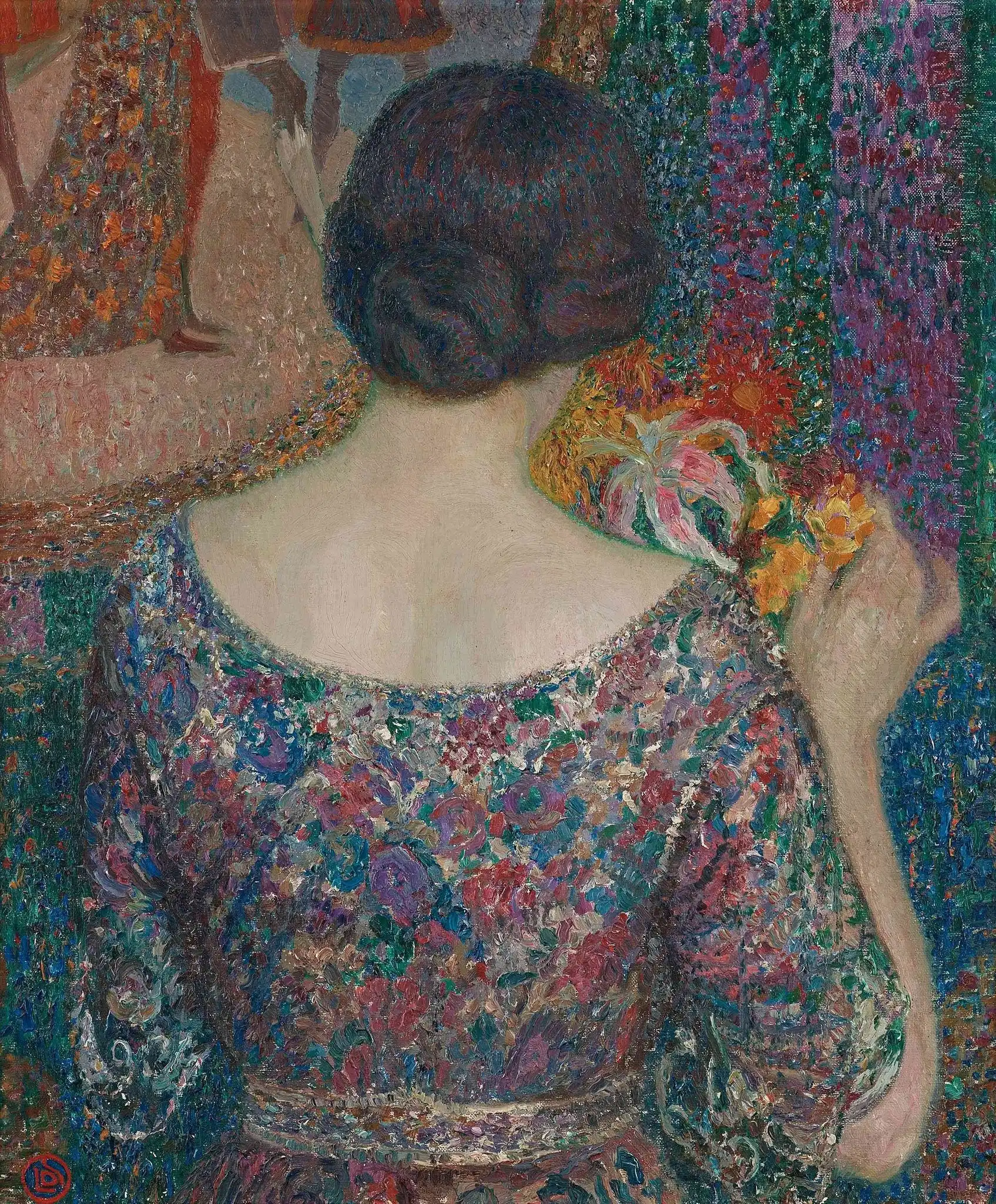
The Belgian Connection: Léon de Smet
Maria with flowers (1915)
Oil on canvas
59 × 50.5 cm
Auctioned at Bukowskis, Stockholm in 2023 for ca. 26,000 EUR
Léon de Smet (1881–1966), one of the most sensitive colorists of the Flemish modern tradition, occupies a distinctive place within the currents of Neo‑Impressionism and Pointillism. Although younger than the pioneering members of Les XX—the Belgian avant‑garde circle of the late nineteenth century—he remained deeply committed to the Impressionist vocabulary at a moment when many artists were turning toward Symbolism or Expressionism. Together with his brother Gustave, he is regarded as a central figure of the second Latem School.
When de Smet arrived in Sint‑Martens‑Latem in 1907, he entered a community of painters searching for new ways to translate light and atmosphere. Among his colleagues were Valerius De Saedeleer, George Minne, and Albert Servaes, each pursuing their own path within the evolving Latem aesthetic. De Smet’s refined technique and instinctive feel for color quickly set him apart. Like many in the village, he worked with short, luminous strokes that capture the shifting play of light, yet his touch remained unusually gentle and attentive. In contrast to Gustave’s growing Expressionist force, Léon allowed the surface to breathe; the act of looking, and the harmony of tones, became the quiet heart of his work.
The First World War brought him to England, where his elegant handling of paint and his gift for likeness were immediately recognized. He became a sought‑after portraitist among writers, intellectuals, and members of London’s high society. After leaving England in 1923, he eventually returned to Belgium and settled in Deurle in 1930, where he continued to refine the Impressionist language that had always felt most natural to him.
Maria with flowers (1915) belongs to this early wartime period and carries the calm, intimate radiance that characterizes de Smet’s finest work. The sitter, Maria, appears in several paintings from these years, forming part of the small circle of models who shaped his domestic imagery. Here, she is seen from behind, her head gently turned, holding a bouquet as she gazes toward a richly colored tapestry or mural. The patterned dress, the soft light, and the quiet moment of reflection evoke a sense of stillness and interiority that feels both personal and universal. Offered at Bukowskis in 2023 it reflects the continued appreciation for de Smet’s luminous, quietly expressive canvases. The work came from a private Swedish collection.
Leave a Reply