The Belgian Connection: Théo van Rysselberghe
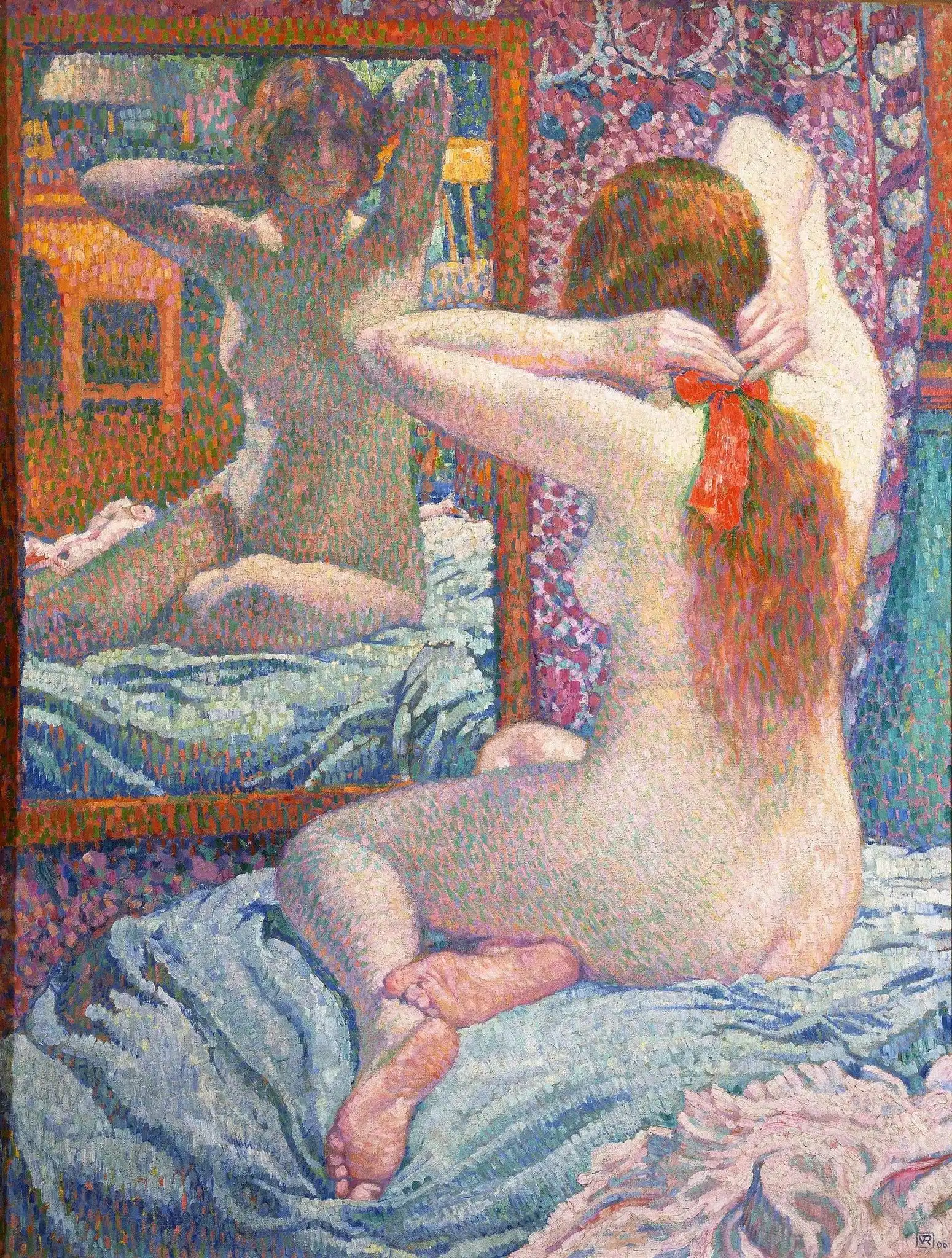
The Scarlet Ribbon (Le Ruban écarlate),1906
Oil on canvas
115.9 × 88.9 cm (45 5/8 × 35 in.)
Auctioned at Sotheby’s, London, 2016 for USD 1,024,000
Born in Ghent, Théo van Rysselberghe (1862–1926) trained at the Académie Royale des Beaux-Arts in Brussels and later spent formative periods in Paris, where he encountered the leading figures of the French avant‑garde. As a founding member of Les Vingt (Les XX), he helped reshape the Belgian art world by bringing international modernism to Brussels. His efforts were crucial in introducing the work of Georges Seurat and Paul Signac to Belgian audiences, establishing Neo‑Impressionism as a vital force beyond France.
Van Rysselberghe’s own embrace of divisionism began in the late 1880s, after seeing Seurat’s Un dimanche après‑midi à l’Île de la Grande Jatte (1886). The painting’s chromatic discipline and optical clarity left a deep impression. He adopted the method with conviction, applying small, distinct touches of unmixed colour to create luminous surfaces. His divisionist works from the 1890s remain among the most refined examples of the technique produced outside France.
Around 1900, his style began to shift. While he continued to rely on colour contrasts and optical principles, the strict dot structure softened into more fluid strokes, and his palette warmed. This evolution coincided with a growing interest in intimate subjects—portraits, domestic interiors, and, increasingly, the female nude.
Although van Rysselberghe had painted only a few nudes before 1905, the genre became central to his practice in the years that followed. His nudes from 1905–1910 form a coherent and well‑documented group, characterised by quiet gestures, gentle light, and a calm, unforced naturalism.
The Scarlet Ribbon / Le Ruban écarlate (1906) belongs to this mature phase. A nude woman sits on a bed, seen from behind, raising her arms to tie a red ribbon in her hair. Her reflection in the mirror reveals the front of her body, framed by patterned wallpaper, a lamp, and the furnishings of a softly lit interior. Van Rysselberghe’s pointillist heritage remains visible in the vibrant, stippled brushwork, yet the handling is relaxed and warm. The scarlet ribbon—both title and chromatic anchor—introduces a vivid accent that draws the eye without disturbing the painting’s quiet atmosphere.
The work exemplifies van Rysselberghe’s late Neo‑Impressionist sensibility: technically assured, intimate in mood, and suffused with light. It reflects his transition from strict divisionism toward a more naturalistic, luminous approach, while retaining the chromatic intelligence that shaped his earlier career.
By 1906, van Rysselberghe was widely recognised as a leading figure of Belgian modernism, and works from this period are represented in major museum collections, including the Musée d’Orsay and the Royal Museums of Fine Arts of Belgium. The Scarlet Ribbon stands as one of the most harmonious and quietly resonant examples of his nude interiors.
Leave a Reply