The Scottish Colourists: John Duncan Fergusson
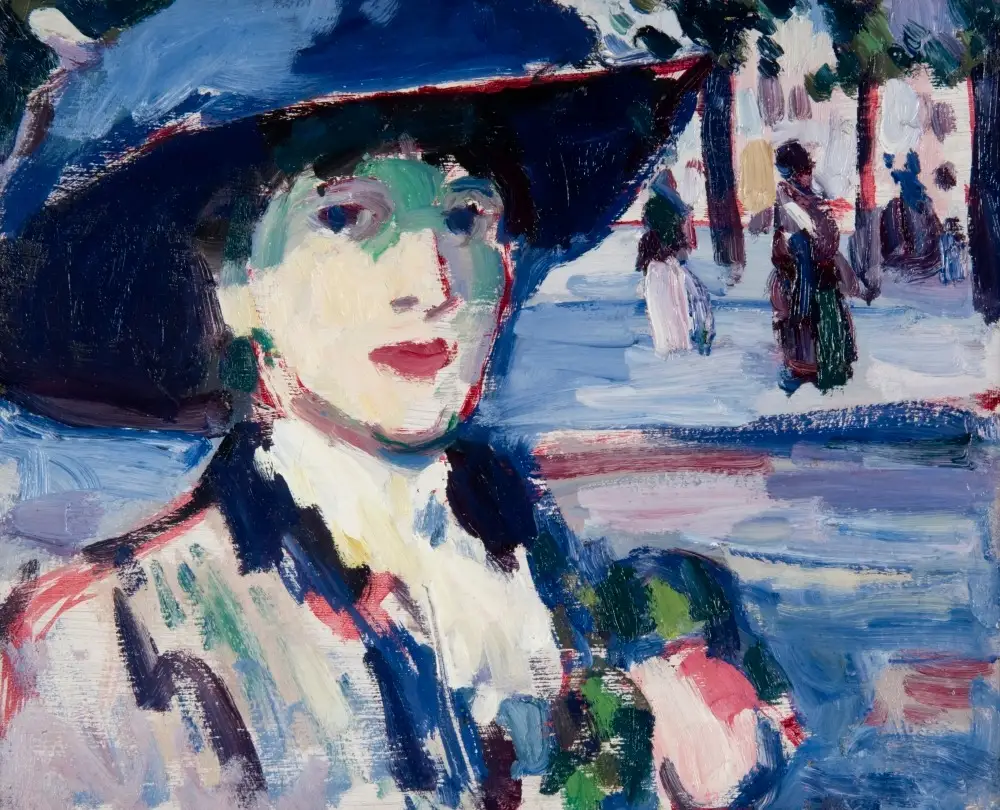
Anne Estelle Rice in Paris (Closerie des Lilas), c. 1907
Oil on board
27.2 × 33.8 cm
© The Hunterian, University of Glasgow
The sitter is Anne Estelle Rice (1877–1959), an American-born painter of Irish descent. Raised in Pennsylvania, Rice trained in Philadelphia before moving to Europe, where she became part of the vibrant Parisian avant-garde. She met Fergusson at Paris-Plage in 1907, and the two quickly formed a close personal and artistic bond. Their relationship lasted for six years, during which Rice became both Fergusson’s lover and one of his most significant muses. Fergusson encouraged her to pursue painting more seriously, and she in turn provided him with a source of inspiration that shaped his art during this formative period.
Rice herself was a notable figure in the transatlantic modernist circle. She contributed illustrations to Vanity Fair and The International Studio, and her bold use of color aligned her with the Fauvist spirit. Her presence in Fergusson’s life exemplifies the reciprocal nature of artistic influence: while she inspired him, he also helped her refine her own painterly voice.
John Duncan Fergusson (1874–1961) is celebrated as one of the four Scottish Colourists, alongside F.C.B. Cadell, G.L. Hunter, and S.J. Peploe. Unlike his peers, Fergusson’s career was distinctly international. Between 1907 and 1913 he lived in Paris, immersing himself in the city’s radical artistic milieu. It was here that he established his reputation, absorbing the innovations of Fauvism and the broader modernist movement.
The setting of this portrait, the Closerie des Lilas café in Montparnasse, was one of the legendary gathering places of the Parisian avant-garde. Frequented by artists and writers such as Picasso, Apollinaire, and later Hemingway, the café embodied the intellectual ferment of the city. By situating Rice in this environment, Fergusson not only captured her likeness but also placed her within the vibrant cultural networks that defined modernism in Paris.
Fauvism, pioneered by Henri Matisse and André Derain, emphasized the expressive potential of pure color and liberated brushwork over naturalistic representation. Fergusson’s works from this period—such as Anne Estelle Rice in Paris (Closerie des Lilas)—demonstrate a restrained yet vibrant response to these ideas. His palette, while bold, often retained a lyrical harmony, situating him at the intersection of Scottish tradition and continental experimentation.
This painting not only documents Fergusson’s artistic development but also captures the intimate exchange between two artists navigating the modernist currents of early twentieth-century Paris, framed by the café culture that nourished their creativity.
Leave a Reply