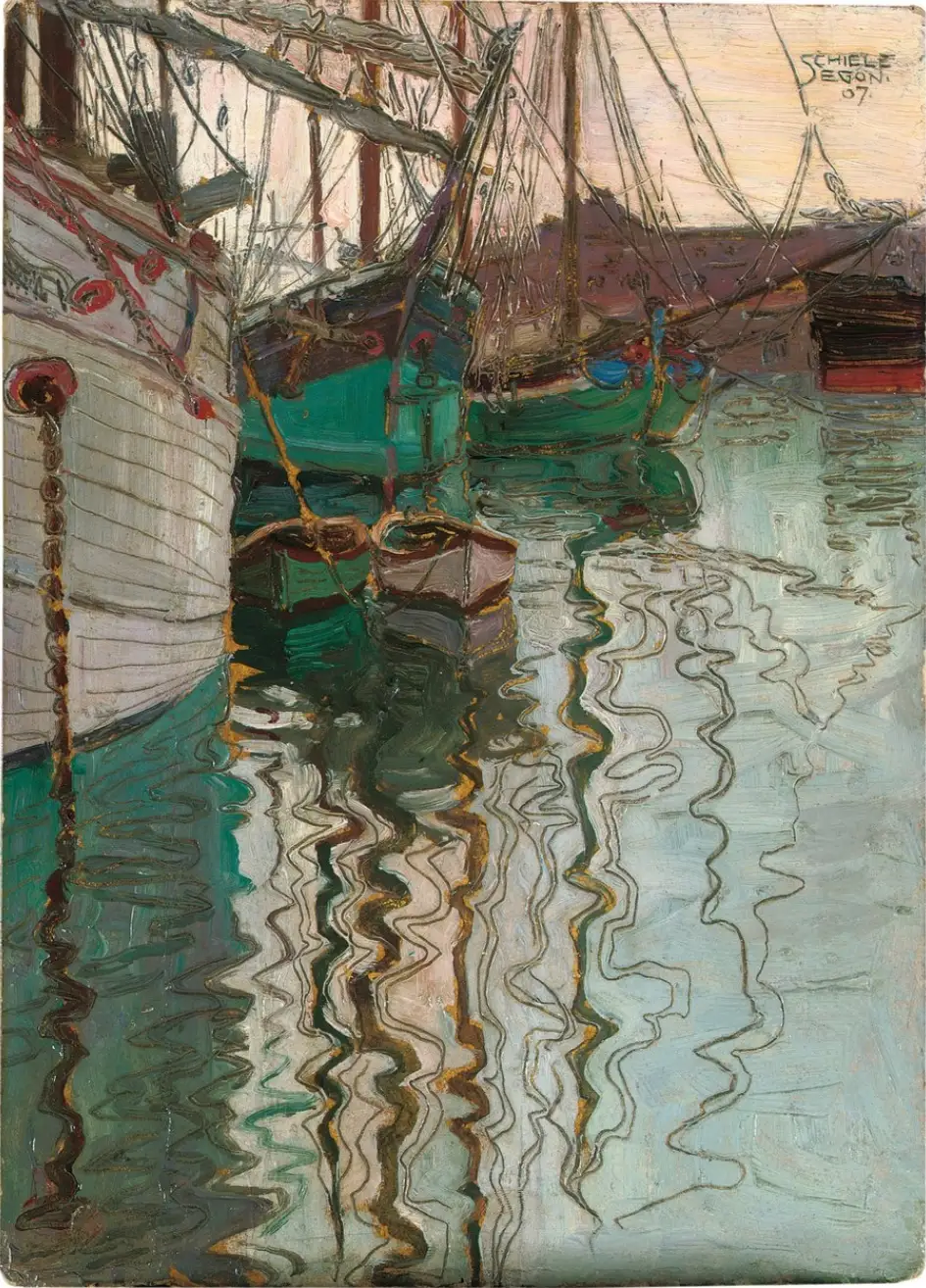
Egon Schiele:
Harbor of Trieste (Hafen von Triest), 1907
Oil and pencil on cardboard
25 × 18 cm (9 7/8 × 7 1/8 in.)
Auctioned at Christie’s, London, July 2006, for GBP 1,038,400
Later Private Collection
(Kallir P84)
In 1907, the young Egon Schiele painted Harbor of Trieste (Hafen von Triest), a small but vivid work in oil and pencil on cardboard. The combination of oil with pencil is unusual, reflecting his experimental phase at the Academy, when he was still testing materials and techniques before settling into the sharper watercolor and gouache style of his mature years. The modest scale and mixed medium give the sheet a freshness that feels almost like a diary entry — a glimpse of the Adriatic port through the eyes of a student on the cusp of independence.
Trieste held a special meaning for Schiele. It was the city where his parents had spent their honeymoon, and he often visited with his beloved sister Gerti. He later recalled these trips as some of the happiest days of his life. In 1912, when imprisoned in Neulengbach, he comforted himself by sketching boats from memory. In his prison journal he wrote:
“I dreamt of Trieste, of the sea, of open space. Longing, oh longing! For comfort I painted myself a ship, colourful and big-bellied, like those that rock back and forth on the Adriatic. In it longing and fantasy can sail over the sea, far out to distant islands where jewel-like birds glide and sing among incredible trees. Oh sea?”
This painting also belongs to Schiele’s early stylistic context. In 1907 he was still enrolled at the Academy of Fine Arts in Vienna, absorbing traditional training but already breaking away from its conventions. That same year he introduced himself to Gustav Klimt, most likely at the Museum Café near the Secession building. Soon after, he nervously showed Klimt his drawings and asked if he had any talent. Klimt’s reply became legendary: “Talent? Yes, too much talent.” This encouragement gave Schiele the confidence to pursue his own vision, even as he absorbed lessons from the older master.
The provenance of Harbor of Trieste adds another layer of meaning. It was once owned by Dr. Heinrich Rieger, a Viennese dentist and close friend of the artist. Both Egon and Edith Schiele were his patients, and Rieger became one of the most important early collectors of Schiele’s work, alongside figures such as Carl Reininghaus and Arthur Roessler. His fate, like that of many Austrian collectors, was tragic: his collection was confiscated by the Nazis in 1938, and he died in Theresienstadt concentration camp in 1942. The painting was restituted to Rieger’s heirs in April 2006 and sold at Christie’s in London a few months later for GBP 1,038,400.
Today, Harbor of Trieste (Hafen von Triest) stands not only as a youthful landscape but also as a vessel of memory — of Schiele’s happiest days by the sea, of his formative encounter with Klimt, and of the tragic history of its collector. Online reproductions often crop the lower edge or heighten the colors, but the original retains its modest scale and quiet charm, a reminder of Schiele’s beginnings before the intensity of his mature style.

Leave a Reply