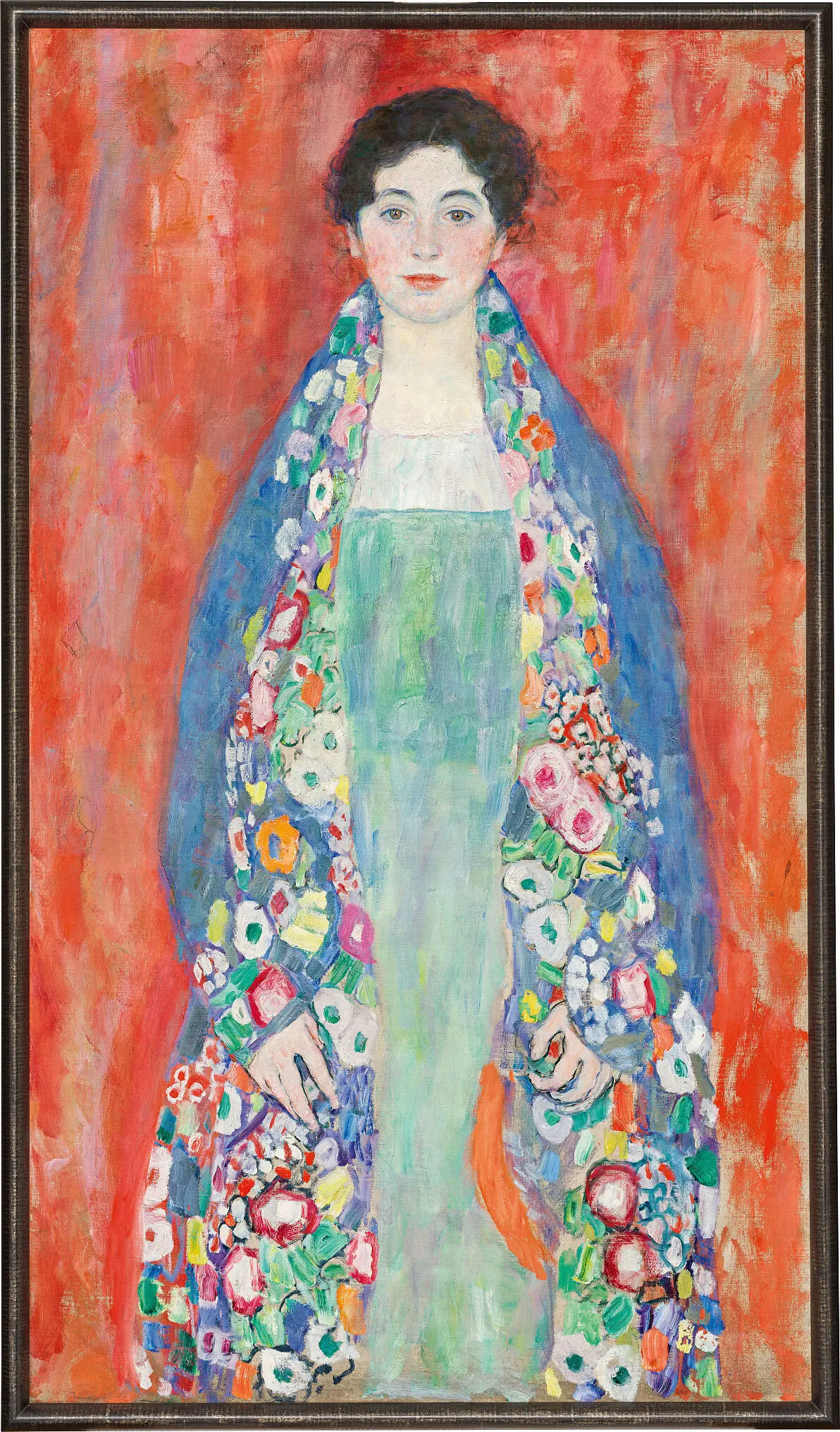
Gustav Klimt:
Portrait of Miss Lieser (Bildnis Fräulein Constance Lieser)(unfinished), 1917
Oil on canvas, unfinished
140 × 80 cm
Auctioned at im Kinsky, Vienna, 2024
(Natter no. 235)
Context and Attribution
Around 1917, Gustav Klimt began work on a portrait long believed to depict Margarethe Constance Lieser (1899–1965). At the time, Margarethe was 18 years old. She later married Baron Henrik Gutmann von Gelse und Beliscse, survived the Second World War, and died in London in 1965—contrary to Tobias Natter’s catalogue entry.
Like several of Klimt’s late works, the portrait remained unfinished at the time of his death in 1918. The canvas shows incomplete passages and visible underdrawing, characteristic of Klimt’s final period. It passed into the sitter’s family but subsequently disappeared from public view. For decades, its whereabouts were unknown: it was neither documented as destroyed nor securely traced in collections.
The painting resurfaced in 2023, creating international attention. Its rediscovery was widely publicized, given the rarity of a lost Klimt portrait returning to the market. The following year, it was auctioned at im Kinsky in Vienna.
Reconsidering the Sitter
Recent provenance research has challenged the identification of the sitter as Margarethe Constance Lieser. Evidence now suggests the model may have been one of the daughters of Henriette Amalie “Lilly” Lieser-Landau (1875–1942), a prominent patron of the Viennese avant-garde. Lilly Lieser, divorced from Justus Lieser in 1905, was a close friend of Alma Mahler and a supporter of composers such as Arnold Schönberg and Alban Berg.
Her daughters, Helene Lieser (1898–1962) and Annie Lieser (1901–1970), were both possible candidates. Most research points to Helene, whose features bear striking resemblance to the unfinished portrait. Helene’s life was remarkable: she trained as an economist, escaped to Geneva during the war, and worked for both Soviet and British intelligence. After 1945 she held positions in Paris with international organizations including UNESCO and the OEEC, before returning to Vienna, where she died in 1962.
This reassessment of the sitter’s identity is crucial, as it determines which branch of the Lieser family might claim historic ownership of the painting.
Provenance and Mystery
After Klimt’s death in 1918, the portrait remained with the Lieser family. Its trajectory between 1925 and 1961 remains unresolved. According to im Kinsky, the work was acquired in the 1960s by a legal predecessor of the consignor and subsequently passed through three successive inheritances to the present owner.
Yet significant gaps remain. The painting’s fate during the Nazi era is particularly opaque. Several members of the Lieser family perished in concentration camps, and questions persist about whether the portrait was confiscated, hidden, or transferred under duress. Im Kinsky has not disclosed further details, leaving scholars and the public to speculate about its whereabouts during those decades.
The rediscovery of the Portrait of Miss Lieser (unfinished) thus represents not only a major addition to Klimt’s oeuvre but also a poignant reminder of the unresolved complexities of provenance in early 20th‑century Vienna.
Leave a Reply