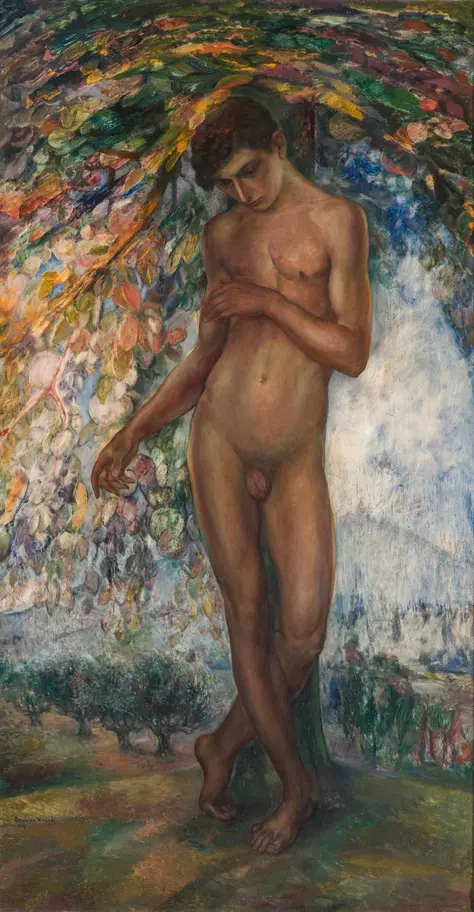
The Hungarian Connection / The Eight: Károly Kernstok
Adam (1927)
Oil on wood
200 × 106.5 cm
© Hungarian National Gallery, Budapest
Károly Kernstok (1873–1940) was one of the defining figures of Hungarian modernism. As a leader of The Eight (A Nyolcak), he helped bring the radical currents of European art into Hungary at the dawn of the 20th century. Their exhibitions between 1909 and 1912 marked a decisive break from academic tradition, introducing Expressionism, Fauvism, and Cubism to a local audience eager for change.
Kernstok’s paintings are distinguished by bold colors, monumental figuration, and a dynamic sense of rhythm. His subjects ranged from landscapes and portraits to equestrian scenes and mythic nudes, always infused with a search for universal resonance. French influences—Paul Cézanne’s structural rigor and Henri Matisse’s chromatic daring—were central to his vision, yet Kernstok fused them with his own intellectual and political commitments.
Born in Budapest, he studied in Munich and Paris before returning to Hungary, where he became a leader of the Neos, artists who rejected the naturalism of the Nagybánya colony in favor of modernist experimentation and socialist ideals. His second stay in Paris (1906) proved decisive: Kernstok’s studio became a meeting place for younger artists, catalyzing the formation of The Eight. Their collaborations extended beyond painting, embracing writers like Endre Ady and composers such as Béla Bartók, situating their work within a broader avant-garde culture.
After the fall of the Hungarian Soviet Republic in 1919, Kernstok went into exile in Berlin, where he lived until 1926. This period exposed him to German Expressionism and the international avant-garde. Upon returning to Budapest, he continued to experiment, producing works that reflect both continuity and transformation in his style.
It was in this context that he painted Adam (1927). Monumental in scale, the work presents a solitary male nude rendered with sculptural solidity and expressive brushwork. The figure’s upright stance carries a quiet strength, evoking both classical prototypes and modernist vitality. The painting resonates with Kernstok’s long-standing interest in the human body as a bearer of meaning, while also reflecting the interwar search for renewal in Hungarian culture.
Rather than a grand statement, Adam feels like a turning point: a work that gathers Kernstok’s experiences in Paris and Berlin and brings them home, balancing tradition with experiment. It shows him still searching, still shaping Hungarian modernism in dialogue with the wider European avant-garde.

Leave a Reply