Młoda Polska: Stanisław Wyspiański
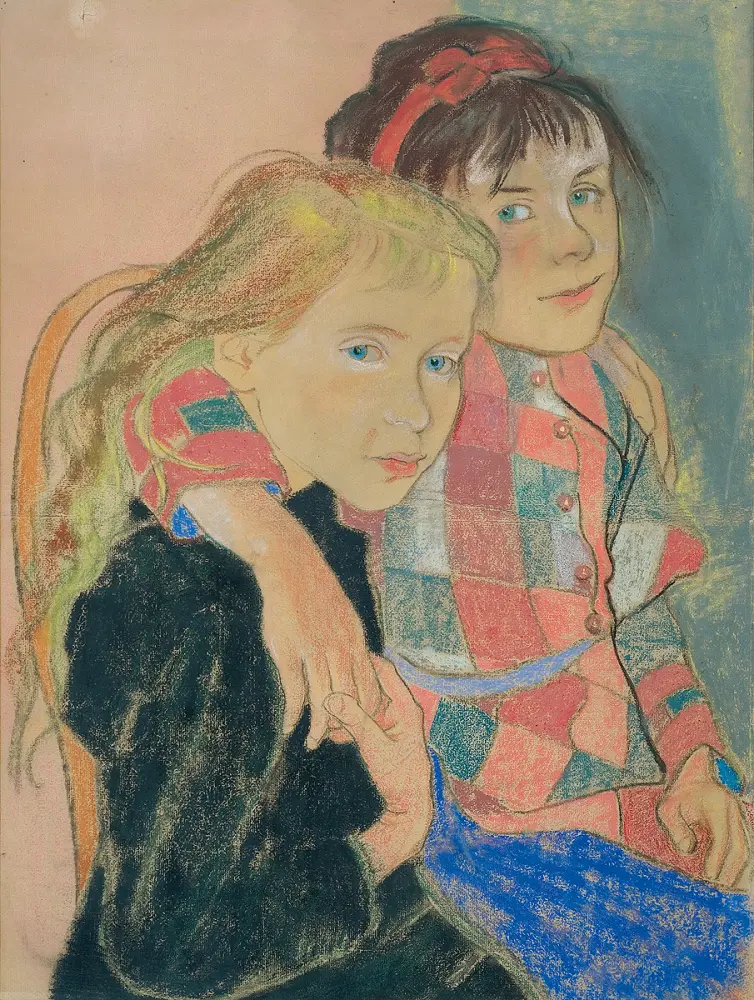
Two Girls (Dwie dziewczynki), 1893/1894
Pastel on paper
62 × 47 cm
Private collection
(Auctioned at Agra‑Art Auction House, Warsaw, 2014 for ca. 192,000 EUR)
Stanisław Wyspiański’s pastel Two Girls (Dwie dziewczynki), created around 1893–1894, belongs to his early experiments with pastel, a medium he adopted around that time both out of necessity, due to an allergy to oil paints, and by choice. In June 1893 he wrote from Paris: “I paint portraits in pastel for all my acquaintances free of charge […] they turn out quite well — and I have a great opportunity to learn.” By July he was already charging 20 francs per portrait, noting that demand was so high his works were scattered across many homes. In his Paris studio he even organized an exhibition of these pastels, presenting them as a coherent body of work.
Only a small number of these early sheets survive. They are always psychological portraits, painted flatly on uniform backgrounds, with contours defining shape and presence. Two Girls stands at the threshold between Wyspiański’s student years and his artistic maturity, and is considered one of his finest works from this transitional phase.
The motif of “double portraits” recurs in Wyspiański’s art of the time. By contrast, in Two Girls the children lean close together, their softly intertwined hands suggesting intimacy and warmth. This closeness anticipates the tenderness of later compositions.
Exhibition labels on the reverse confirm its public display: in 1914 at the Warsaw Society for the Encouragement of Fine Arts, and in 1921 at the Grand Palais in Paris during the Exhibition of Polish Art, where it was mistakenly catalogued as Fillette. Reviews also suggest it was shown in Kraków in 1947.
Wyspiański (1869–1907) was a central figure of Młoda Polska, or Young Poland, a movement that sought to break away from late‑nineteenth‑century stagnation and aligned with the broader Secession currents in Munich, Vienna, and Berlin. His pastel portraits, with their psychological intensity and modern flatness, stand as Polish counterparts to the innovations of Klimt and Schiele.
Although less known than his later masterpieces, Two Girls embodies the seeds of Wyspiański’s mature style. It shows how pastel became not just a substitute for oil but a deliberate artistic choice, allowing him to explore the human psyche with immediacy and tenderness. The portrait carries emotional truth, poised between innocence and introspection, between the golden dreams of youth and the raw truths of modernity — a dialogue at the heart of Młoda Polska and of this blog.

Leave a Reply