The Scottish Connection: Hannah Frank
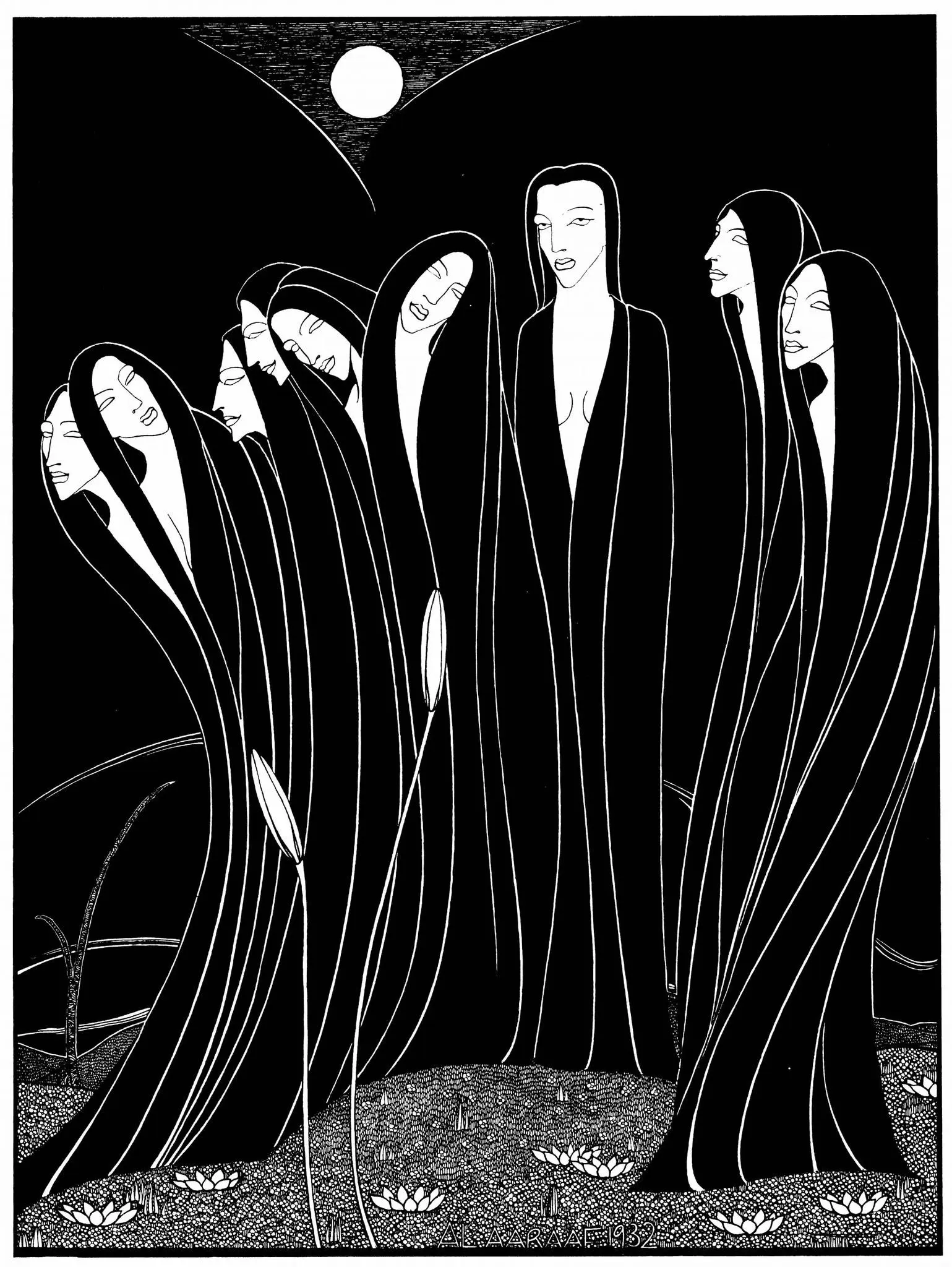
Night Forms (1932)
Lithographic print
33 × 25 cm
© Glasgow Women’s Library
Hannah Frank (1908–2008) once said with honesty: “I was much better at drawing women than men … Women I quite liked, I was a woman, and it wasn’t a mystery to me.” That sense of closeness shaped her art throughout her life.
Frank was born in Glasgow to Jewish immigrant parents. She began making her black‑and‑white drawings as a teenager in 1925. While studying Latin and moral philosophy at the University of Glasgow, she also attended evening classes at the Glasgow School of Art. Getting in was not simple: as a Jewish woman she faced prejudice, and her mother had to ask a local civic officer, Baillie Drummond, for a recommendation.
From 1927 to 1932 she contributed drawings to almost every issue of the Glasgow University Magazine under the pen name Al Aaraaf, taken from a poem by Edgar Allan Poe. The magazine gave her a steady audience and helped her develop her style. Her early work grew into the flowing lines and strong contrasts that became her hallmark. Critics have compared her to Aubrey Beardsley and Jessie M. King, and she is often linked to Art Nouveau and Symbolist traditions, though her work kept its own character.
Her drawings were shown regularly at the Royal Glasgow Institute of the Fine Arts from 1930 to 1950. In the early 1950s she turned to bronze sculpture, studying with Benno Schotz. At first she hoped sculpture would improve her understanding of anatomy, but it soon became her main focus. She never returned to drawing, finding in bronze a new way to explore form and presence.
Frank married Lionel Levy in 1952 and remained active in Glasgow’s Jewish community. Later in life arthritis limited her ability to sculpt, but she stayed involved with her art and its preservation. Her centenary in 2008 was marked by exhibitions that celebrated her contribution to Scottish modernism and brought her work to new audiences.
Women remained at the heart of her art. Whether in her lithographs or her bronzes, she portrayed them as thoughtful, joyful, and resilient. Night Forms shows her early style at its best: elongated figures, flowing hair, and a dreamlike setting where shadow and light meet. It is a quiet but powerful example of her lifelong fascination with the female form.


Leave a Reply