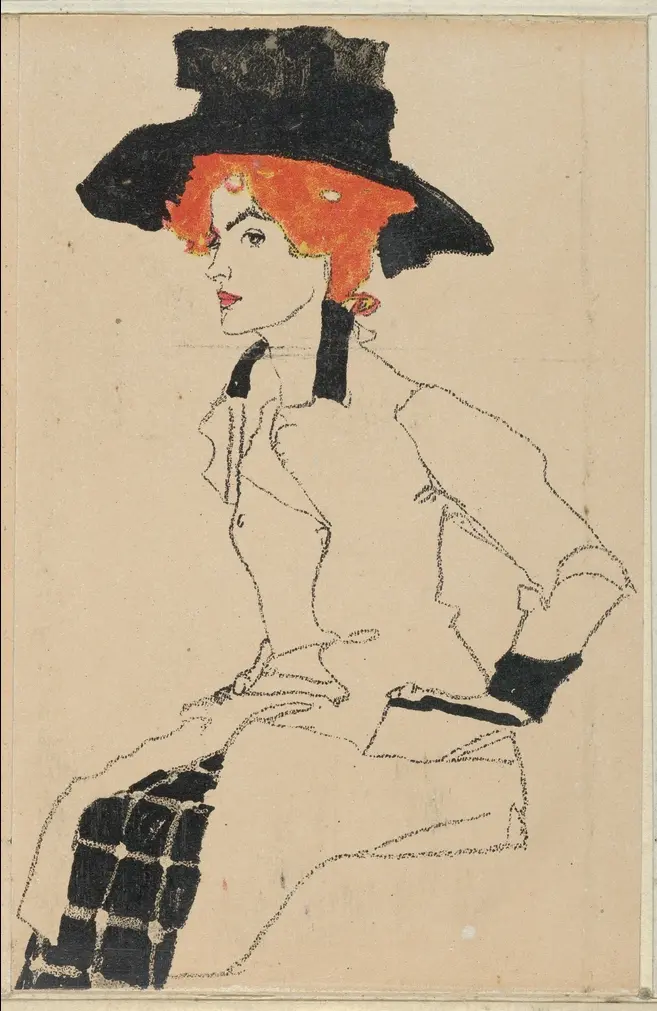
Egon Schiele:
Portrait of a Woman (1910)
also known as Portrait of a Woman with Big Hat (Gertrude Schiele)
Color lithograph
14 × 8.9 cm (5 ½ × 3 ½ in.)
© The Metropolitan Museum of Art, New York
(Kallir d488)
In 1910, Egon Schiele submitted three watercolor designs to the Wiener Werkstätte, the Viennese collective founded by Josef Hoffmann and Koloman Moser and celebrated for its refined approach to applied arts. His aim was to have them reproduced as postcards, part of the Werkstätte’s vision of bringing art into everyday life. Yet all three designs were rejected, a decision that reflected the gulf between Schiele’s raw, expressionist style and the polished decorative language the Werkstätte preferred.
The original watercolors are no longer known, and their dimensions were never recorded. What survives are the postcard versions — small lithographs in the format for which they were intended. Because they were printed as cards, more than one impression of each design exists today. Portrait of a Woman, showing Schiele’s younger sister Gertrude in a strikingly oversized hat, is among them. The Metropolitan Museum of Art in New York holds one of these cards, while other examples are preserved in different collections.
Though modest in scale, the image carries Schiele’s intensity. The bold outlines and simplified forms give it graphic clarity, while the choice of subject — a close family member — adds intimacy. The rejection by the Werkstätte did not discourage him; instead, it marked a turning point. By 1910 Schiele was already moving away from Klimt’s influence and decorative traditions, toward a more radical expression of the human figure.
Seen today, Portrait of a Woman feels less like a failed commission and more like a glimpse of an artist in transition. The oversized hat and simplified features anchor the work in its era, but the restless energy of Schiele’s line points forward to the uncompromising portraits and figure studies that would define his brief, intense career. Several impressions of these postcard designs survive.


Leave a Reply to Harold van de LaarCancel reply