Munich Secession:
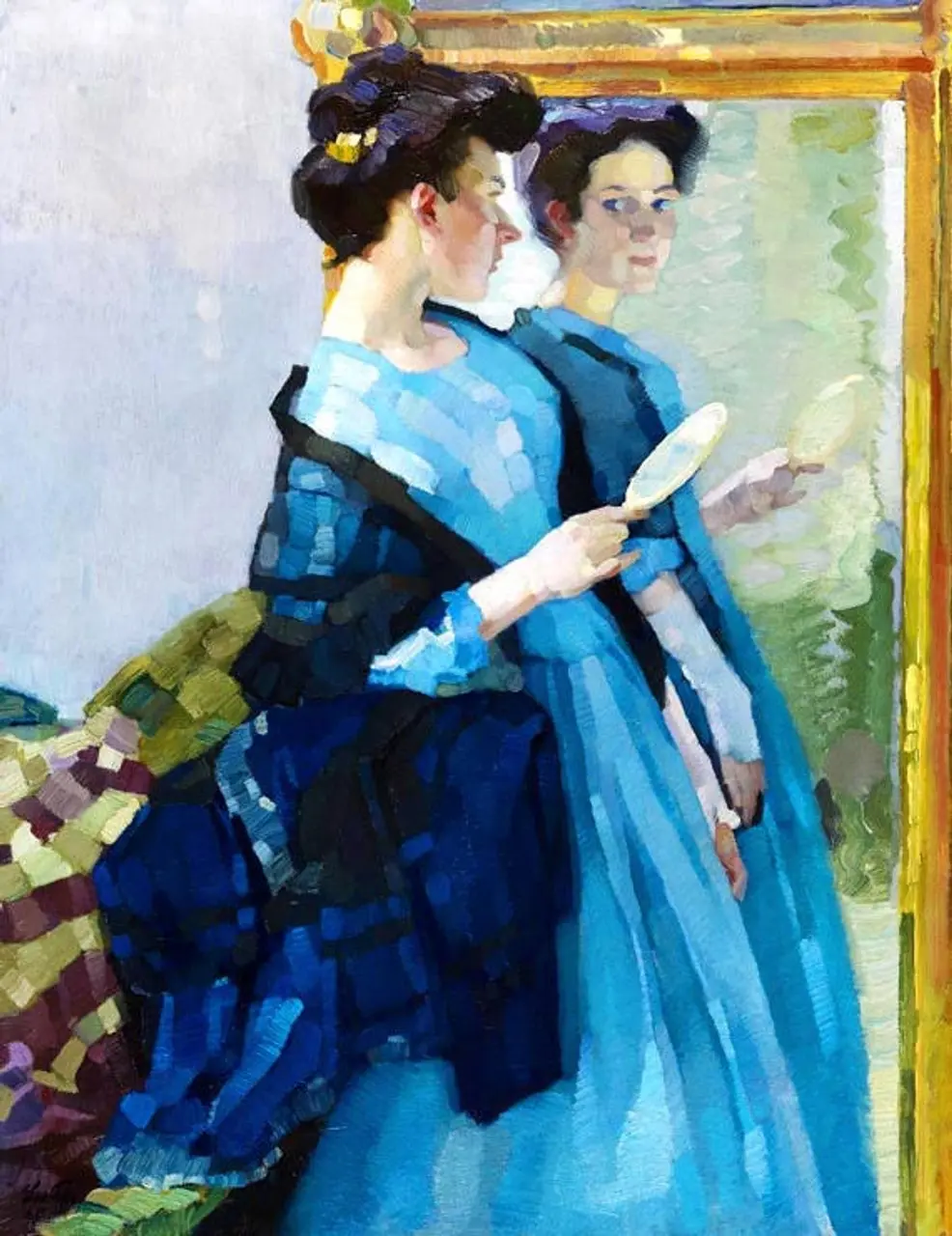
Mirror Image (Spiegelbild, 1908) – Leo Putz
Oil on canvas
124 × 95.3 cm
Auctioned at Ketterer Kunst, Munich, June 4, 2011
This luminous interior by Leo Putz shows a woman quietly absorbed in her own reflection—a familiar theme in his early work, but here treated with particular tenderness. Painted around 1908/09, Mirror Image is one of two known versions of the “lady in blue” motif. Two others are mentioned, though their whereabouts are unknown.
The sitter—possibly Gusti, one of Putz’s favored models—is shown in profile before a mirror, her form echoed in the glass. The brushwork is broad but gentle, and the palette—soft blues, warm creams, and muted golds—gives the scene a quiet glow. The mirror doesn’t just double the figure; it creates a moment of pause, where the reflected gaze seems almost more alive than the original. Putz leans into this ambiguity with grace, letting the viewer linger between presence and illusion.
The painting was likely made in his lakeside studio near Chiemsee, where natural light and calm interiors shaped many of his early portraits. It was featured in Jugend magazine in 1911 and later included in Jugend Leo Putz Mappe I, affirming its place in his celebrated pre-war output. Its reappearance at auction in 2011, where it exceeded expectations, reflects the quiet strength of these early interiors—works that balance decorative poise with emotional subtlety.
Though not formally part of the Vienna Secession, Putz’s early work shares its decorative clarity and introspective tone—especially in his treatment of mirrored figures and ornamental surfaces. His connection to the Munich Secession was more direct: he exhibited regularly and helped found the Scholle group in 1899, which sought to move beyond academic historicism toward a more spirited, modern style. The human figure, especially the female form, remained central to his work throughout.
Putz’s path to this moment was shaped by early defiance and steady conviction. At sixteen, he left home against his father’s wishes to study in Munich under his stepbrother Robert Poetzelberger. He trained at the Munich Academy and later in Paris at the Académie Julian, where he studied under Bouguereau and Constant. Back in Munich, he joined Paul Höcker’s atelier and became a founding member of the Scholle group. Mirror Image stands as a quiet testament to that early phase: a moment of stillness and clarity, painted with affection and technical ease, before the tropical colors and broader travels of his later years.


Leave a Reply