Egon Schiele:
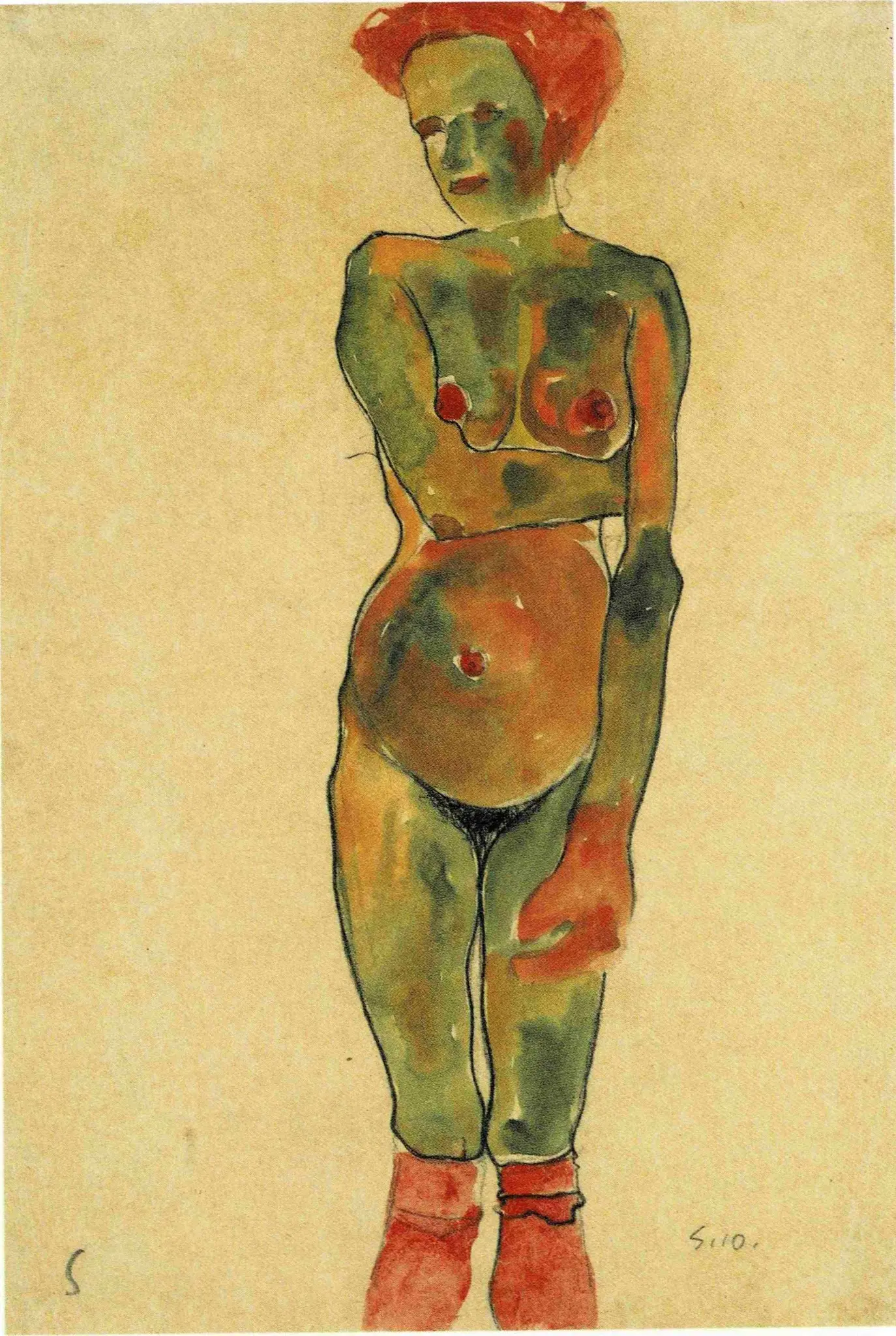
Standing Female Nude with Red Stockings (Stehender weiblicher Akt mit roten Strümpfen), 1910
Watercolor and black crayon on paper
44.8 × 29.7 cm
Private collection
(Kallir D531)
This raw and arresting drawing from 1910 shows a nude woman standing upright, her body slightly tilted, one arm bent and the other hanging loose. Her red hair flares outward, echoing the emotional tension in her pose. She wears red stockings — a vivid accent that anchors the composition and draws the eye downward. Red also appears in the nipples and genital area, intensifying the sense of exposure and discomfort. The body is painted in mottled tones of green, ochre, and crimson, giving it a bruised, almost feverish quality.
The face is rendered with minimal detail, almost mask-like, which shifts the focus to the body’s posture and coloring. The plain beige background isolates the figure completely, heightening the sense of vulnerability and psychological intensity. The drawing is signed “S.10” in the lower right corner, quietly marking the artist’s name and the year — a moment of authorship during a period of intense creative output.
1910 was a turning point for Schiele. He was just twenty, already pushing against academic norms and embracing a radical, expressionist approach to figuration. During this time, he produced many drawings of pregnant women, likely made possible through his connection with Dr. Erwin von Graff, a gynecologist who allowed Schiele access to his clinic. Schiele also painted a portrait of von Graff, possibly as a gesture of thanks — I’ll add that later in the comments.
For many viewers, this drawing provokes discomfort — and that’s part of the point. Schiele’s work doesn’t flatter or idealize. It confronts. The body here is not eroticized or beautified; it’s exposed, raw, and emotionally charged. That discomfort is intentional, a way of challenging the viewer’s expectations and forcing a more honest engagement with the human form.
There’s also an ethical layer to consider. Schiele’s access to medical patients — especially pregnant women — through von Graff’s clinic raises questions about consent and context. While there’s no direct evidence of exploitation in this case, it’s a reminder that even groundbreaking art can carry complicated histories. Acknowledging that complexity doesn’t diminish the work; it deepens our understanding of it.
This drawing is held in a private collection and rarely seen publicly. It’s not a study of beauty or anatomy — it’s a confrontation. A body exposed, not for pleasure, but for truth.

Leave a Reply