Catalan Modernisme: Hermenegildo Anglada-Camarasa
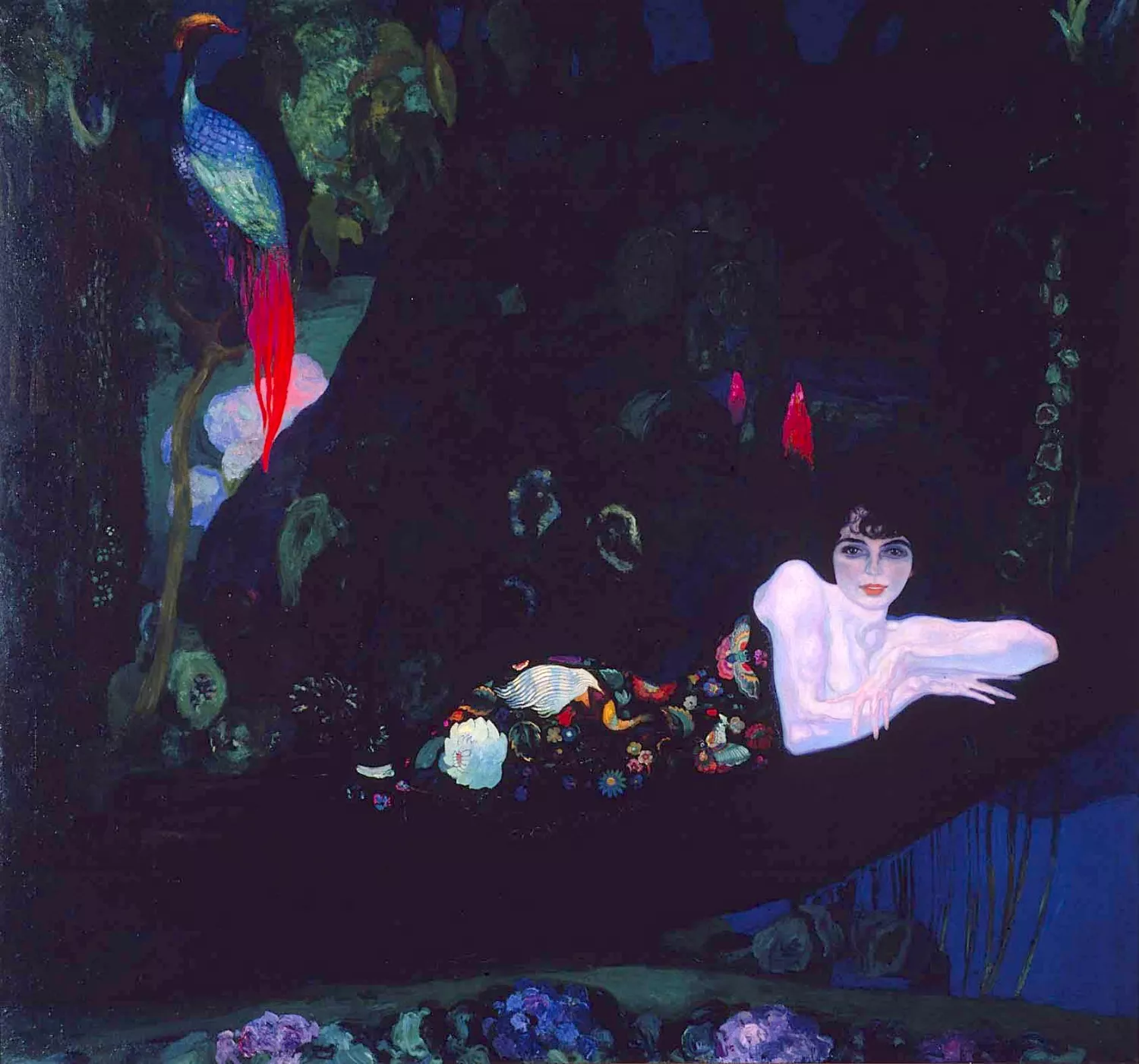
Portrait of Sonia de Klamery, 1913 (Retrato de Sonia de Klamery)
Oil on canvas
187 × 200 cm
©Museo Reina Sofía, Madrid, Spain
Countess Sonia de Klamery, a young Polish aristocrat, appears here in a luminous swirl of color and detail. Painted in 1913, this portrait reflects Hermenegildo Anglada-Camarasa’s mature style—one defined by theatrical composition, folkloric motifs, and a bold, expressive palette. Her reclining pose, pale skin, and direct gaze evoke something between dream and apparition, while the exotic peacock to her left adds a burst of saturated color and symbolic flair. The painting also hints at Anglada-Camarasa’s fascination with the Russian Ballet, which had electrified Paris just a few years earlier. The visual drama of Diaghilev’s productions—especially those featuring Nijinsky and Anna Pavlova—inspired the artist’s exploration of movement, mysticism, and exoticism.
Anglada-Camarasa (1871–1959) was a key figure in Catalan modernism, a movement that echoed the decorative richness of Art Nouveau and the introspective symbolism of the fin de siècle. He began his studies in Barcelona under Modest Urgell, whose naturalist landscapes shaped his early approach. Encouraged by his father, also a painter, Anglada-Camarasa entered the city’s artistic circles while still young, eventually moving to Paris in 1894 to study at the Académie Julian.
In Paris, he absorbed the energy of the Belle Époque and drew inspiration from artists like Degas and Toulouse-Lautrec, especially their depictions of nightlife and interior scenes. His use of color grew increasingly daring, anticipating the vibrancy of Fauvism. He also incorporated influences from Oriental and Arab aesthetics, which added a sensual, exotic dimension to his work.
His connection to the Vienna Secession was particularly meaningful. Anglada-Camarasa’s decorative style and symbolic content resonated with artists like Gustav Klimt, and his participation in the 1904 Secession exhibition helped establish him as a bridge between Spanish modernism and the wider European avant-garde.
Between 1904 and 1914, he developed a distinctive visual language—one that fused Catalan folklore, aristocratic portraiture, and ornamental abstraction. Women became central to his compositions, often portrayed with emotional intensity and surrounded by rich textures and patterns, as seen in Portrait of Sonia de Klamery.
Later in life, Anglada-Camarasa settled in Majorca, where he continued to paint and mentor younger artists. Though his work was widely exhibited across Europe, and later in Argentina and the United States, it took time for Spanish art historiography to fully embrace his legacy. Today, his paintings are recognized as vivid reflections of a society in transition—capturing the fleeting beauty, mysticism, and cultural richness of the early 20th century.


Leave a Reply