The Hungarian Connection / The Eight: Ödön Márffy
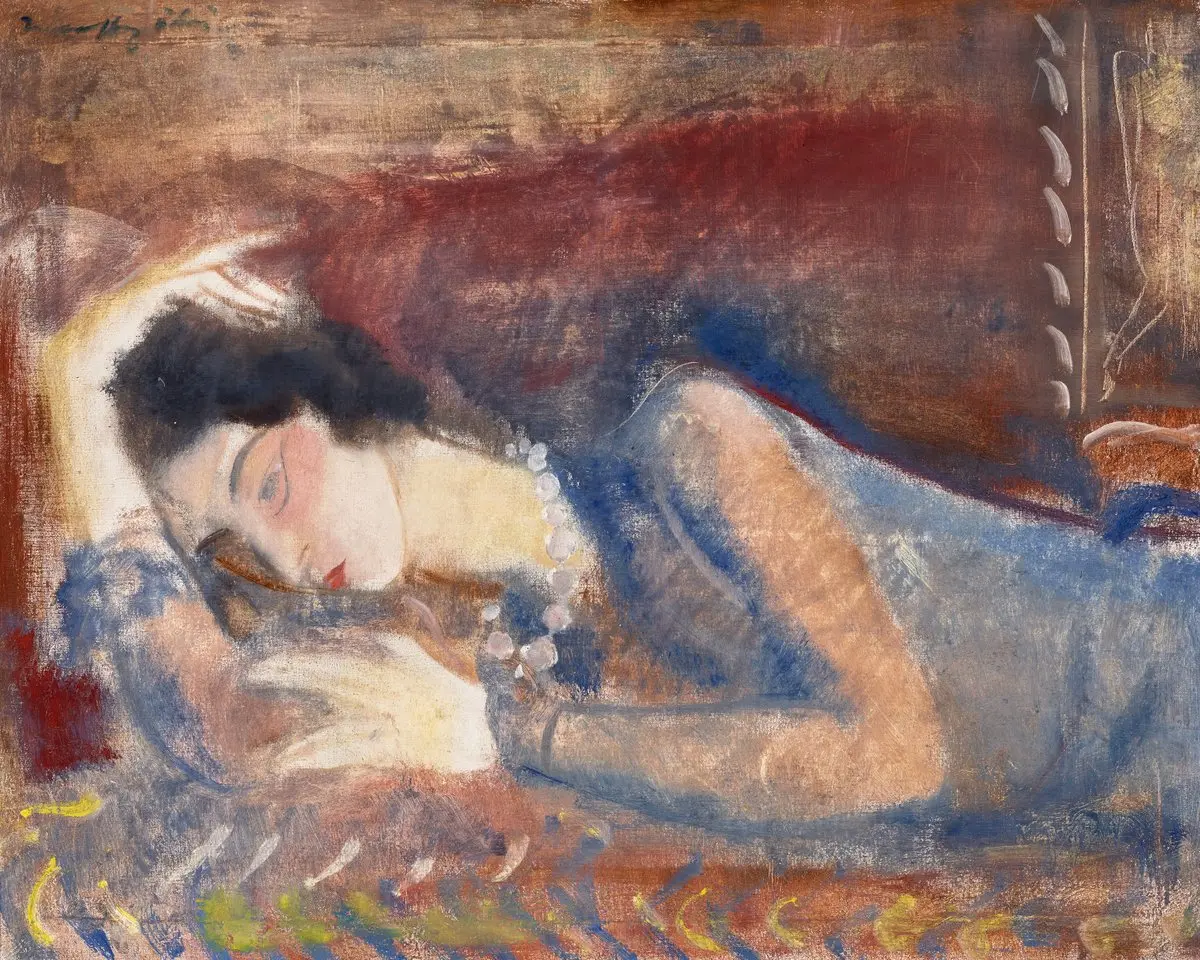
Reclining Zdenka (Fekvő Zdenka, 1926) – Ödön Márffy
Oil on canvas
65 × 81 cm
© Hungarian National Gallery, Budapest
Ödön Márffy (1878–1959) played a vital role in shaping early modern art in Hungary. As a founding member of The Eight (A Nyolcak), he helped bring the energy of European avant-garde movements—Fauvism, Cubism, Expressionism—into the Hungarian art scene, bridging Budapest with the pulse of Paris.
He spent several formative years in Paris between 1902 and 1907, absorbing the work of Cézanne, Matisse, Bonnard, and others. He claimed to have met Matisse in 1905 and even visited his studio—a moment that clearly left its mark. During this time, Márffy also connected with fellow Hungarian artists like Béla Czóbel, Róbert Berény, and Bertalan Pór, who would later join him in The Eight. In 1906, he exhibited with the Fauves at the Salon d’Automne before returning to Budapest.
By late 1909, Márffy was actively working with the group that would become The Eight, including Berény, Czigány, Czóbel, Kernstok, Orbán, Pór, and Tihanyi. Their first joint exhibition came in 1909, and by 1911 they formally adopted the name A Nyolcak, marking a turning point in Hungarian modernism.
His style evolved quickly. Early works were bold and expressive, full of color and movement. But by the mid-1910s, his compositions became more structured, and his brushwork more restrained. Encounters with artists like Oskar Kokoschka added psychological depth to his portraits and figures.
In the 1920s, Márffy’s work softened. The vibrant colors gave way to gentler tones, and his paintings took on a more decorative, lyrical quality. Reclining Zdenka (1926) is a beautiful example of this shift. The painting shows Zdenka Ticharich—Márffy’s wife and muse—resting on her side, dressed in a soft blue gown and a pearl necklace. Her dark hair falls in gentle waves, and her expression is quiet, introspective. The background is abstract, with warm reds and cool blues blending into a dreamy atmosphere.
The brushwork is fluid and light, with soft transitions and a muted palette that gives the painting a sense of calm. It’s not dramatic, but it’s deeply felt. Zdenka is present, but not posed—captured in a moment of ease. The use of oil allows for subtle layering and tonal harmony, and the overall mood is one of quiet intimacy.
Zdenka wasn’t just Márffy’s muse—she was also a pianist and composer of Croatian origin, and a figure in her own right within Hungary’s cultural circles. She was portrayed by József Rippl-Rónai in 1921 as well, a testament to her presence and influence among the artists of the time.
By the late 1920s, Márffy’s style had become more palatable to a wider audience. In postwar Hungary, his softer, more decorative approach resonated with viewers seeking beauty and calm after years of upheaval. His work from this period was widely exhibited and appreciated for its emotional clarity and refined elegance.

Leave a Reply