Die Brücke/Degenerate Art: Emil Nolde
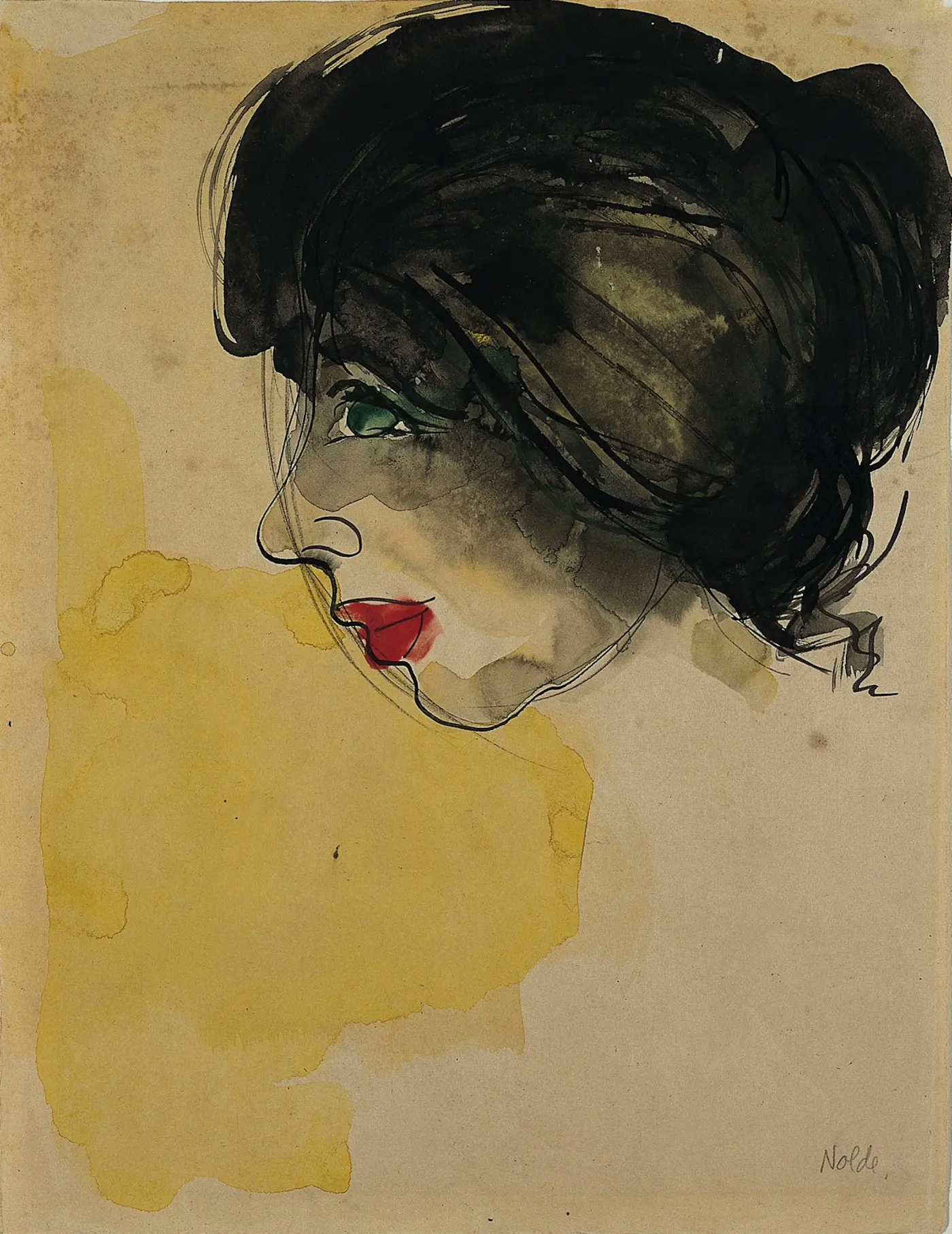
Head in Profile (Kopf im Profil) (1919)
Watercolor and India ink on tan wove paper
36.8 × 28.3 cm (14½ × 11⅛ inches)
© Norton Museum / The Blue Four Galka Scheyer Collection, West Palm Beach, Florida, USA
Emil Nolde (1867–1956) was a German-Danish painter celebrated for his vivid colors and emotional intensity. A leading figure of Expressionism, he was born in the village of Nolde, Germany, and initially trained as a woodcarver before turning to painting.
Nolde joined the Expressionist collective Die Brücke (‘The Bridge’) in 1906. Founded in Dresden in 1905 by Ernst Ludwig Kirchner, Fritz Bleyl, Erich Heckel, and Karl Schmidt-Rottluff, Die Brücke sought to connect traditional and modern art by rejecting academic conventions in favor of raw emotion and spontaneity. Nolde’s brief association with the group influenced his use of bold, non-naturalistic color and expressive form, aligning with their interest in primitivism, folk art, and spiritual themes.
Head in Profile reveals a quieter, more introspective side of Nolde’s portraiture. The stark contour and muted palette suggest a retreat from his earlier chromatic exuberance, reflecting the tension between inner solitude and external scrutiny that marked his later years.
In 1934, Nolde became a member of the National Socialist German Workers’ Party (NSDAP). Despite this affiliation, his work was condemned by the Nazi regime and prominently featured in the infamous 1937 Degenerate Art (Entartete Kunst) exhibition. Hitler included more works by Nolde than by any other artist: 27 paintings, watercolors, and etchings were displayed, and a staggering 1,052 of his works were confiscated from German museums. Following this denunciation, Nolde withdrew to his home in Seebüll, a remote area in Frisia, northern Germany. In 1941, the Reich Chamber of Culture officially banned him from painting. Nevertheless, Nolde continued to support National Socialist ideology until the end of World War II.
For decades after the war—and even after Nolde’s death in 1956—his political sympathies remained obscured. In West Germany, he was often celebrated as a misunderstood victim of Nazi censorship. Only in recent years has his alignment with Nazi ideology, including anti-Semitic views, come to light. This revelation complicates Nolde’s legacy. While he was undeniably persecuted by the regime that labeled his art “degenerate,” he was also an ideological sympathizer. His artistic achievements remain significant, but they are now viewed through a more critical lens that acknowledges both his creative brilliance and his troubling convictions.
Leave a Reply