Art from Japan: Kiyoshi Kobayakawa:
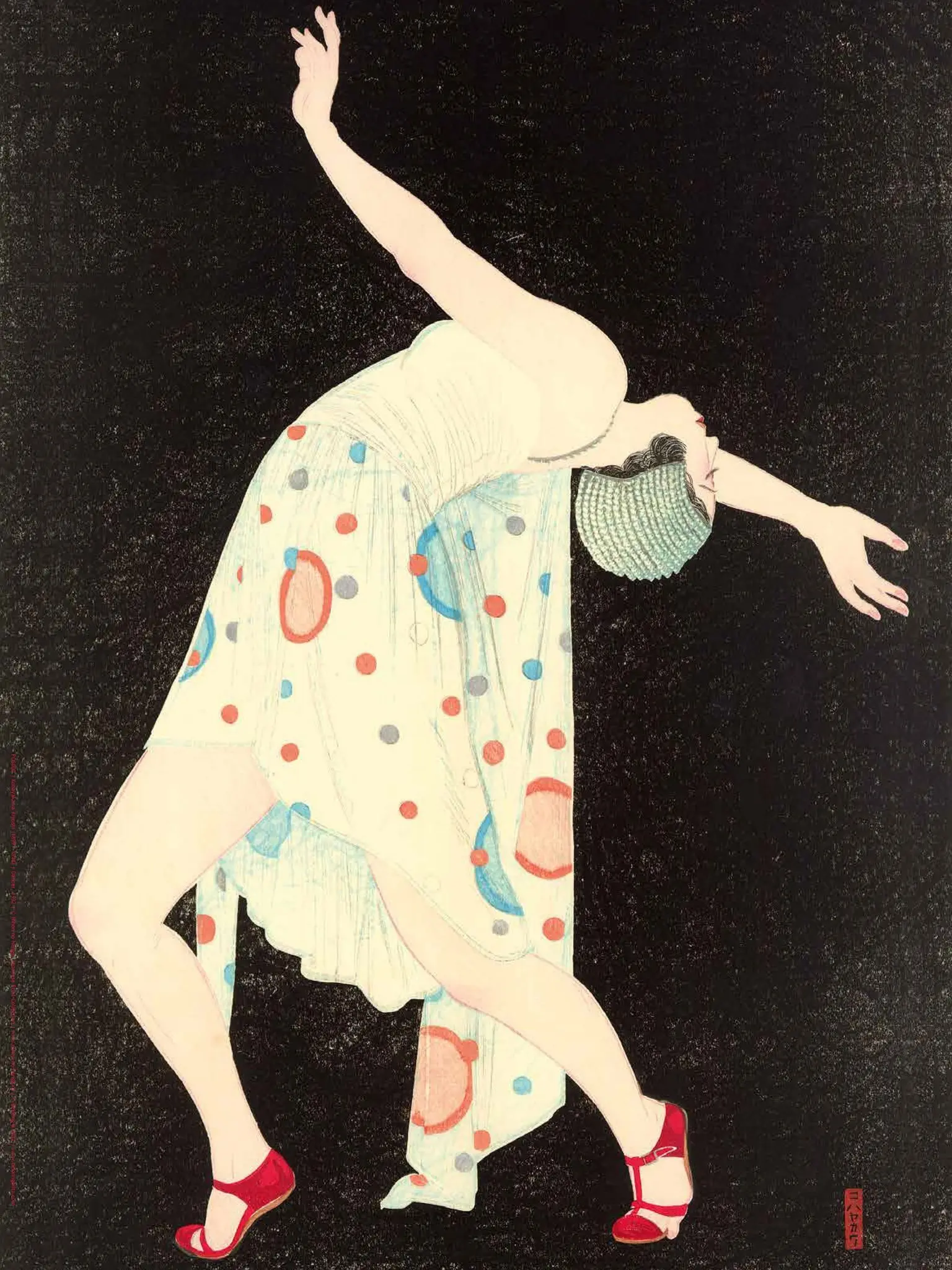
Dancer, or “Curved Line of the Instant” (Dansā, or Setsuna no kyokusen), 1932
Ink and color on paper (woodblock print, ōban tate-e)
Published by Hasegawa Shōten
40 × 27 cm
Private collection or unknown
Kiyoshi Kobayakawa (1896–1948) was born in Hakata, Fukuoka province, on the southern island of Kyushu. His early artistic training began in earnest in 1918 under Kaburagi Kiyokata, a leading figure in the Nihonga tradition and mentor to several prominent bijinga artists, including Itō Shinsui and Yamakawa Shūhō. Kobayakawa’s affiliation with Kiyokata’s private art association, as well as his participation in the government-sponsored Teiten exhibitions during the 1920s and 1930s, positioned him within both official and avant-garde circles.
Though trained in classical techniques, Kobayakawa developed a distinctly modern sensibility. He is best known for his bijinga — images of women — rendered not as idealized echoes of the past, but as reflections of contemporary life. His subjects often embody fleeting gestures, urban poise, and the subtle tensions of modern femininity. Rather than romanticizing tradition, Kobayakawa sought to distill the present moment — its tempo, its silhouettes, its emotional undercurrents.
Dancer (1932), subtitled Curved Line of the Instant, exemplifies this approach. The title itself evokes movement and ephemerality — a gesture caught mid-flight. Published by Hasegawa Shōten in a limited edition of 100 impressions, the print was issued in ōban tate-e format, a vertical composition traditionally used for bijinga. The figure is stylized yet immediate, her form defined by sweeping curves and poised asymmetry. Kobayakawa’s line is confident but never rigid; it follows the arc of motion rather than anatomical precision.
This image is not a portrait of a dancer, but a study in rhythm — a visual haiku. It captures not just the body in motion, but the sensation of time passing through it. In this way, Kobayakawa’s work bridges Nihonga technique with modernist intuition, offering a quiet but radical redefinition of beauty in 1930s Japan.
Though less widely known than some of his contemporaries, Kobayakawa’s bijinga have gained renewed attention for their elegance, restraint, and psychological depth. His work is now recognized as a subtle but significant voice within the Shin Hanga movement — one that captured not just the image of the modern woman, but her tempo and interiority.


Leave a Reply