Egon Schiele:
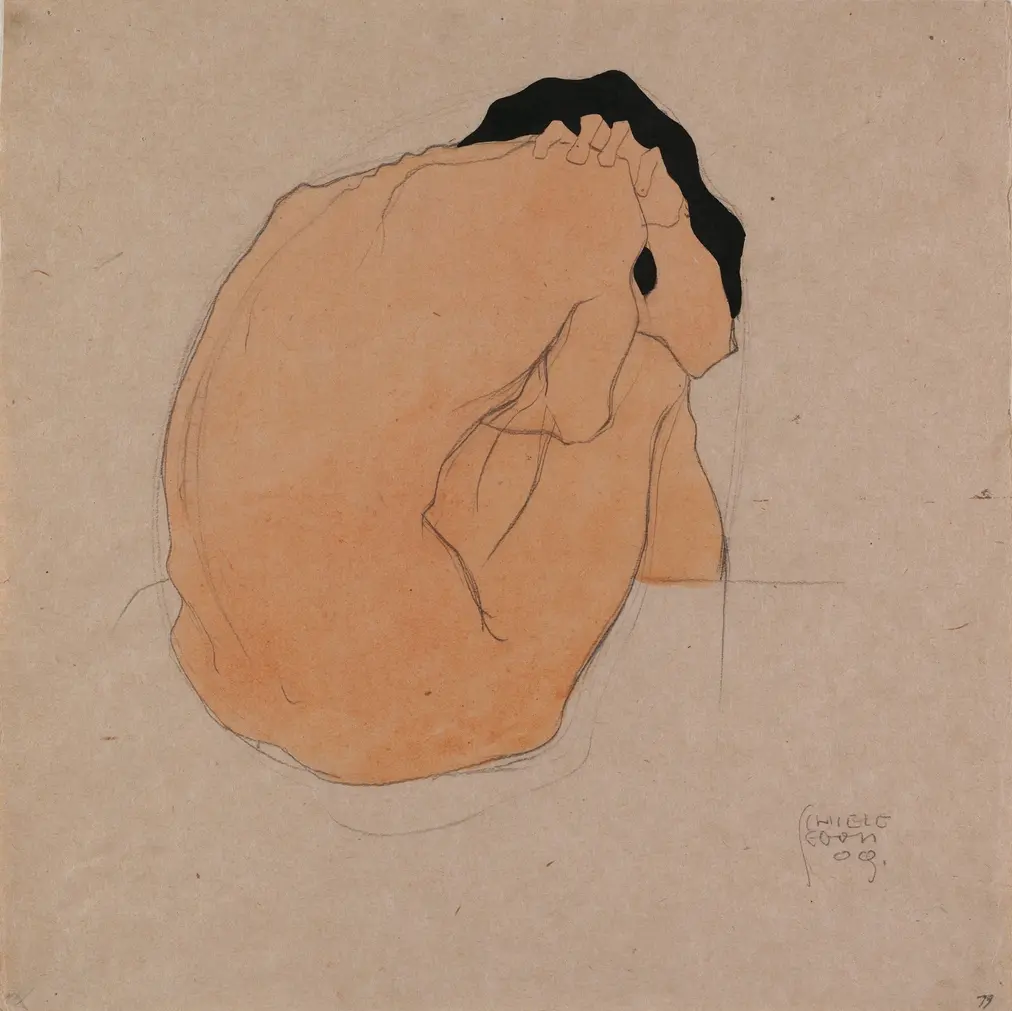
Seated Black-Haired Man, 1909, Sitzender schwarzhaariger Mann
Pencil, ink with brush, watercolor on wrapping paper
31.7 × 31.5 cm
© Leopold Museum, Vienna
(Kallir d320)
This early work by Egon Schiele offers a quiet yet arresting glimpse into his evolving artistic language. Made in 1909, while he was still formally enrolled at the Vienna Academy, the drawing already distances itself from academic restraint. The figure—a seated man with dark hair—is rendered with a kind of urgent clarity, stripped of embellishment and background, as if Schiele were more interested in presence than polish.
The choice of wrapping paper as support is telling: modest, ephemeral, and intimate. It reflects Schiele’s early willingness to bypass convention in favor of immediacy. The man’s posture is compact, almost folded into himself, suggesting introspection or guardedness. There’s no theatricality here—just a body held in tension, a moment suspended.
Schiele’s line is taut and searching, his brushwork sparse but deliberate. Watercolor washes lend a muted rhythm to the composition, softening the starkness without diluting its intensity. The sitter’s identity remains unknown, yet the drawing feels personal—less a portrait than a study in psychological atmosphere.
Though it predates Schiele’s more radical distortions and erotic provocations, this piece already carries the hallmarks of his mature style: the isolation of the figure, the emotional charge of the pose, and the sense that drawing can be a form of exposure. It’s a quiet assertion that even the simplest materials—paper, pencil, ink—can bear the weight of human complexity.

Leave a Reply