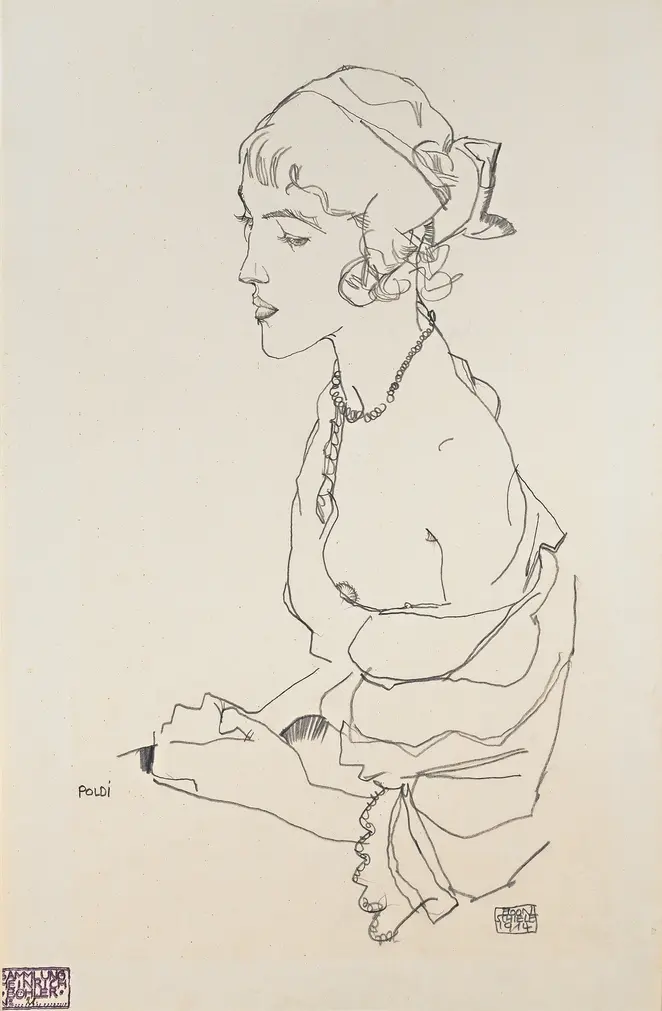
Egon Schiele
Poldi (1914)
Pencil on paper
47.5 × 31 cm
© Leopold Museum, Vienna
(Kallir d1519)
This drawing portrays Poldi Lodzinsky, daughter of Kasimir Lodzinsky, a Fiaker—a horse-drawn cab driver—in the Bohemian town of Krumau (now Český Krumlov). Schiele met Poldi and her sister Trude in the summer of 1910, during an early retreat from Vienna. He was still young himself, seeking quiet and creative space, and the Lodzinsky sisters became part of his close-knit circle during that stay.
Krumau wasn’t just a scenic escape—it was his mother’s birthplace and a place Schiele returned to emotionally and artistically. Its winding streets and riverbanks appear often in his work, not just as backdrops but as emotional landscapes. The town’s modest rhythm offered him a counterbalance to the intensity of urban life and the pressures of the Viennese art world.
When Schiele first drew Poldi in 1910, she was still a child. Those early portraits carry a sense of gentle curiosity—his line expressive but not yet fully sharpened. By 1914, Poldi had grown into a young woman, and Schiele’s approach had changed. His drawings from that later year, including this one, show a more deliberate hand and a deeper emotional register. The gaze is steadier. The contours are more defined. There’s a quiet tension in the way he captures her presence.
Over those four years, Schiele’s style had shifted. The lyrical softness of his early work gave way to sharper, more angular forms. He began to draw not just what he saw, but what he sensed—psychological depth, vulnerability, defiance. In Poldi (1914), her posture suggests self-awareness, maybe even a trace of melancholy. The pencil work is restrained, yet it carries weight. It’s not just a likeness—it’s a moment held still.
This drawing is part of a small group that traces Schiele’s relationship with Poldi across time. It’s not a grand portrait, but something quieter: a record of change, of familiarity, of someone seen again with new eyes. Schiele wasn’t interested in idealizing his subjects. He drew people as they were—complex, evolving, marked by memory and transformation.


Leave a Reply