Młoda Polska: Stanisław Wyspiański
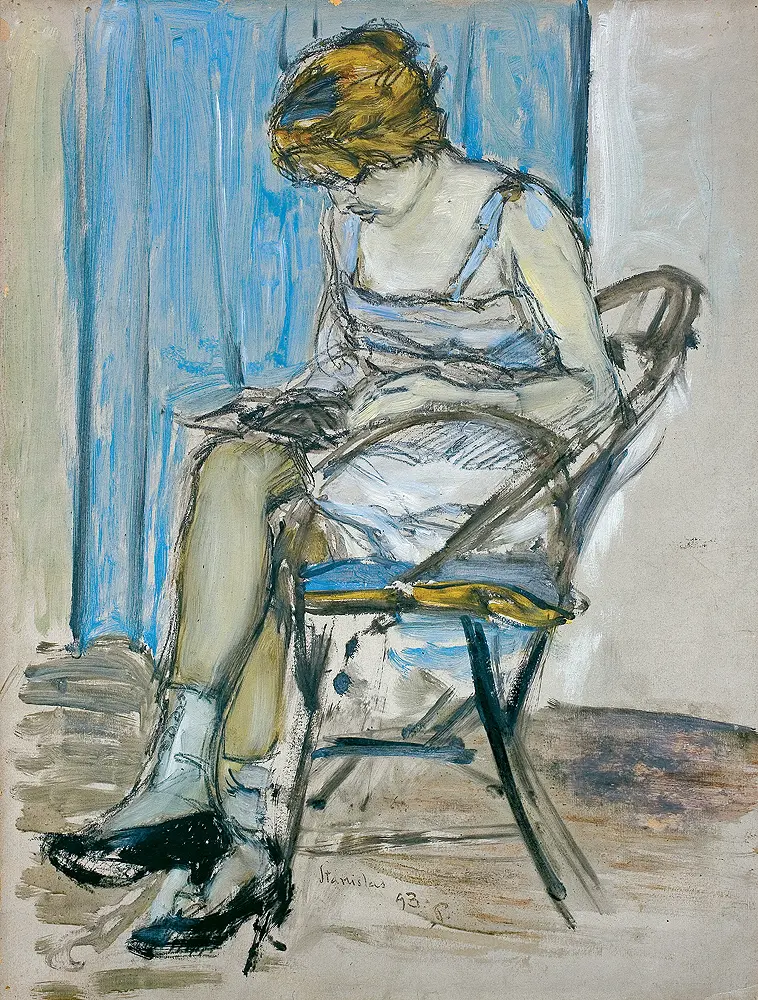
Read, 1893 (‘Zaczytana’)
oil, crayon, cardboard
49.2 cm x 36.5 cm
Auctioned at Agraaart in 2017
The painting shows a young, semi-nude woman with a book on her lap. It is one of many studies Stanisław Wyspiański (1869–1907) created during his time in Paris. While attending the Académie Colarossi—a progressive art school known for its openness to female students and life drawing—he worked diligently to master drawing. He used models from the school, producing numerous sketches and studies of nude figures in both drawings and oil paintings. He captured their forms with realism, never hiding flaws or imperfections. Her pose suggests quiet introspection—a moment suspended between thought and form.
Wyspiański often depicted his models in simple, shallow interiors, usually with drapery in the background. The Reader belongs to this series. The painting stands out for its strong expression, emphasized with black crayon in certain areas. The interplay of oil and crayon lends the figure both softness and graphic immediacy. It is executed in oil paint—a technique Wyspiański soon abandoned. Works from his Paris period are often signed with the name Stanislas, a form he later stopped using. These studies laid the groundwork for his later synthesis of symbolism and design, visible in his pastel portraits, stained glass, and theatrical work.
Stanisław Wyspiański (1869–1907) was a Polish painter, playwright, designer, and poet—a true polymath and one of the most influential figures of Polish modernism. He was a key figure in Młoda Polska (Young Poland), a movement in Polish literature and art that spanned two generations of artists born in the 1860s and 1870s. It emerged in response to the artistic climate at the end of the 19th century, which many young Polish artists viewed as stagnant or uninspired. In spirit, Młoda Polska aligned with broader Secession movements, such as those in Munich, Vienna, and Berlin. Wyspiański was listed among the members of the Vienna Secession, reflecting his alignment with its ideals of artistic synthesis and modern expression. His work shares affinities with other leading artists of the movement, including Józef Mehoffer, Leon Wyczółkowski, and Jacek Malczewski—each exploring symbolism, emotional depth, and national identity through distinct yet overlapping visual languages. Though academic in form, The Reader echoes Młoda Polska’s ethos—personal, expressive, and quietly defiant.

Leave a Reply