Młoda Polska: Teodor Axentowicz
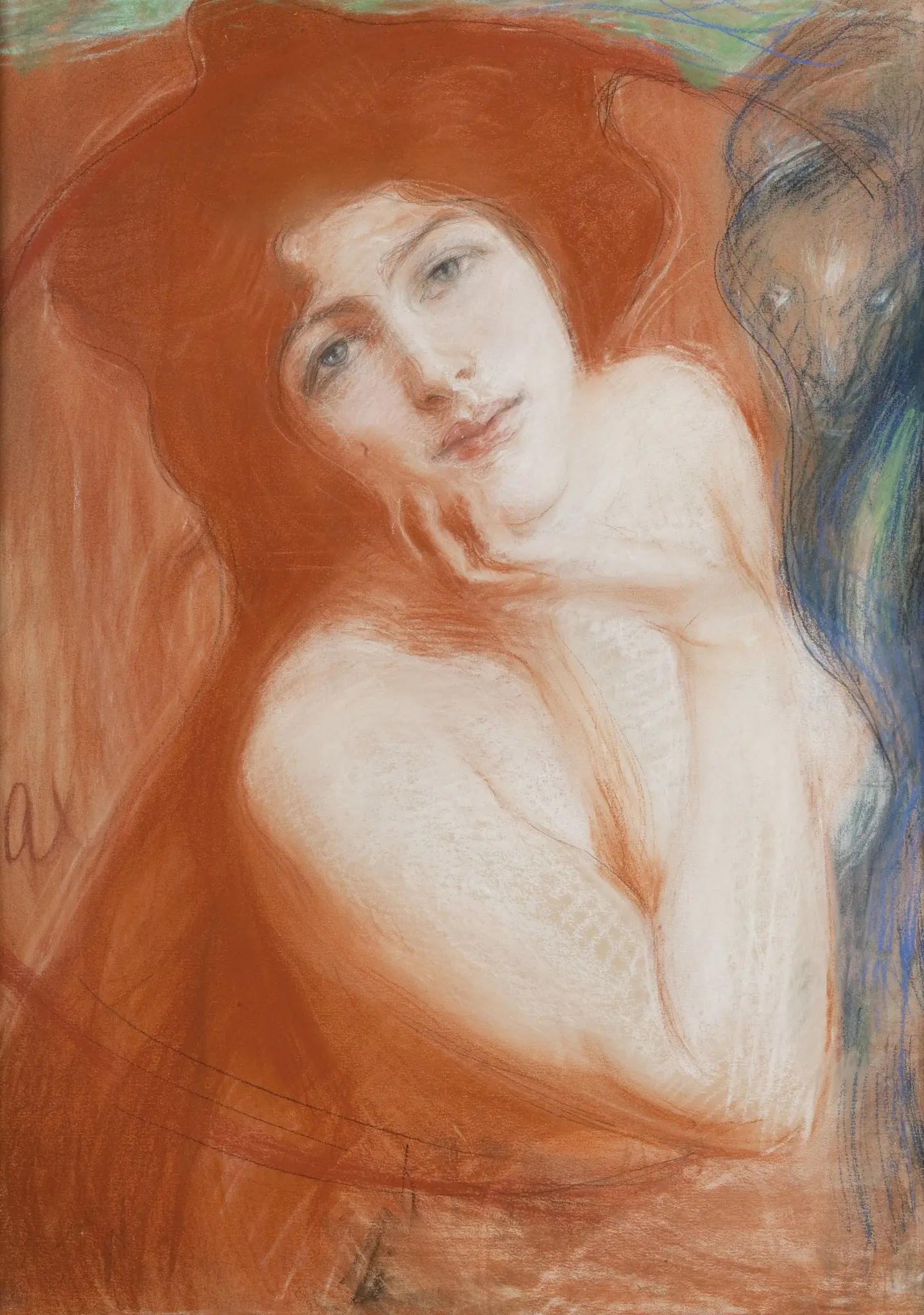
Redhead, 1899 (‘Rudowłosa’ or ‘Ruda’) – Teodor Axentowicz
watercolor
50 x 70 cm
©National Museum in Krakow, Poland
This painting exemplifies Teodor Axentowicz’s mastery of portraiture, shaped by his engagement with the Vienna Secession and the Young Poland (Młoda Polska) movement. His portraits are distinguished by a refined psychological sensitivity, soft tonal harmonies, and a graceful synthesis of academic technique with modernist expressiveness.
Teodor Axentowicz (1859–1938), a painter of Polish-Armenian descent and a university professor, was celebrated for his portraits and evocative depictions of Hutsul life in the Carpathians. Born on May 13, 1859, in Brașov, Romania, he studied at the Munich Academy of Fine Arts from 1879 to 1882, and later in Paris under Carolus-Duran until 1895. That same year, he returned to Kraków, where he became a professor—and eventually rector—at the Academy of Fine Arts.
Axentowicz was an active member of the Vienna Secession, contributing to its journal Ver Sacrum and exhibiting in Vienna. The Secession sought to liberate contemporary art from academic constraints, and Axentowicz’s involvement infused his work with elements of Art Nouveau and modernist aesthetics. He was also widely recognized for his portrayals of ethnic and folkloric subjects.
His fascination with folk life began after his first visit to the Hutsul region, located near the present-day borders of Ukraine, Romania, and Poland. He began developing these themes during his Paris years and continued to explore them throughout his career. His art often reflected Polish folklore, positioning him as a central figure in the Young Poland movement.
The Young Poland (Młoda Polska) movement, active from 1890 to 1918, marked a modernist turn in Polish visual arts, literature, and music. It embraced currents of decadence, neo-romanticism, symbolism, and Impressionism. Axentowicz played a prominent role in the movement’s evolution, contributing to its success through works that celebrated the beauty and cultural richness of Polish folk traditions.
In 1897, Axentowicz co-founded the Society of Polish Artists “Sztuka,” a progressive group that championed modern Polish art and fostered collaboration among leading figures of the time. He exhibited widely across Europe—including in Paris, London, and Venice—earning international recognition and helping to elevate Polish art on the global stage. His peers included Stanisław Wyspiański, Józef Mehoffer, and Jacek Malczewski, with whom he shared a commitment to artistic renewal and cultural depth.


Leave a Reply