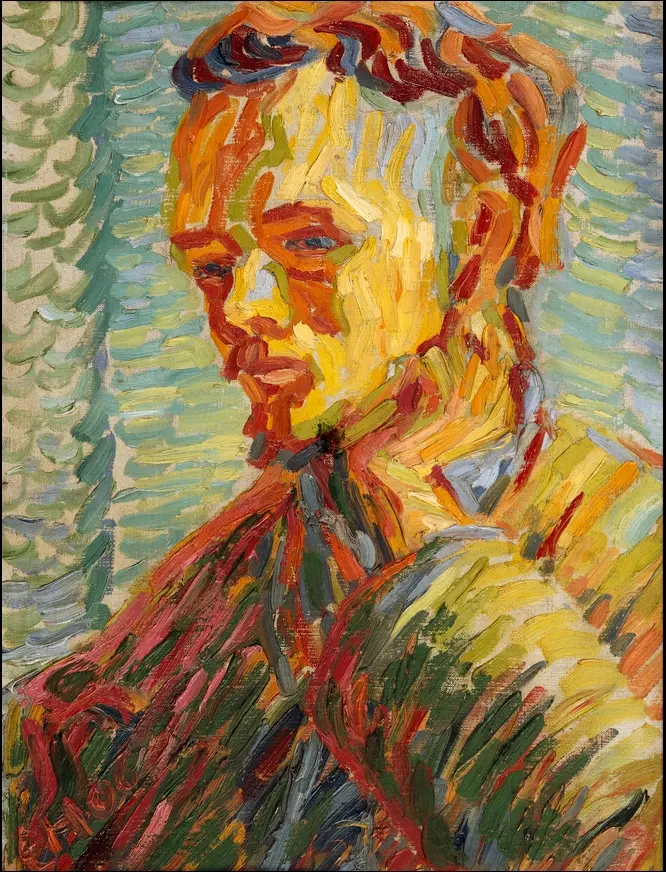
Die Brücke: Erich Heckel
Man in His Youth (Self-Portrait), 1906 ‘Mann in jungen Jahren (Selbstbildnis)‘, 1906 – Erich Heckel
Oil on canvas
81 x 65 cm
©Die Brücke Museum, Berlin
In April 1904, Erich Heckel began studying architecture at the Royal Saxon Technical University in Dresden, where he met fellow students Ernst Ludwig Kirchner and Fritz Bleyl. Shortly afterward, Karl Schmidt-Rottluff joined them. On June 7, 1905, the four young men founded the artist group Die Brücke. As manager, Heckel—along with Schmidt-Rottluff—rented a vacant shop in Dresden, which became the group’s first studio. Die Brücke aimed to bridge traditional and modern art, embracing raw emotion, spontaneity, and primitivism. Their rejection of academic norms helped shape the foundations of German Expressionism.
Heckel’s early work was influenced by artists such as Paul Gauguin and Vincent van Gogh, known for their bold colors and expressive forms. His initial pieces were marked by a vibrant palette and emotional intensity. In 1911, Heckel moved to Berlin, where his art became more introspective and melancholic, reflecting a shift toward subtler tones and psychological depth.
During World War I, Heckel served as a medical orderly, an experience that left a profound mark on his work. He produced haunting portraits of wounded soldiers and somber landscapes, deepening the emotional resonance of his art. His woodcuts—bold, expressive, and distinctly German—became a hallmark of his style and a major contribution to Expressionism.
In the 1930s, the Nazi regime labeled Heckel’s work “degenerate,” removing many pieces from public collections. Despite this suppression, he continued to create and exhibit after the war, regaining recognition in post-war Germany. His involvement with Die Brücke remained central to his legacy, not only through his paintings and prints but also through his efforts to organize exhibitions and promote the group’s ideals, linking the work of Edvard Munch to modern Expressionist painting.
Heckel spent his later years in Radolfzell, Germany, where he remained active until his death in 1970. His influence endures in the evolution of modern printmaking and figurative art.
Leave a Reply