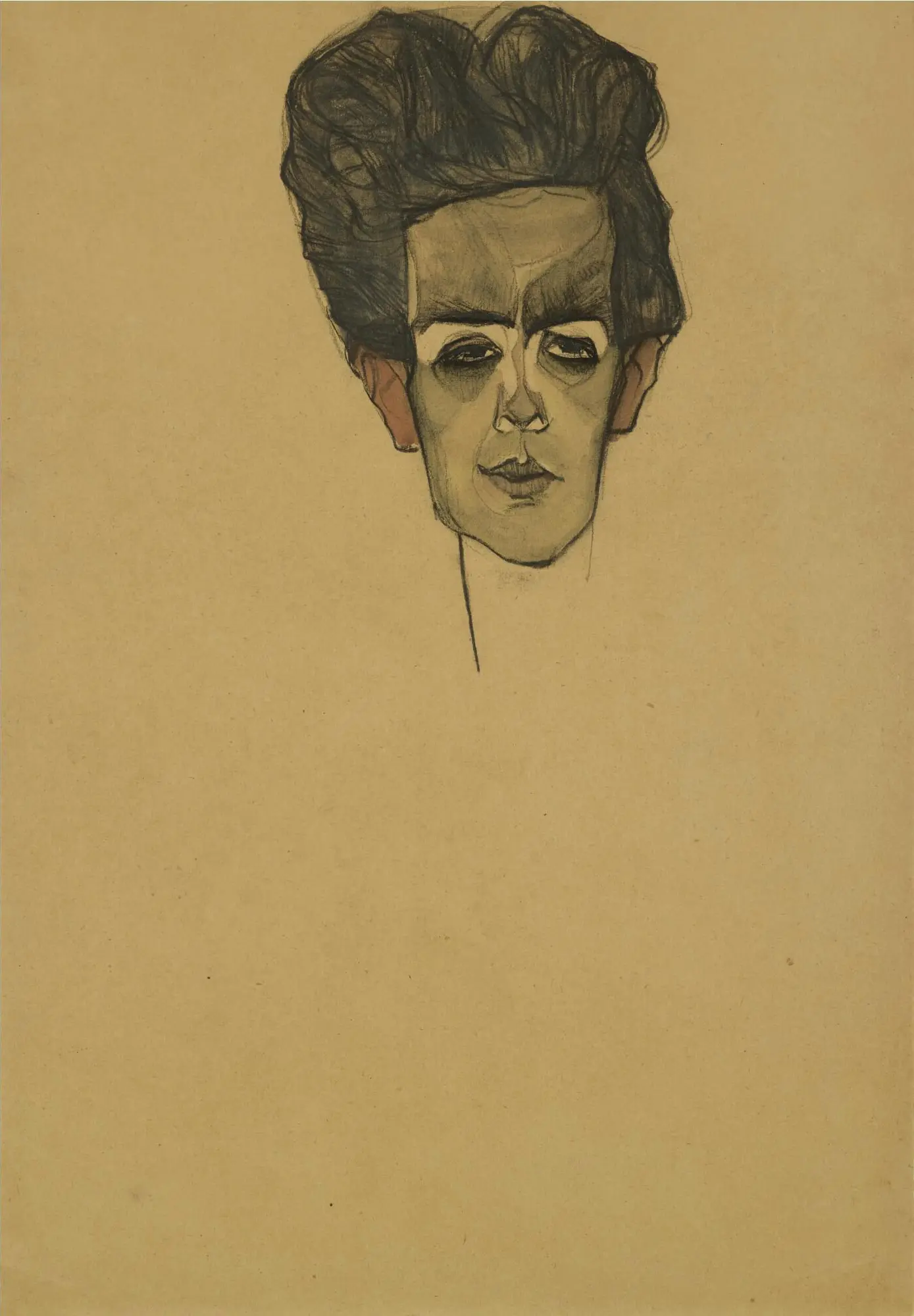
Egon Schiele:
Self-Portrait (1910, ‘Selbstbildnis’)
watercolor and charcoal on buff paper
43.7 x 30.5 cm (17¼ x 12 in.)
Auctioned at Christie’s in 20913 for USD 1,625,000
(Kallir d685)
In 1909, Schiele left the Vienna Academy and participated in the Kunstschau, a major international exhibition. There, he encountered works by artists such as Oskar Kokoschka, Edvard Munch, Vincent van Gogh, and the Belgian sculptor Georges Minne. Their intense and expressive styles offered a striking contrast to the refined elegance of Jugendstil art.
Within months, Schiele began to distance himself from Klimt’s influence and developed his own bold expressionist style. His lines grew sharp, tense, and charged with nervous energy. He abandoned the decorative elements typical of Klimt and instead embraced the empty space of the page, using it to create a powerful tension between figure and background. Art historian Jane Kallir described this transformation, noting that Schiele replaced decorative effect with emotional impact, revealing the sensual and sinister world hidden within Klimt’s ornamental style.
During this period, Schiele produced a series of self-portrait drawings in which he examined himself with intense scrutiny. Using two movable mirrors in his studio, he sometimes depicted his full-length figure in twisted postures and exaggerated gestures, conveying emotions so powerful they seemed to ripple through his entire body. In other self-portraits—such as the one referenced here—he focused on his head, using facial expressions to reveal the complex emotional landscape within.


Leave a Reply