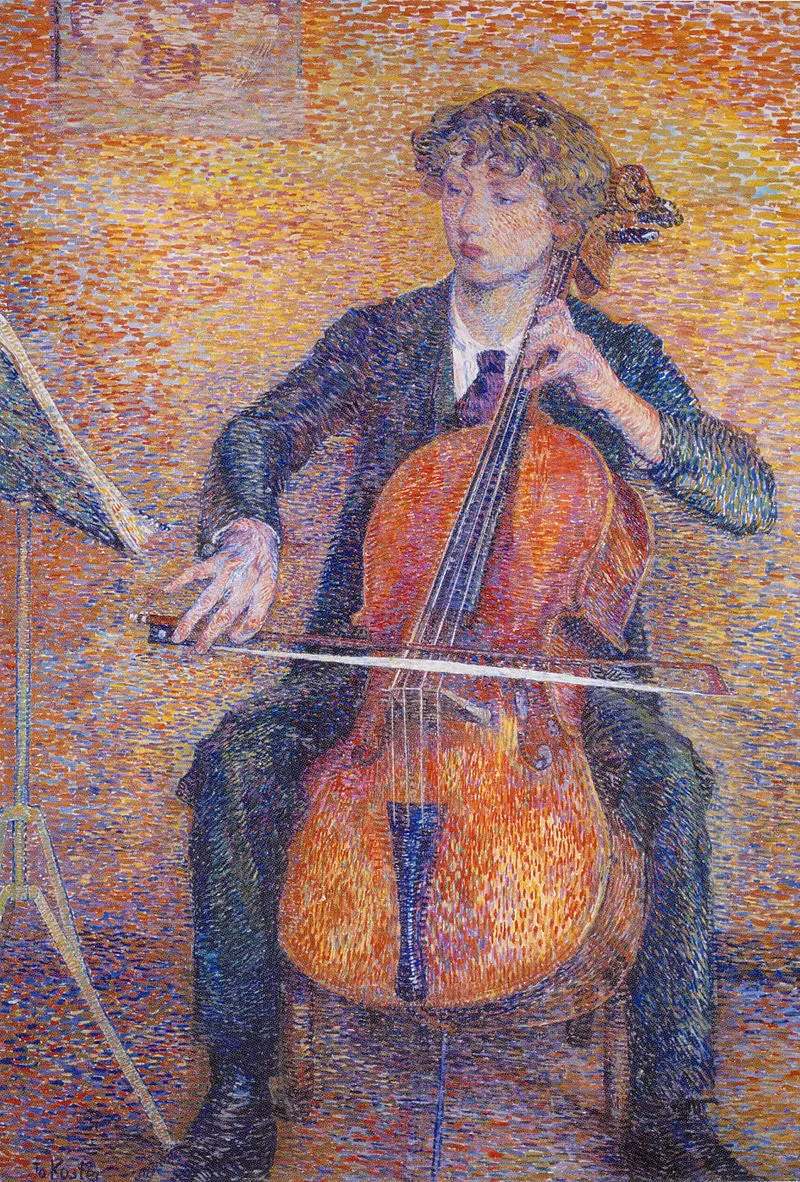
Dutch Modernism: Jo Koster
The young cellist (1900s)
oil on canvas
123 x 84 cm
Auctioned at Christie’s in 2001
Jo Koster (1868–1944) was a Dutch graphic artist, painter, and draftsman. She studied art in Amsterdam and later in Rotterdam.
Driven by a restless spirit, she moved to Paris in 1894, then the vibrant epicenter of the art world. There, Koster was exposed to the latest artistic movements and developed a deep fascination with neo-impressionism. Her stay in Paris was brief, however, as she soon relocated to Brussels.
In Brussels, she became a member of the renowned artists’ association Les Vingts (Les XX), where notable figures such as Jan Toorop and James Ensor were also frequent guests. It was in this creative environment that Koster discovered pointillism and began developing her own distinctive technique using stripes and dots.
Upon returning to the Netherlands, she settled in Laren, a well-known artists’ village. Yet her wanderlust persisted—she frequently packed up to explore new places. One particularly significant destination was Hattem, where she found rich inspiration, especially in nearby Staphorst.
Koster’s work during this period focused largely on people in traditional costumes, Staphorst interiors, landscapes, and scenes of farmers working the land. The Hattem years are widely regarded as the most fruitful and successful phase of her career.
She remained in Hattem until the mid-1920s, after which she resumed traveling, visiting Italy, Spain, France, and Germany. In 1939, she settled in The Hague, where she continued to exhibit her work until the outbreak of the Second World War. During this time, her once-bright color palette became noticeably more subdued.
Jo Koster died of cancer in 1944. Though her name faded somewhat after her death, her legacy has since been revived. Today, her paintings are part of prestigious collections, including those of the Rijksmuseum Amsterdam and the Kröller-Müller Museum.

Leave a Reply