Egon Schiele (born June 12, 1890 – died October 31, 1918) was an Austrian painter known for his raw, emotional style and bold drawings of people. He was born in the town of Tulln, near Vienna. His father, Adolf Schiele, worked for the railways and died of illness on December 31, 1904, when Egon was just 14 years old. After that, Egon’s uncle, Leopold Czihaczek, became his legal guardian and helped support his education.
Schiele was the third of four children. His older sisters were Melanie and Elvira, and his younger sister was Gertrude (Gerti). Elvira died young, which left a lasting impression on Egon and deepened his sensitivity to themes of loss and mortality—subjects that would later appear in his art. His mother, Marie Schiele (née Soukup), was of Czech descent and known for being strict and emotionally distant. Their relationship was often strained, and this tension may have shaped some of the emotional intensity in his work. Egon remained close to Melanie throughout his life, and Gerti would later marry his friend and fellow artist Anton Peschka.
Schiele showed artistic talent early on and joined the Academy of Fine Arts in Vienna in 1906. But he didn’t get along with the teachers there, who preferred traditional styles. He found their approach rigid and uninspiring, and began looking for new ways to express himself. In 1909, he left the academy and helped form the Neukunstgruppe—a group of young artists who wanted to break away from old-fashioned art and explore more modern, personal styles.
Some of the other members included Anton Faistauer, Rudolf Kalvach, Hans Böhler, Franz Wiegele, Robin Christian Andersen, Erwin Osen, and Anton Peschka. The group organized exhibitions and created a space for experimentation, often drawing attention—and criticism—for their unconventional work. Schiele’s early pieces from this period already showed signs of the intense emotional energy and distorted figures that would become his signature.

In his early years, Schiele often drew and painted his younger sister Gertrude, known as Gerti. She was one of his first models and appeared in several portraits and figure studies. Their bond was close, and Gerti’s presence in his work helped him explore themes of identity, intimacy, and form.
Schiele’s other sister, Melanie, appeared also in some of his early works. Though less frequently portrayed than Gerti, Melanie was part of his family circle and featured in several and drawings in his early years.
One of the most important people in Schiele’s life was Gustav Klimt, who became his mentor. They likely met around 1908, while Schiele was still a student at the Academy of Fine Arts in Vienna and Klimt was already a leading figure in the Viennese art world. Klimt recognized Schiele’s talent early on and supported him by introducing him to collectors and offering guidance. In 1909, Schiele exhibited three portraits at the Kunstschau, a major exhibition organized by Klimt’s group after breaking away from the Vienna Secession. This opportunity gave Schiele early public exposure and placed him among the progressive artists of the time. At first, his work resembled Klimt’s, with decorative touches and flowing lines. But in March 1910, Schiele made a clear break. He said, “I went by way of Klimt until March. Today I believe I am someone entirely different.” From that point on, his style became more personal and intense. He focused on the human body in twisted, raw poses, using sharp lines and bold shapes to show deep emotion. This shift marked the beginning of the expressionist style that made him famous.
In 1911, Schiele met Walburga “Wally” Neuzil, a young woman who became his model, companion, and muse. She was just 17 when they met, and for the next four years, she appeared in many of his most powerful works. Wally wasn’t just a subject—she stood by him during difficult times, including his brief imprisonment in 1912.

That year, Schiele was arrested in the town of Neulengbach after a local scandal involving one of his young models. Though serious charges were brought against him, they were mostly dropped. He was ultimately convicted only for displaying an erotic drawing in a place visible to minors and spent 24 days in custody. The incident damaged his reputation but also deepened the emotional intensity of his work.
Schiele’s relationship with Wally Neuzil came to an end in 1915, when he decided to marry Edith Harms, a young woman from a respectable middle‑class family. The separation marked a painful rupture: Wally had been his partner, model, and emotional anchor for years, and the break left a deep imprint on both their lives.
Some later accounts — particularly those of Arthur Roessler — describe Schiele proposing an ambiguous arrangement in which he would marry Edith yet continue seeing Wally during holidays. Modern scholarship treats this anecdote with caution: Roessler’s recollections are vivid but often unreliable, written years after the events and shaped by his desire to dramatize Schiele’s life. No primary sources confirm the details of their final conversation.
What is certain is that Wally left soon after the separation. She trained as a nurse and died in 1917 died of scarlet fever on Christmas Day in 1917, in the town of Sinj, Croatia, while caring for soldiers during World War I.

In 1915, Schiele married Edith Harms, a woman from a middle-class family in Vienna. He had first met Edith and her older sister, Adele Harms, during a visit in which Wally Neuzil, his companion at the time, acted as a chaperone. Adele was also present, and Schiele hadn’t yet decided which of the sisters he was most drawn to. Eventually, he chose Edith, and the two were married that year.
After their marriage, Schiele often portrayed Edith in his drawings and paintings. She appeared frequently in his work, including a small number of early nude and even erotic studies that have survived. Over time, however, Edith became increasingly reluctant to pose nude, and Schiele’s depictions of her shifted toward clothed portraits and more intimate, domestic scenes.
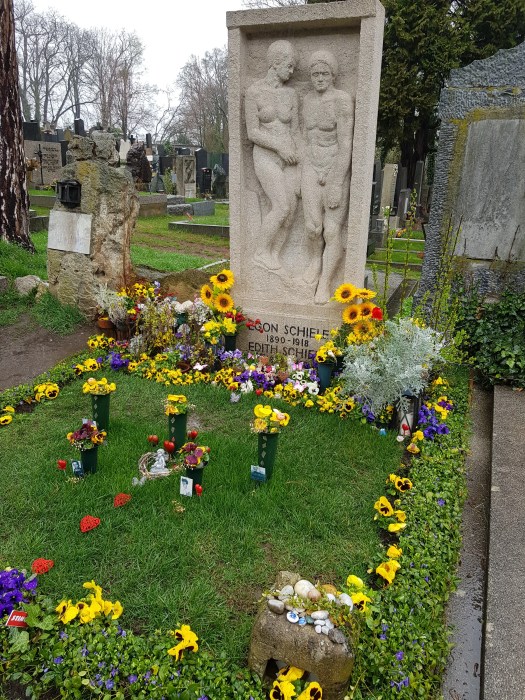
Around 1917, Adele began stepping in to model in her sister’s place, especially for more intimate or revealing works. As a result, many of Schiele’s portraits from this period show a blend of the sisters’ features, and it’s often difficult to say with certainty whether a particular drawing depicts Edith or Adele. Adele remained close to Schiele and his legacy, living until 1968. She was later buried in the same grave as Egon and Edith at the Ober St. Veit Cemetery in Vienna.

That same year, 1915, Schiele was drafted into the army during World War I. He did not serve on the front lines but was assigned to administrative duties, which allowed him to continue drawing and painting, though at a far more limited pace. His artistic production during these years was markedly reduced, shaped by the constraints and interruptions of military service.
By 1918, Schiele was becoming more successful. The death of Gustav Klimt in February left a noticeable gap in the Austrian art world, and Schiele was increasingly seen as Klimt’s natural successor. That same year, he had a major exhibition at the Vienna Secession, which marked a turning point in his career. The show was a great success—his works sold very well, and critics began to recognize him as one of Austria’s leading modern artists. His reputation was growing rapidly, and he was finally receiving the attention and financial stability he had long worked toward.
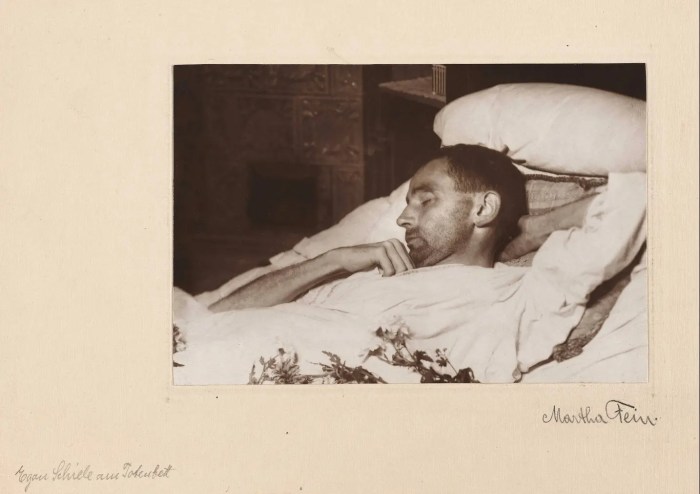
But in October, the Spanish flu pandemic hit Vienna. Edith, who was pregnant, died on October 28. Egon died just three days later, on October 31, at the age of 28.
Even though his career was short, Schiele left behind a large body of work—hundreds of paintings and thousands of drawings. His art is known for its honesty, intensity, and emotional power. Today, his work is shown in major museums, especially the Leopold Museum in Vienna, and he is remembered as one of the key figures of Austrian Expressionism.